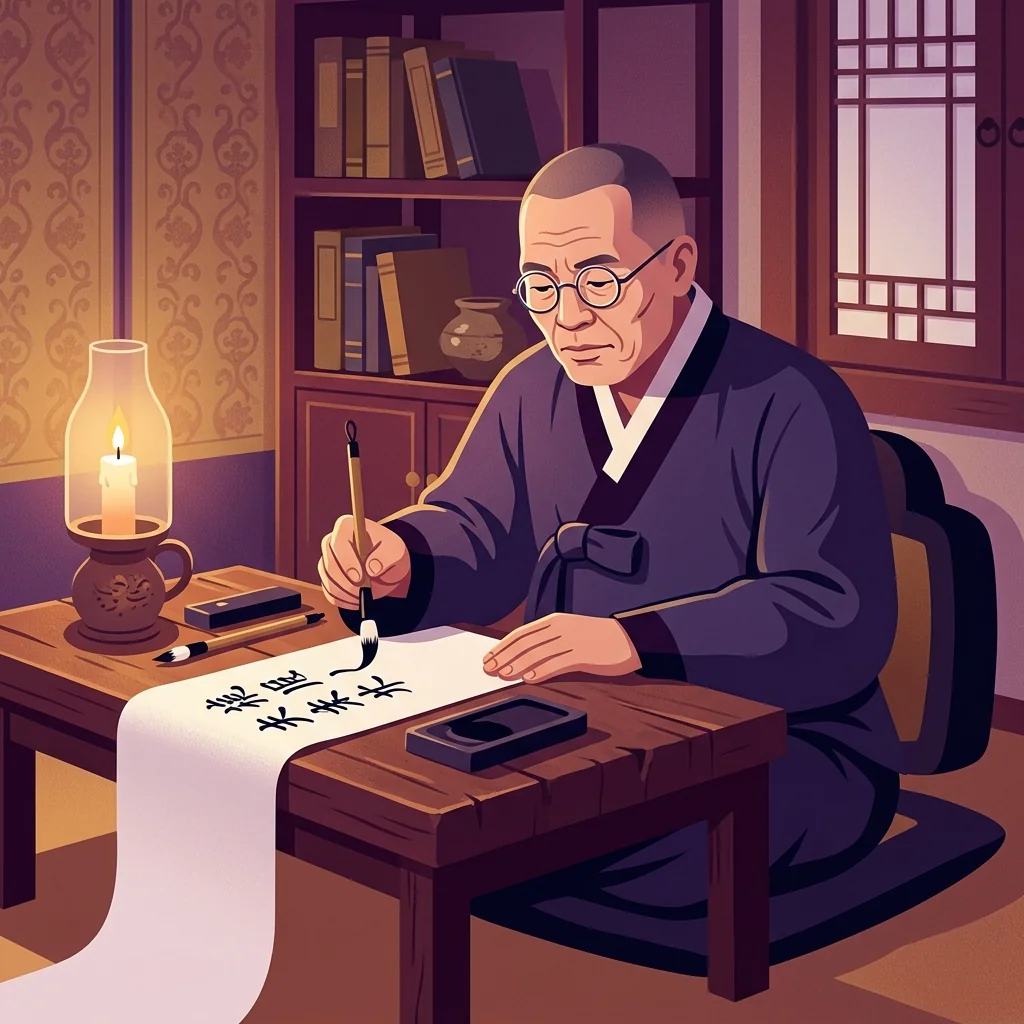
“As I gather my strength at the tip of the brush to draw a single line, chaotic distractions recede, leaving only a transparent conviction upon the paper.” 🖌️
Kim Koo (1876–1949), honored as Baekbum, was the premier leader of the Provisional Government of the Republic of Korea who spearheaded the Korean independence movement during Japanese colonial rule. Operating under perpetual threat of assassination, espionage, and the agonizing sacrifices of his comrades, Kim Koo carried an extraordinary psychological burden.
Amidst extreme life-and-death stress, he adhered to a non-negotiable daily mind-cultivation ritual: grinding ink silently and practicing calligraphy (Seoye). As recorded in his autobiography Baekbum Ilji, when complex strategic dilemmas or personal despair mounted, Kim Koo sat upright, slowly ground ink stones against water, and navigated his brush across traditional mulberry paper. Focusing his motor consciousness entirely on the micro-movements of the brush tip simplified his mental landscape and reset emotional anxiety. Neuroscientifically, controlling the fine pressure and angle of a soft brush requires intense Fine Motor Control, stimulating the somatosensory cortex while suppressing hyper-reactivity in the amygdala to restore profound composure.
In today’s post, we unpack the cognitive neuroscience behind Kim Koo’s ‘calligraphy meditation’ routine and present a modern 3-step analog guide to master fine tactile focus and eliminate emotional anxiety.
Historical & Academic Evidence
This content is based on Historical Verification from Kim Koo's Autobiography *Baekbum Ilji*, Provisional Government Archives & Cognitive Neuroscience and Motor Control Science Research.
 BuildSelf
Inspired by historical greats? Make it your daily habit!
BuildSelf
Inspired by historical greats? Make it your daily habit!

















1. Fine Motor Control and the Neuroscience of Amygdala Stabilization
Executing Fine Motor Control—precisely modulating hand pressure and tool angle as in brush calligraphy—heavily engages neural assemblies in the Somatosensory Cortex and Motor Cortex. When central executive resources shift entirely onto fine tactile manipulation, hyper-arousal in the amygdala (the brain’s threat and anxiety alarm) is physically suppressed. Furthermore, rhythmic, steady physical actions like grinding ink stones or tracing measured strokes activate the Parasympathetic Nervous System, driving down cortisol concentrations and stabilizing baseline heart rate.
2. 3-Step Practical Routine for Modern Professionals
Step 1: Blocking Digital Devices & Setting Up an Analog Writing Sanctuary
Power off laptops and smartphones, stowing them away. Align a calligraphic brush or fountain pen alongside a sheet of blank paper directly at the center of your desk to create a tactile focus sanctuary.
Step 2: 1 Minute of Constant Breathing & Fine Tactile Sensing
Maintain slow, deep breathing for 1 minute while quietly grinding ink stones or feeling the metallic texture of the pen nib and paper grain against your fingertips.
Step 3: Slow Writing Immersed Exclusively in Stroke Thickness and Line Precision
Transcribe a favored aphorism or personal motto slowly, investing deliberate cognitive focus into every single stroke. Immerse your consciousness entirely in line thickness and friction rhythm to reset your mental baseline.
3. Caution: Eliminating Outcome-Oriented Impatience to Immerse in Fingertip Tactile Sensation
When distressed, avoid hunting for instant solutions or obsessing over aesthetic output. Anchor your conscious awareness strictly onto the friction felt as the brush or pen nib contacts the paper and the immediate motor action of tracing a line. Process-oriented tactile presence quells anxiety and restores prefrontal clarity.
📌 Frequently Asked Questions (FAQ)
What is the neuroscientific mechanism behind how calligraphy relieves stress and calms the mind? ▼
Regulating the delicate pressure and angle of a brush requires Fine Motor Control, which heavily activates the somatosensory cortex and prefrontal executive networks. This concentrated engagement physically down-regulates threat signaling in the amygdala, suppressing anxiety.
Can I achieve identical neurobiological benefits using a fountain pen or standard pen if I don't own calligraphy brushes? ▼
Yes, completely! The core mechanism is not the specific tool, but 'fine pressure modulation and deliberate decelerated motor speed'. Holding a fountain pen, dip pen, or pencil while writing slowly (Slow Writing)—feeling line variations and paper friction—delivers identical parasympathetic and amygdala-calming benefits.