“A single visual illusion can become a fatal error in life sciences.” 🔬
Dr. Robert Koch, the founder of modern bacteriology and recipient of the 1905 Nobel Prize in Physiology or Medicine, transformed medical paradigms from pathology to bacteriology by first identifying pathogens such as Mycobacterium tuberculosis, Bacillus anthracis, and Vibrio cholerae, and establishing Koch’s Postulates. The microbes he discovered and his pure culture techniques served as the decisive keys to saving humanity from terrifying infectious diseases.
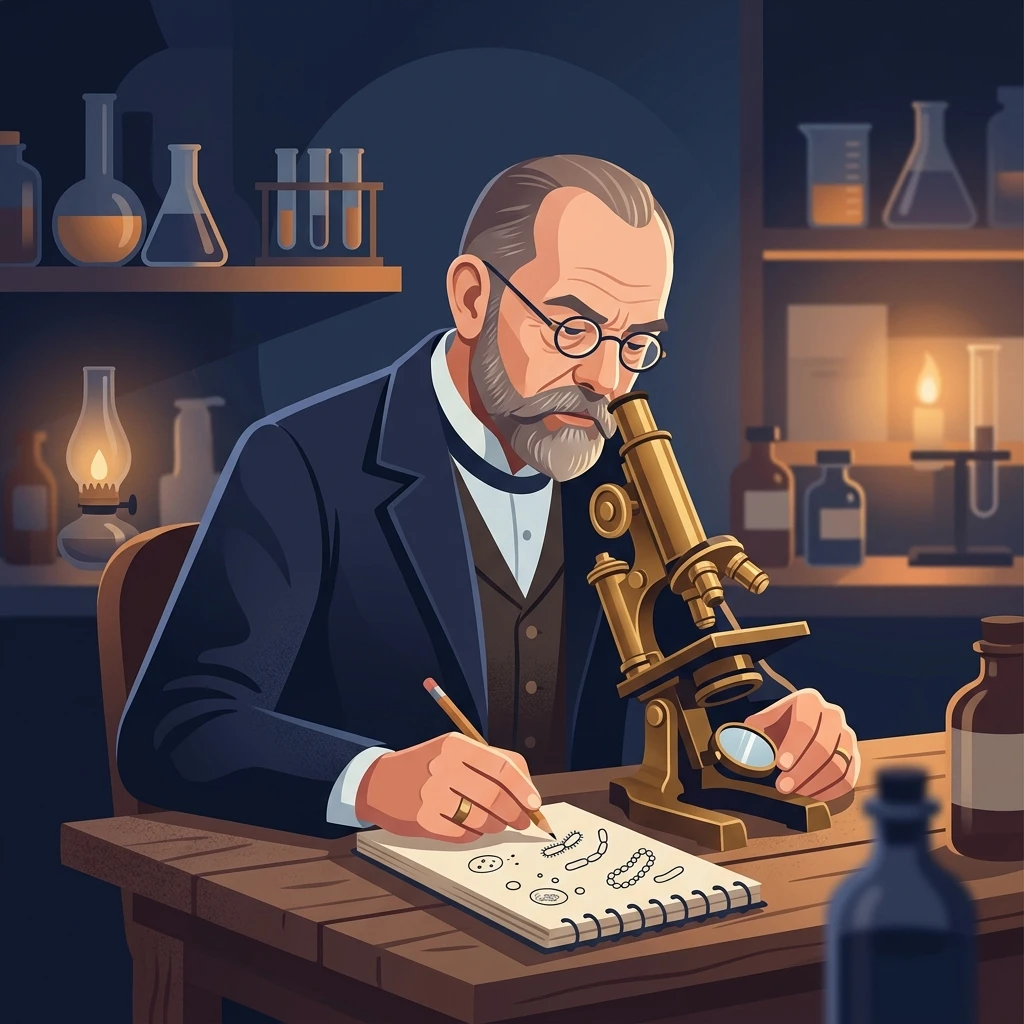
Conducting independent research in a modest rural clinic, the secret behind his ability to overcome observational limitations and eliminate visual error was his ‘Nightly Sample Sketching & Morning Dual Cross-Verification’ routine. Every night under his microscope, Koch painstakingly hand-sketched the exact morphology, structure, and arrangement of micro-organisms.
He never drew conclusions from a single observation. The following morning, he would examine the exact same specimen under the microscope and compare it directly against the original sketch drawn the night before. Through this dual verification process, he flawlessly corrected visual illusions, optical artifacts from lighting, and transient observation errors. In today’s post, we introduce the science of Metacognitive Monitoring and visual-motor integration embedded in Robert Koch’s precision sketching routine.
Historical & Academic Evidence
This content is based on Thomas D. Brock, *Robert Koch: A Life in Medicine and Bacteriology*, Nobel Foundation Official Records & Metacognition & Visual-Motor Integration Research.
 BuildSelf
Inspired by historical greats? Make it your daily habit!
BuildSelf
Inspired by historical greats? Make it your daily habit!














1. Metacognitive Monitoring and Visual-Motor Feedback Correction
Sketching observed structures by hand and re-verifying them after a time gap is a cognitive system that maximizes Metacognitive Monitoring and visual-motor feedback. The act of precisely drawing a shape by hand simultaneously activates the brain’s somatosensory and visual cortices, meticulously encoding the subject’s micro-structures into memory.
Furthermore, re-examining night-time observations the next morning with a refreshed mind engages metacognitive functions that detect visual distortions or preconceptions caused by fatigue. This serves as a cognitive correction mechanism that blocks subjective confirmation bias and maximizes data accuracy.
2. 3-Step Practical Routine for Modern Professionals
Step 1: Nightly Microscopic Observation and Precision Sketching
Every night, closely observe the structures and minute features of your target subject and meticulously record them by hand.
Step 2: Resetting Visual Fatigue Through Sleep
Get adequate sleep after observation to settle eye fatigue and clear cognitive biases or preconceptions in the visual cortex.
Step 3: Morning Re-Observation and Dual Cross-Verification with Previous Sketches
Re-examine the same subject the following morning, comparing it one-to-one against the previous night's sketch to fix subtle errors.
3. Avoid Rushing for Results and Focus on Precision
Koch’s verification routine prioritized zero-error perfection over speed. When applying this method in modern life, rushing to reach quick conclusions can turn cross-checking into a mere formality. The key is securing cognitive rest between review cycles and focusing on rigorous correction.
📌 Frequently Asked Questions (FAQ)
Can this method be applied to general work or academic study outside of medical microscopy? ▼
Absolutely. Completing a report, plan, design, or programming code at night and re-evaluating it the next morning with a clear mind creates a 'Dual Verification' habit that effectively catches critical errors before final output.
Can taking a camera photograph replace hand-drawn sketching? ▼
While photos are helpful secondary records, hand-drawn precision sketching uniquely stimulates the visual and motor cortices simultaneously, maximizing metacognitive ability to catch errors and deeply understand structures. Combining digital capture with handwritten sketching is ideal.