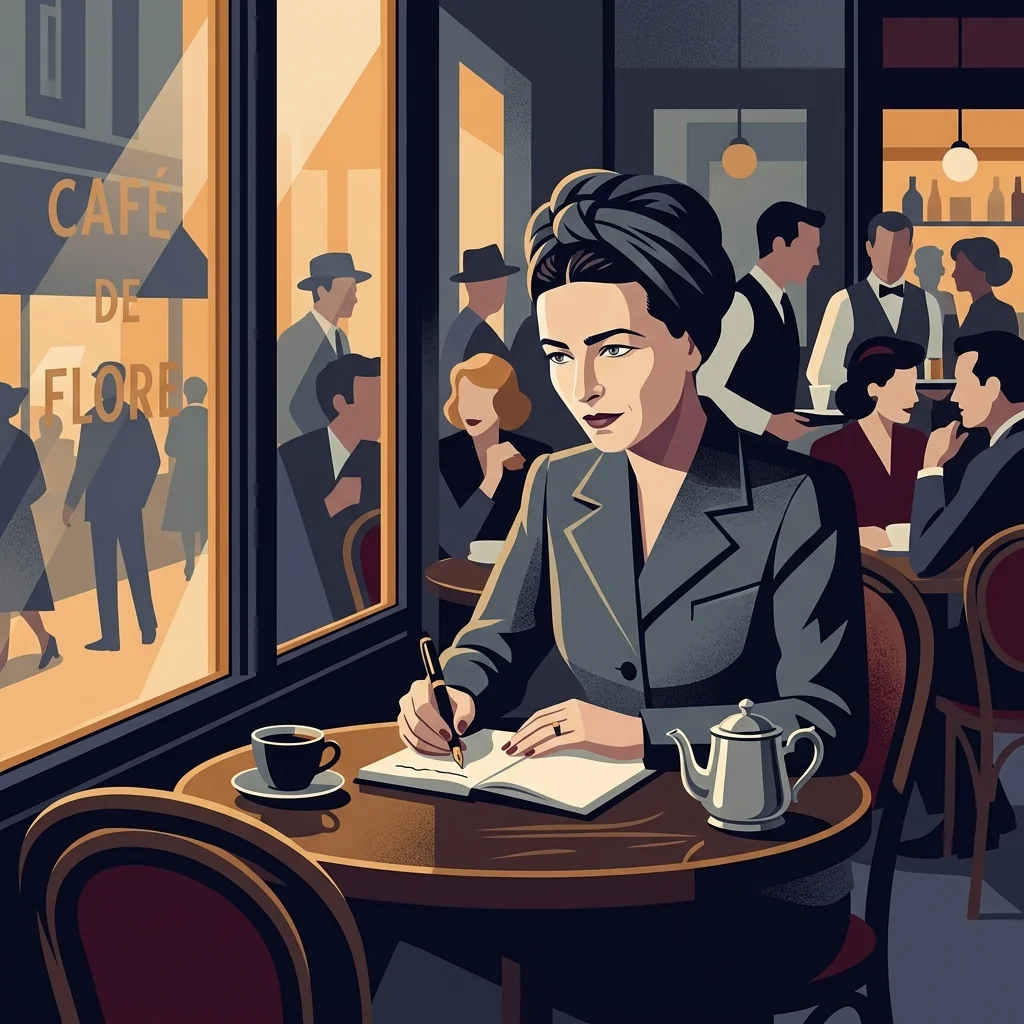
“At 10 in the morning, I would go to Café de Flore. On that small table, my thoughts finally began to take shape.” ☕
Simone de Beauvoir (1908–1986) was a prominent French philosopher and novelist who reshaped modern feminism with ‘The Second Sex’ and won the prestigious Prix Goncourt with her novel ‘The Mandarins’, leaving a monumental mark on 20th-century existentialism. Renowned for her rigorous logic and incisive writing, her hyper-focused state of mind was forged not inside an ornate private study, but at a corner table in a bustling Parisian cafe in Saint-Germain-des-Prés.
Every morning at 10 AM, Beauvoir walked into her favorite haunt, Café de Flore, as if punching in for work. Sitting at her usual quiet corner table with a cup of warm tea, she immersed herself in writing for four solid hours until 2 PM. The cafe staff minimized service interruptions to protect her creative flow, while the low hum of chatter and clinking cups served as excellent white noise—erasing stray thoughts and softening the isolation of deep work. For Beauvoir, the cafe was not a place of distraction, but a sanctuary where she could simplify her surroundings and retreat entirely into focused thought.
In today’s post, we examine the brain science behind Simone de Beauvoir’s ‘cafe writing’ routine and present a 3-step practical action plan for modern individuals to set up their own ‘Focus Zone’ amidst endless distractions.
Historical & Academic Evidence
This content is based on Historical Verification from Simone de Beauvoir's Autobiography *La Force des choses* & Cognitive Neuroscience Research.
 BuildSelf
Inspired by historical greats? Make it your daily habit!
BuildSelf
Inspired by historical greats? Make it your daily habit!

















1. Working Mechanism of White Noise and Cognitive Scripts
Neuroscientifically, facing the exact same physical environment daily (a designated table, a specific drink) triggers a ‘Cognitive Script’ that reduces decision fatigue and smoothly transitions the brain into hyperfocus. Furthermore, the soft ambient white noise of 50 to 70 decibels (dB) typical of cafes stimulates brainwaves to activate alpha waves, inducing creativity and problem-solving. Low-level dynamic activity nearby appropriately engages the brain’s mirror neuron system, providing a sense of psychological safety that alleviates isolation and maximizes Deep Work efficiency.
2. 3-Step Practical Routine for Modern Professionals
Step 1: Selecting Your Personal Focus-Optimized Venue
Designate 1-2 candidate locations near home or work that feature tables of comfortable height and maintain a soft, non-intrusive ambient background noise without loud music.
Step 2: Building an Entry Script Exclusively for Hyperfocus
Fix a routine sequence—such as sitting at the table, ordering a specific beverage (e.g., herbal tea or Americano), and setting up your workspace—to prompt your brain to automatically flip the focus switch.
Step 3: Executing Deep Focus & Deploying Noise Contingency Plans
Execute your tasks with focus for a set time block (2-4 hours), and if surrounding noise exceeds acceptable levels, immediately activate noise-canceling devices to protect your cognitive state.
3. Caution & Tips: Guarding Against Social Noise and Speech Noise
Not all noise is beneficial to the brain. Loud music exceeding 70 decibels or clearly audible conversations (Speech Noise) interfere with the brain’s phonological loop, diminishing reading comprehension and logical writing abilities. Choose a venue where a calm noise level is maintained, or if conversation sounds are prominent, actively use noise-canceling headphones to bypass cognitive interference.
📌 Frequently Asked Questions (FAQ)
Why did Simone de Beauvoir choose Café de Flore as her writing space? ▼
During the severe cold of 1940s Paris, Café de Flore kept its indoor stove warm and offered an artist-friendly atmosphere where intellectuals could stay for hours without pressure, making it an ideal, stable space for creative work.
Can I implement a similar Cognitive Script in a home or remote work environment? ▼
Yes, absolutely. You can induce the same cognitive switching effect at home simply by turning on a specific desk lamp in a dedicated corner, using a designated focus mug, and playing 50-60 dB ambient white noise tracks.