Norbert Wiener (1894–1964), the child prodigy mathematician who revolutionized topology and probability, and founded Cybernetics—the interdisciplinary study of control and communication in animals and machines that laid the foundation for modern artificial intelligence, robotics, and systems theory. Breaking down traditional academic silos, he formalized automated control and feedback loops, becoming one of the most visionary intellectual pioneers of the Information Age. 🤖⚙️
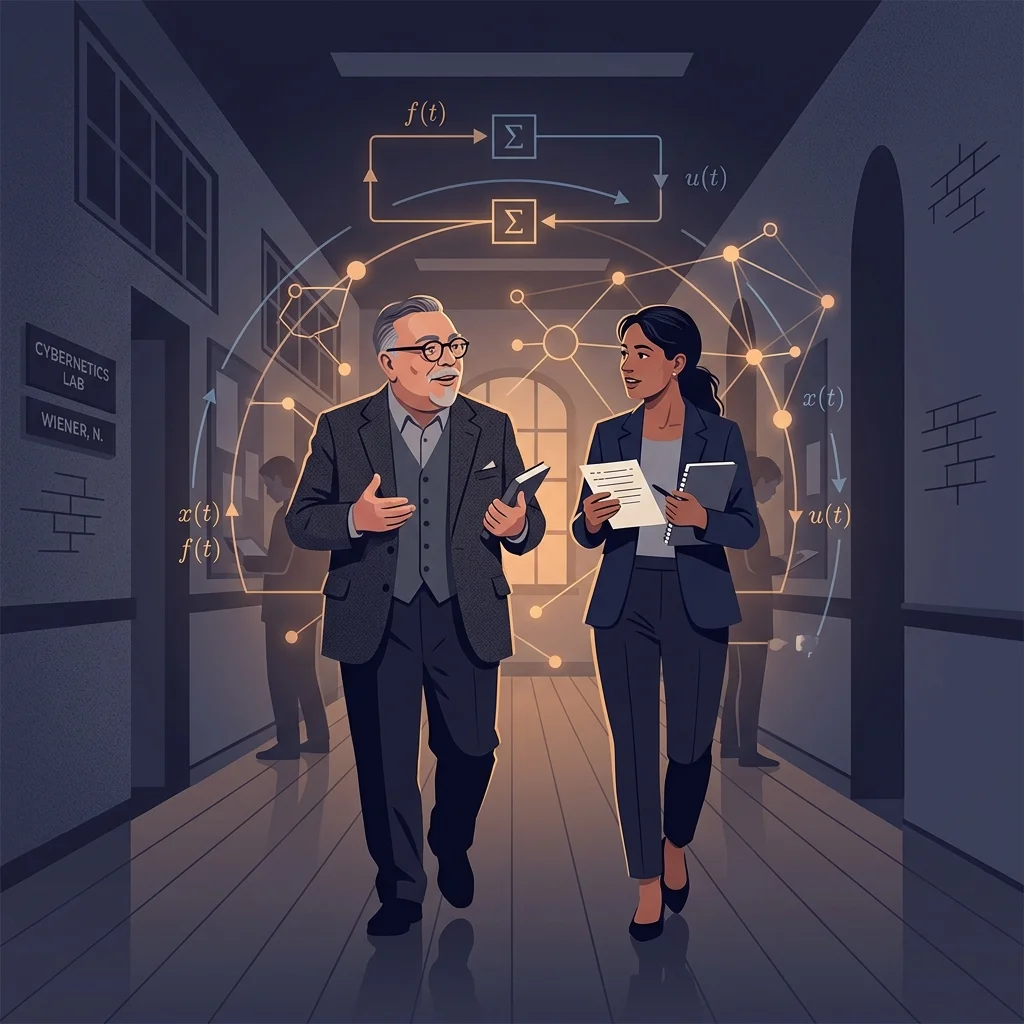
Behind his ability to engineer groundbreaking academic breakthroughs amidst deep mathematical isolation lay his daily habit: the ‘Cross-Disciplinary Walk’. Whenever he hit an insurmountable impasse in complex formulas, Wiener put down his pencil and roamed the corridors of MIT. He randomly knocked on the doors of neurophysiologists, economists, engineers, and biologists, reframing his mathematical dilemmas into the native language of their respective fields. Through these unstructured dialogues, he re-encoded his ideas into novel cognitive frameworks, capturing unexpected insights that shattered his mathematical blocks. This serendipitous cross-disciplinary exchange was the very catalyst that birthed Cybernetics.
In today’s post, we dissect the cognitive neuroscience behind Wiener’s cross-disciplinary walk, exploring how alien domain interactions disengage rigid task networks, stimulate the Default Mode Network (DMN), and maximize divergent thinking.
Historical & Academic Evidence
This content is based on Historical Verification from Flo Conway & Jim Siegelman's *Dark Hero of the Information Age: In Search of Norbert Wiener* & MIT Archives & Special Collections and Cognitive Neuroscience Research.
 BuildSelf
Inspired by historical greats? Make it your daily habit!
BuildSelf
Inspired by historical greats? Make it your daily habit!

















1. Default Mode Network (DMN) Release and Cross-Domain Associative Memory Activation
Obsessively fixating on a single problem overloads the brain’s Executive Control Network, trapping cognitive processing within rigid paradigms. Engaging in a ‘Cross-Disciplinary Walk’—combining physical movement with dialogues across disparate fields—strongly activates the Default Mode Network (DMN) and temporal-parietal associative networks. Translating hypotheses into foreign domain terminology (Semantic Re-encoding) expands conceptual distance, triggering novel neural feedback loops that unlock creative breakthroughs.
2. 3-Step Practical Routine for Modern Professionals
Step 1: Abstracting the Core Problem Frame & Initiating Physical Movement
Distill the essential principle of your unsolved bottleneck into a simple abstract frame, then step away from your desk for a walk to seek out cross-domain peers.
Step 2: Re-Framing the Problem in the Peer's Domain Language
Translate your challenge into metaphors native to your peer's expertise (e.g., design, marketing, biology) and listen actively to their intuitive feedback.
Step 3: Collecting Cross-Domain Insights & Integrating into Core Work
Map the fresh perspectives and metaphors gained during dialogue back onto your primary challenge, constructing a novel breakthrough framework.
3. Caution: Preventing Unstructured Small Talk and Distracted Loss of Problem Core
When adopting cross-disciplinary dialogues, avoid wasting time on superficial small talk lacking core problem context. Meaningful neural integration occurs only when you hold a clear abstract premise in mind while actively translating and re-framing it through the lens and language of another discipline.
📌 Frequently Asked Questions (FAQ)
Can non-academic professionals apply this cross-disciplinary walk habit in corporate settings? ▼
Absolutely. When stuck on a project, visiting a completely different department (e.g., a software developer consulting the marketing or design team) and explaining your problem in their language produces the same powerful cognitive expansion.
How can I achieve this cognitive effect if no conversation partners are available? ▼
You can practice 'virtual cross-interrogation' by reading literature from alien fields (e.g., medicine, biology, classic literature) and journaling your problem using their metaphors. The act of linguistic re-encoding itself stimulates temporal associative networks.