“I don’t need to fill my daily life with madness for art. When my daily life is extremely simple and neat, the surrealism on my canvas gains sharp persuasiveness.” 🎩
René Magritte (1898–1967) was Belgium’s master surrealist painter who overturned conventional thinking by writing ‘This is not a pipe’ beneath a painting of a pipe. In contrast to his bizarre, reality-deconstructing artistic visions, his daily routine was notoriously neat and disciplined.
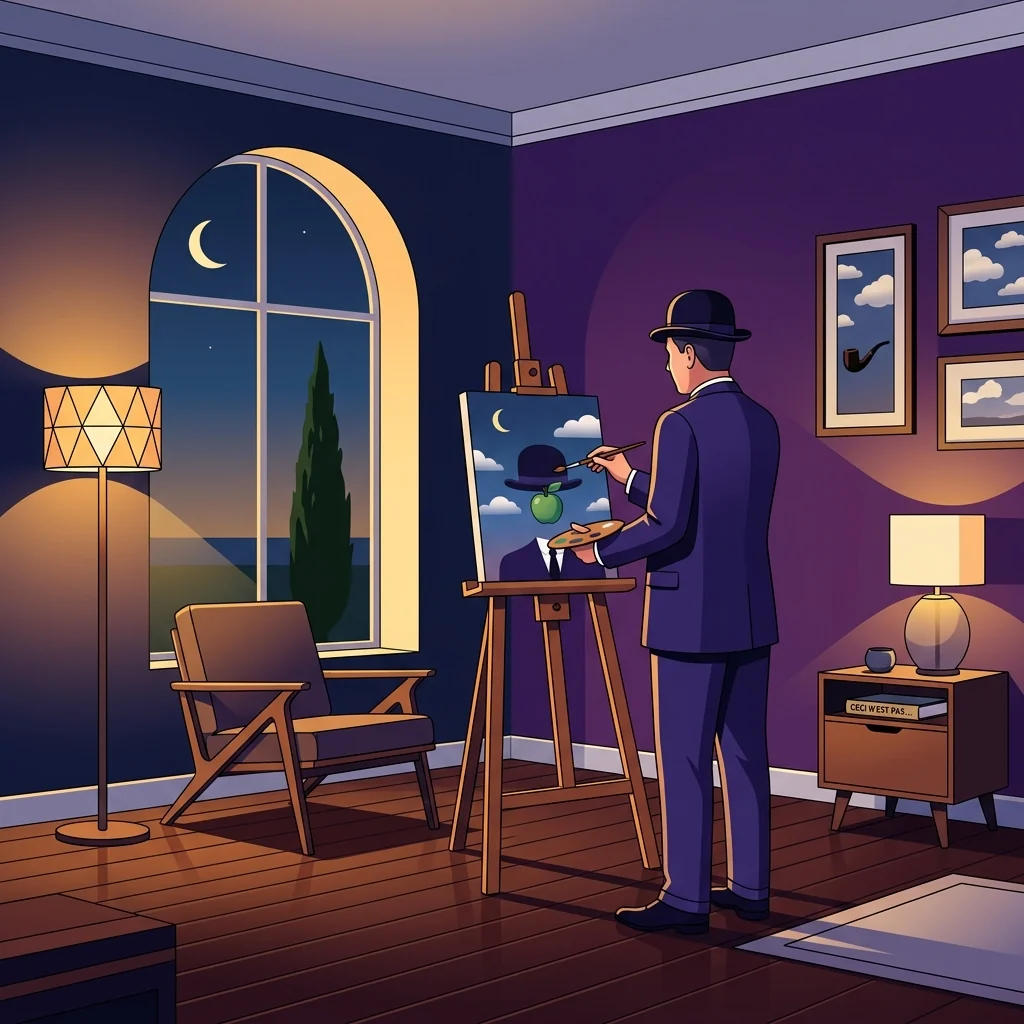
Magritte differed completely from bohemian artists who pulled all-nighters covered in paint. Every morning, dressed in a dark suit and bowler hat like a gentleman commuting to an office, he stood before an easel in a corner of his Brussels dining room. He completed his paintings with mathematical precision, never spilling a drop of paint on his clothes or rug. From a brain science perspective, this dress ritual stimulates the prefrontal cortex’s cognitive control system, intuitively switching the brain into work mode.
Modern remote workers frequently experience blurred boundaries between work and life. Sitting at a desk in comfortable pajamas causes cognitive confusion as the brain wanders between relaxation and arousal due to the lack of a physical gear-shift device.
This post analyzes how Magritte’s suit painting routine controls brain waves and psychology through clothing, presenting a 3-step guide for knowledge workers to instantly switch into Deep Work mode.
Historical & Academic Evidence
This content is based on Historical records from René Magritte biographies & Royal Museums of Fine Arts of Belgium archives, alongside Cognitive Neuroscience and Cognitive Psychology research.
 BuildSelf
Inspired by historical greats? Make it your daily habit!
BuildSelf
Inspired by historical greats? Make it your daily habit!

















1. Enclothed Cognition Effect and Brain Science of Prefrontal Cortex Cognitive Control
Human brains experience Enclothed Cognition, where clothing’s symbolic meaning and physical sensation directly influence cognitive processes.
When wearing neat formal attire or work clothes, the brain subconsciously primes social identities such as professionalism, diligence, and responsibility.
This psychological setup stimulates the cognitive control system of the Prefrontal Cortex, filtering distractions and immediately activating work immersion mode even in a comfortable living room.
2. 3-Step Practical Routine for Modern Professionals
Step 1: Shedding Relaxed Clothes and Changing into Neat Workwear
Take off loungewear or pajamas that signal relaxation to the brain, and change into a collared shirt or neat casual outfit to send a clear start-work signal.
Step 2: Organizing the Workspace and Physical Analog Tools
Clear unnecessary items from your desk like Magritte's living room easel setup, systematically arranging only the core tools needed for the day's task.
Step 3: Switching to Complete Rest Mode by Changing Clothes After Work
After fulfilling tasks during scheduled work hours, immediately change back into comfortable clothing to provide the brain with a clear signal for full relaxation.
3. Rule for Avoiding Overly Constricting Suits and Finding the Right Neat Workwear Balance
Avoid wearing clothes that overly constrict the body or cause pain just to achieve Enclothed Cognition. Physical discomfort sends fatigue signals to the Prefrontal Cortex, impairing concentration. The essence is to maintain neatness while establishing a comfortable balance (such as neat slacks or collared shirts) suitable for prolonged immersion.
📌 Frequently Asked Questions (FAQ)
Does wearing indoor shoes or dedicated work shoes while working from home help Enclothed Cognition? ▼
Yes, it produces an exceptional effect! The firm texture and tactile stimulation delivered to the soles send an 'outdoor activity mode' signal to the Somatosensory Cortex. This suppresses the urge to lie on the couch or bed and serves as a physical switch for work mode.
Does dressing neatly help even when engaged in creative work like painting or content creation? ▼
Yes, absolutely! While people often assume chaotic and loose attire fosters creativity, neat routines and clothing conserve prefrontal cognitive resources, allowing the brain to immerse in high-level thinking that unearths deep ideas and surreal associations.