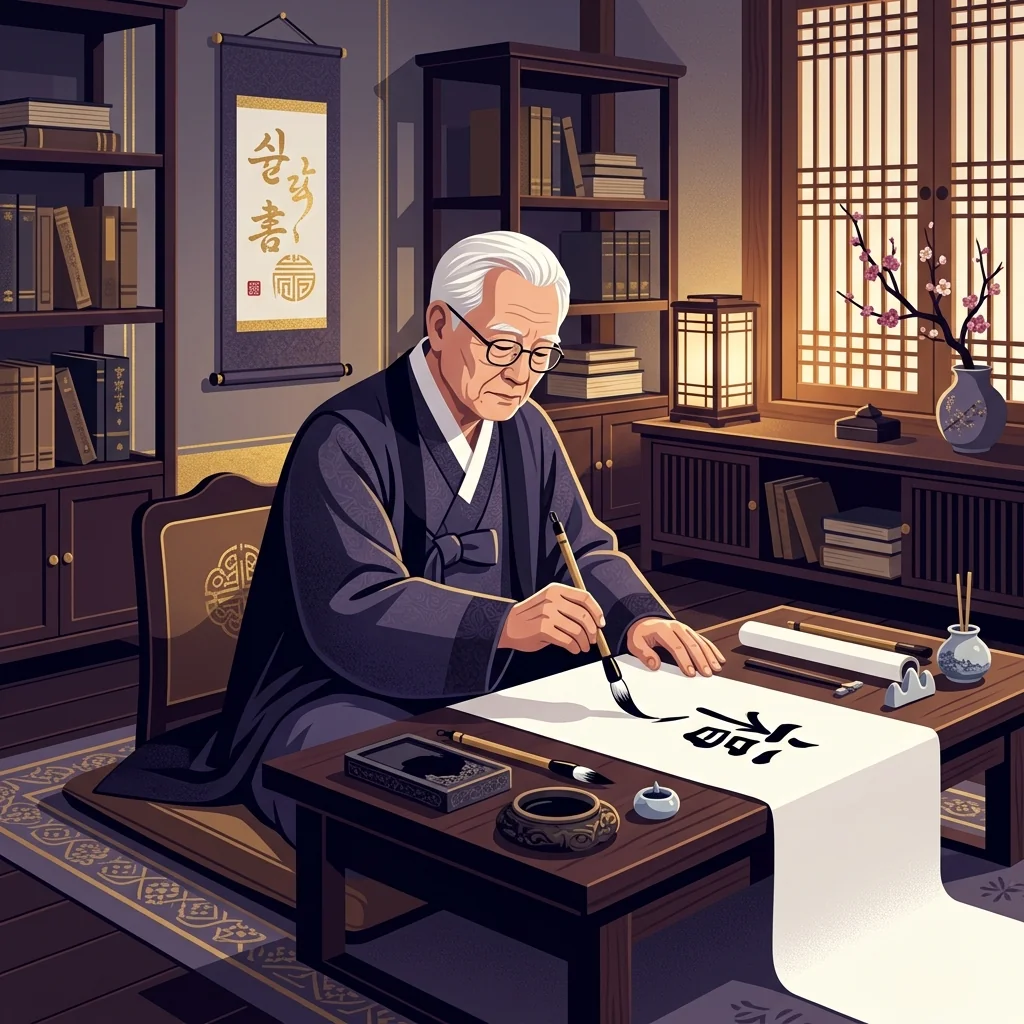
“While holding the brush, grinding the ink, and tracing characters, mental clutter dissolves and the core essence of business decisions emerges with crystal clarity.” 🖌️
Lee Byung-chul (1910–1987), honored as Ho-Am, was the visionary industrialist who founded the Samsung Group and laid the foundation for Korea’s semiconductor miracle. Steering an emerging enterprise through wartime destruction and economic volatility required uncompromising rational judgment and strategic foresight. Behind his decisive leadership lay an unvarying morning Eastern ritual.
Every single morning upon waking, Lee retreated to his quiet study, ground ink stones manually, and engaged in brush calligraphy (Seoye). As recorded in his autobiography Ho-Am Jajeon, tracing foundational corporate principles like ‘Talent First’ (Injae Je-il), ‘Infinite Pursuit’ (Muhan Chugu), and ‘Service to the Nation Through Business’ (Saeup Boguk) on traditional mulberry paper served as his primary mental discipline. Focusing his motor precision on modulating brushstroke tension disengaged emotional noise and activated central executive networks. Neuroscientifically, executing delicate Fine Motor Control engages the Primary Motor Cortex and Cerebellum, soothing the Autonomic Nervous System and awakening the Prefrontal Cortex for high-stakes executive reasoning.
In today’s post, we examine the motor control science and cognitive neuroscience behind Lee Byung-chul’s ‘morning calligraphy’ routine and present a modern 3-step protocol to eliminate cognitive noise and enter deep executive focus.
Historical & Academic Evidence
This content is based on Historical Verification from Ho-Am's Autobiography *Ho-Am Jajeon*, Samsung Group Archives & Cognitive Neuroscience and Motor Control Science Research.
 BuildSelf
Inspired by historical greats? Make it your daily habit!
BuildSelf
Inspired by historical greats? Make it your daily habit!

















1. Primary Motor Cortex Engagement and Prefrontal Autonomic Nervous System Relaxation
Unlike rigid metallic pens, brush calligraphy demands micro-precision adjustments of flexible bristle tension, stroke velocity, and pressure gradients. This complex task intensively engages neural networks within the Primary Motor Cortex and Cerebellum, physiologically suppressing emotional chatter and cognitive distractions. Furthermore, multi-sensory feedback—the tactile friction against paper, the scent of ground ink, and visual stroke formation—calms the Autonomic Nervous System and activates executive control in the Prefrontal Cortex, empowering leaders to align complex strategic thoughts with cool rationality.
2. 3-Step Practical Routine for Modern Professionals
Step 1: Establishing a Calm Analog Calligraphy & Writing Sanctuary at Dawn
Upon waking, bypass checking your smartphone. Arrange an ink stone, paper, and brush (or a fountain pen with textured paper) at a clean desk to create a distraction-free analog space.
Step 2: Regulating Breath & Selecting a Core Philosophy Word
Sit upright and quiet your mind with deep breathing. Select a single word or phrase reflecting your core values (e.g., 'Talent First', 'Relentless Focus') to anchor your focus for the day.
Step 3: Mindful Execution Immersed in Friction and Ink Saturation
Slowly trace characters one stroke at a time, anchoring your entire attention onto the tactile friction against your fingers and the visual spreading of ink on paper.
3. Caution: Excluding Perfectionist Calligraphic Judgment to Immerse in Sensorimotor Flow
Obsessing over the aesthetic perfection or artistic quality of your handwriting triggers self-critical evaluation networks, undermining neurobiological relaxation. This routine is not an artistic performance, but a sensorimotor mindfulness process focused on micro-pressure modulation. Ignore slight crookedness and immerse your awareness strictly in the physical sensation of friction as the brush glides across paper.
📌 Frequently Asked Questions (FAQ)
What household tools can I substitute if I don't own traditional calligraphy equipment? ▼
Fountain pens, dip pens, or a graphite pencil paired with heavy paper serve as ideal substitutes. The core mechanism is real-time sensory awareness of tactile friction and finger pressure modulation. Any writing instrument that provides clear haptic feedback yields identical autonomic relaxation benefits.
Why is it superior to practice this calligraphy routine immediately upon waking rather than at night? ▼
Upon waking, the brain is pristine, unburdened by accumulated cognitive clutter or external stress inputs. Engaging in precision fine motor control during the first 15 minutes grounds the autonomic nervous system while softly awakening prefrontal executive networks. This sets a calm, highly rational baseline for your entire workday.