“A sentence only becomes true when it leaves the mouth and rings in the ear.” 🗣️
Fyodor Dostoevsky (1821–1881) was the Russian titan of world literature whose masterpieces, including ‘Crime and Punishment’ and ‘The Brothers Karamazov’, explore the absolute depths of human psychology. How did his prose achieve such breathless dramatic intensity and psychological authenticity?
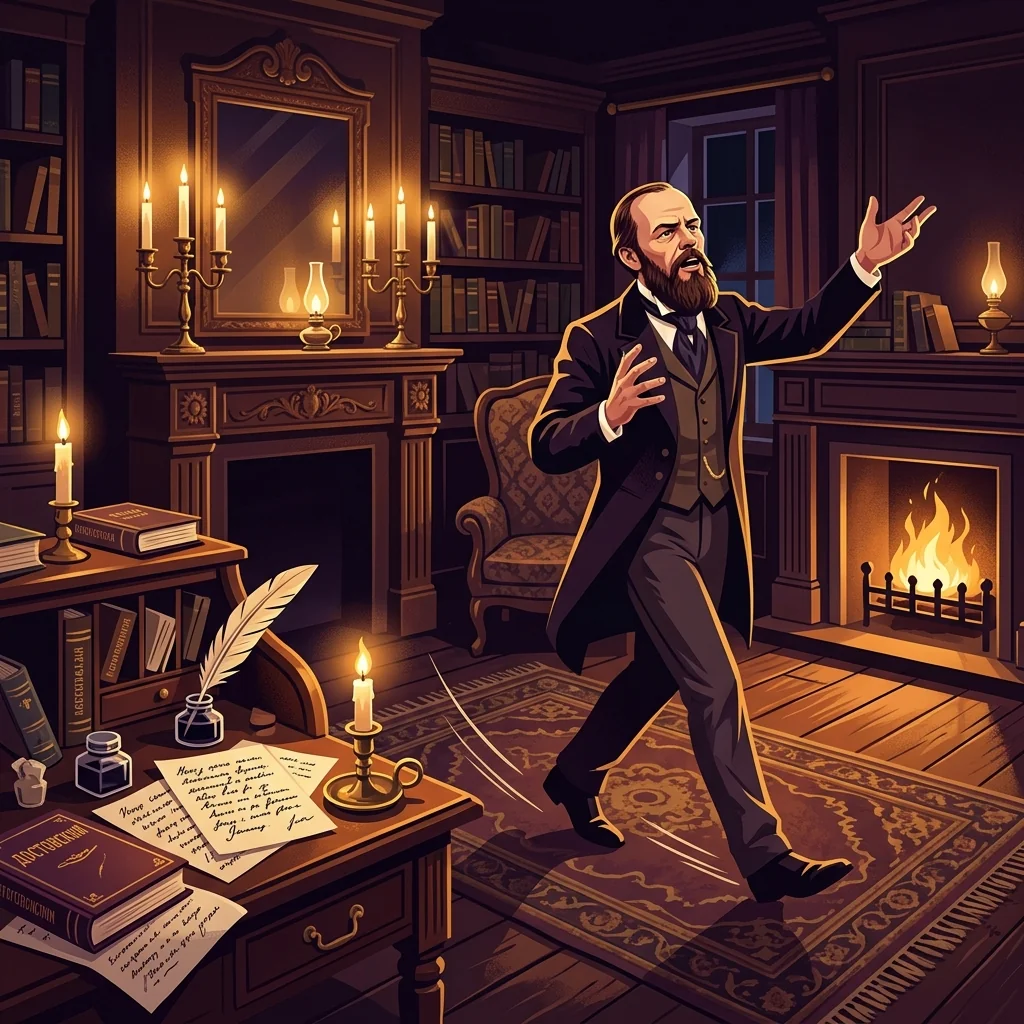
According to the memoirs of his wife and stenographer, Anna Grigoryevna Dostoevskaya, Dostoevsky never wrote sitting passively at a desk when crafting intense scenes. Instead, he paced frantically back and forth across his study, acting out dialogue at the top of his voice as if performing on stage. Only when a spoken monologue felt entirely natural and emotionally piercing would he dictate the finalized sentence to Anna, who recorded it in shorthand. Coupling rhythmic physical movement with loud oral recitation acted as a neuro-cognitive catalyst, activating his motor cortex alongside speech processing centers to infuse his writing with unmatched realism.
In today’s post, we analyze the brain science underlying Fyodor Dostoevsky’s ‘pacing recitation and oral dictation’ routine and present a 3-step practical guide for modern creators to unblock writing friction and build structural rhythm.
Historical & Academic Evidence
This content is based on Historical Verification from Anna Dostoevskaya's Memoirs *Reminiscences* & Cognitive Neuroscience Research.
 BuildSelf
Inspired by historical greats? Make it your daily habit!
BuildSelf
Inspired by historical greats? Make it your daily habit!













1. Neuroscience of Coupling Physical Pacing and Oral Recitation to Activate Speech Networks and Mirror Neurons
Physical pacing stimulates the motor cortex, boosting cerebral blood flow and oxygenation to prefrontal networks. Simultaneously, oral recitation (Oral Cognition) establishes a tight Auditory-Motor Feedback Loop, co-activating Broca’s area (speech production) and Wernicke’s area (language comprehension). Furthermore, physically acting out characters directly recruits the brain’s Mirror Neuron system. This motor-auditory synergy breaks static, abstract text processing, enabling creators to embed visceral, 1st-person psychological depth into written arguments and narratives.
2. 3-Step Practical Routine for Modern Professionals
Step 1: Instantly Standing Up Upon Encountering Cognitive Blocks
The instant writing or planning stalls and prefrontal congestion occurs, remove your hands from the keyboard and stand up to change your physical posture.
Step 2: Physical Pacing & Loud Oral Recitation of Core Arguments
Pace the room at a steady rhythm, speaking your intended core points or dialogue out loud in a clear, expressive voice as if presenting to an audience or executing a dramatic scene.
Step 3: Immediate Text Archiving of Auditory-Verified Formulations
The moment a spoken phrase sounds smooth, rhythmic, and convincing to your ears, immediately record or transcribe it into your notebook, laptop, or voice-to-text app.
3. Caution & Tips: Securing a Safe Private Space & Preventing Social Evaluation Interference
Because oral recitation involves vocalization and dramatic expression, practicing in open offices or public spaces triggers Social Evaluation Anxiety, prompting amygdala arousal and severely disrupting cognitive flow. To obtain full benefits, execute this routine strictly within a secure private space—such as a personal study, enclosed office, or private vehicle—where you can articulate out loud without fear of judgment.
📌 Frequently Asked Questions (FAQ)
Does whispering or silently mouth-reading produce the same cognitive benefits as speaking out loud? ▼
No. Whispering or silent subvocalization fails to fully engage articulatory motor muscles and generates insufficient auditory feedback. You must articulate clearly so your voice travels through the air and returns through the ears, completing the Auditory-Motor Feedback Loop that co-activates Broca's and Wernicke's areas.
Is it effective to record spoken thoughts using smartphone voice memos or Speech-to-Text (STT) apps while pacing? ▼
Yes, this is an outstanding modern implementation of Dostoevsky's routine. Capturing your spoken thoughts via voice memos or STT apps prevents physical handwriting from interrupting your walking and vocal flow, lowering cognitive friction and maximizing creative dictation.