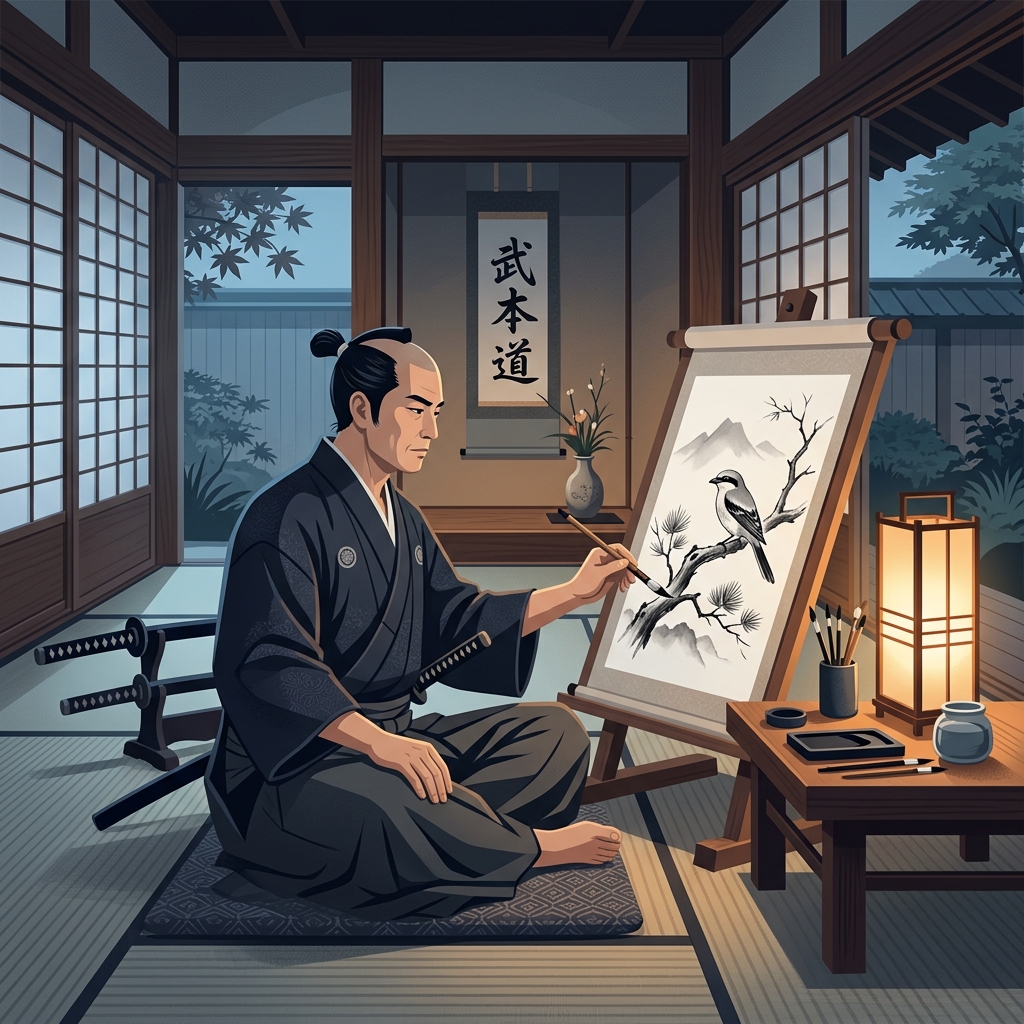
“Setting down the brush where the sword was drawn, anchoring a wild mind into deep stillness.” 🖌️
Miyamoto Musashi, the legendary swordsman, military strategist of early Edo-period Japan, and philosopher who authored the timeless treatise ‘Go Rin No Sho’ (The Book of Five Rings). As the founder of the Niten Ichi-ryu two-sword style who remained undefeated across more than 60 life-or-death duels, he possessed an uncanny ability to maintain composure even amidst chaotic martial combat.
Immediately after a fierce duel or high-stakes clash, Musashi sat down, ground ink on an inkstone, and picked up a brush. He calmed his excited inner landscape by painting exquisite ink wash artworks—such as ‘Bodhidharma’ embodying resolute spirit or ‘Shrike on a Withered Branch’ depicting a bird perched on a barren tree—alongside fine calligraphy. As preserved in his ink paintings at Kenshoji Temple and the Kyushu National Museum, alongside records in ‘Go Rin No Sho’, ink painting was for Musashi a sacred emotional reset ritual that transformed surging adrenaline and extreme physical tension back into profound equilibrium.
In today’s post, we introduce the neuroscientific principles of Parasympathetic Nervous System activation and Fine Motor Control embedded in Miyamoto Musashi’s ink painting and calligraphy routine.
Historical & Academic Evidence
This content is based on Kumamoto Prefecture Designated Cultural Property Original Manuscript of 'Go Rin No Sho' (The Book of Five Rings) & Musashi's Ink Paintings at Kenshoji Temple and Kyushu National Museum ('Shrike on a Withered Branch', 'Bodhidharma') & Cognitive Neuroscience Research on Parasympathetic Nervous System Activation and Fine Motor Emotional Regulation.
 BuildSelf
Inspired by historical greats? Make it your daily habit!
BuildSelf
Inspired by historical greats? Make it your daily habit!

















1. Emotional Reset Effects Created by Fine Motor Control and Parasympathetic Activation
Immediately after high stress or intense competition, the brain is dominated by sympathetic nervous system hyper-arousal, surging adrenaline and overheating the amygdala (Amygdala).
Grinding ink and controlling delicate brush pressure, as Musashi did, intensely stimulates the brain’s ‘Fine Motor Control’ and the ‘Somatosensory Cortex’. Immersing oneself in precise finger movements suppresses sympathetic drive and shifts the Parasympathetic Nervous System to dominance, stabilizing heart rate, cooling emotional hyper-arousal in the amygdala, and delivering a powerful Emotional Reset.
2. 3-Step Practical Routine for Modern Professionals
Disconnect from Digital Devices Immediately After High-Intensity Focus or Stress
Right after intense work or competition, shut off smartphones and screens, settling into a quiet space with minimal visual stimulation.
Draw Lines or Write Calligraphy, Focusing on Fine Fingertip Sensations
Apply brush or pen to paper, slowly controlling speed and pressure to perform calligraphy, ink sketching, or neat handwriting.
Regulate Breathing and Confirm Muscle Relaxation and Inner Equilibrium
Focus on fingertip pressure and paper texture while maintaining deep, slow breathing to activate the parasympathetic nervous system and reset emotions.
3. Avoid Obsessing Over Artistic Perfection and Focus on the Brush’s Flow
The essence of Musashi’s ink painting routine was not creating a masterpiece to show others, but centering his own mind. Perfectionist pressure to draw well can re-activate the sympathetic nervous system, so focus purely on the tactile texture of ink and subtle finger movements.
📌 Frequently Asked Questions (FAQ)
Can I get the same effect using handwriting or calligraphy pens if I lack traditional ink painting tools? ▼
Yes, you can achieve the exact same neuroscientific benefits. The core of Musashi's routine relies on fine motor pressure control rather than traditional ink materials. Using a fountain pen, calligraphy pen, or pencil to write neatly or draw controlled lines works perfectly.
How many minutes of this practice are required in a busy schedule to reset the brain? ▼
Just 5 to 10 minutes is sufficient. Engaging in fine finger control and regulated breathing for 5 minutes stabilizes heart rate variability (HRV) and suppresses amygdala activity, restoring emotional balance.