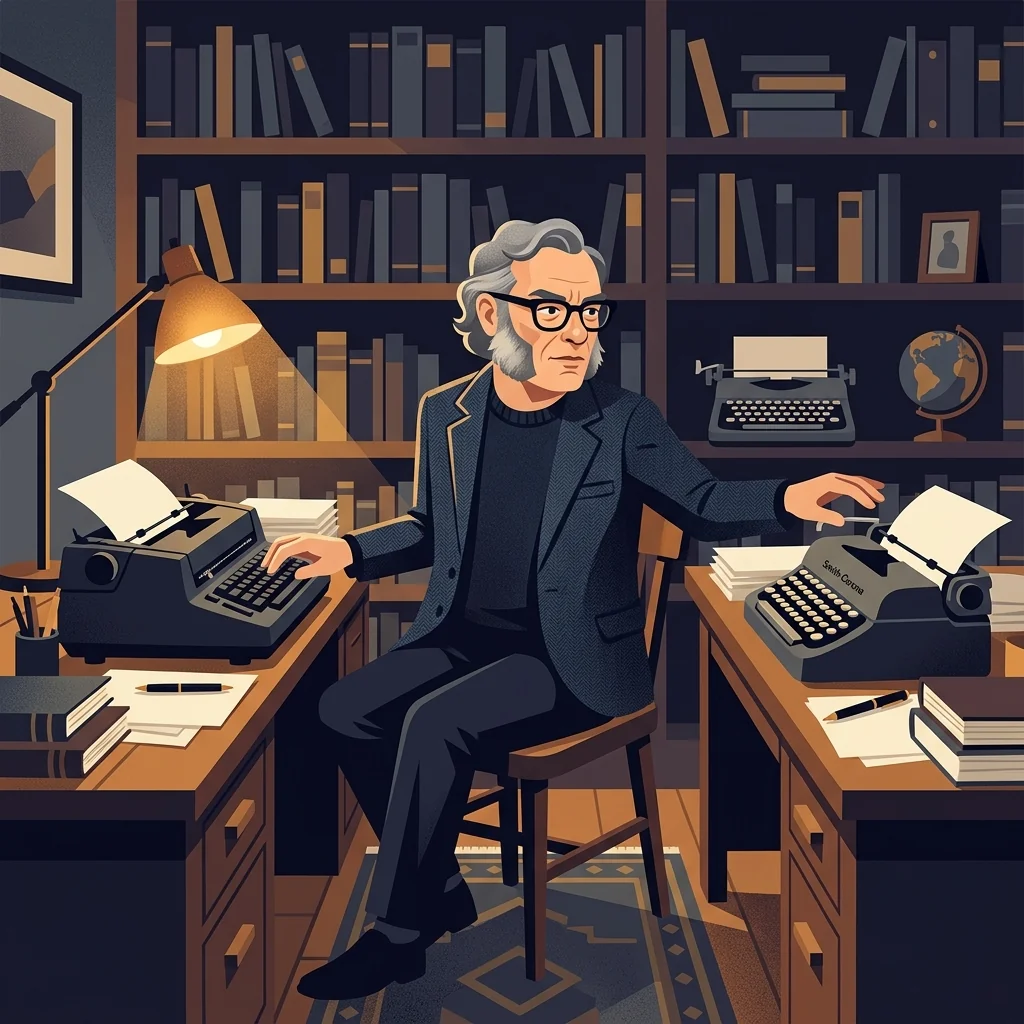
“I don’t stare at a blank sheet of paper. When I get stuck, I don’t try to force it. Instead, I move to another typewriter and write a manuscript on an entirely different topic.” ⌨️
Isaac Asimov, who wrote over 500 books across vast disciplines throughout his life, becoming a master of science fiction and the premier popular science writer of his era. Behind this phenomenal master of prolific writing pouring out manuscripts like magic every day was his unique and ingenious working habit.
That was precisely the ‘autonomous switching of tasks’. Asimov arranged multiple typewriters side-by-side in his study, setting each up with projects on different topics (such as novels, science explanations, essays, etc.). When his flow stalled on one manuscript or his mind grew bored, instead of forcing it under stress, he simply stood up and moved to the adjacent typewriter to write a manuscript in a completely different field.
In today’s post, we propose the cognitive science principles hidden within Isaac Asimov’s ‘typewriter switching’ routine and a 3-step practical action plan for modern individuals to overcome cognitive stagnation in a single task and maximize work efficiency.
Historical & Academic Evidence
This content is based on Historical Verification from Isaac Asimov's Autobiography *I, Asimov: A Memoir* & Cognitive Neuroscience Research.
 BuildSelf
Inspired by historical greats? Make it your daily habit!
BuildSelf
Inspired by historical greats? Make it your daily habit!

















1. Context Switching and the Novelty Effect: Regional Brain Fatigue Recovery
According to research in cognitive psychology and working memory, hanging onto a single task for a long time causes the brain to hyperactivate only specific neural networks, inducing cognitive stagnation. When squeezing the brain forcefully during the resulting Writer’s Block, cortisol is secreted, drastically reducing cognitive efficiency.
When you switch context (Context Switching) to a completely different task like Asimov did (e.g., shifting from writing fiction to explaining scientific facts), the cortical areas previously activated with accumulated fatigue enter forced rest, and an entirely different neural network corresponding to the new stimulus awakens. This is called the ‘Novelty Effect’, allowing the newly stimulated brain to safely re-enter a state of immersion without recognizing prior cognitive fatigue.
2. 3-Step Practical Routine for Modern Professionals
Step 1: Preparing Diverse Tasks with Different Cognitive Characteristics
To cross-utilize different brain fatigue regions, always prepare 2 to 3 types of tasks side-by-side with non-overlapping cognitive circuits, such as writing requiring advanced phrasing, budget organizing requiring intuitive numerical entry, or foreign language vocabulary memorization.
Step 2: Proactive Context Switching Upon Facing Focus Limits
When feeling stuck or bored while progressing in a task, do not overwork the brain unnecessarily; instead, switch tasks as if moving immediately to the next typewriter. Instantly flip screens to an already open tab or document to kickstart immersion in the next task.
Step 3: Inducing Brain Activation Through Novel Regional Stimulation
Cognitively block the fatigue of prior work through the novelty effect of the newly switched task. The brain enjoys a sufficient rest effect and smoothly maintains focus not just by stopping work, but simply by 'activating a different region'.
3. Neuroscientific Advice for Efficient Focus Switching
When stuck on one task, holding on relentlessly to the bitter end is not the only virtue. Neurons in the brain also need shift-work across different regions. Flexibly break through work plateaus through clever context switching between drafting minor emails or writing an entirely different proposal.
📌 Frequently Asked Questions (FAQ)
Why did Isaac Asimov alternate between multiple typewriters? ▼
To avoid cognitive fatigue and stress generated when blocked while writing on a single topic, he alternated between tasks of entirely different genres or natures to awaken different regions of the cerebral cortex, obtaining the novelty effect.