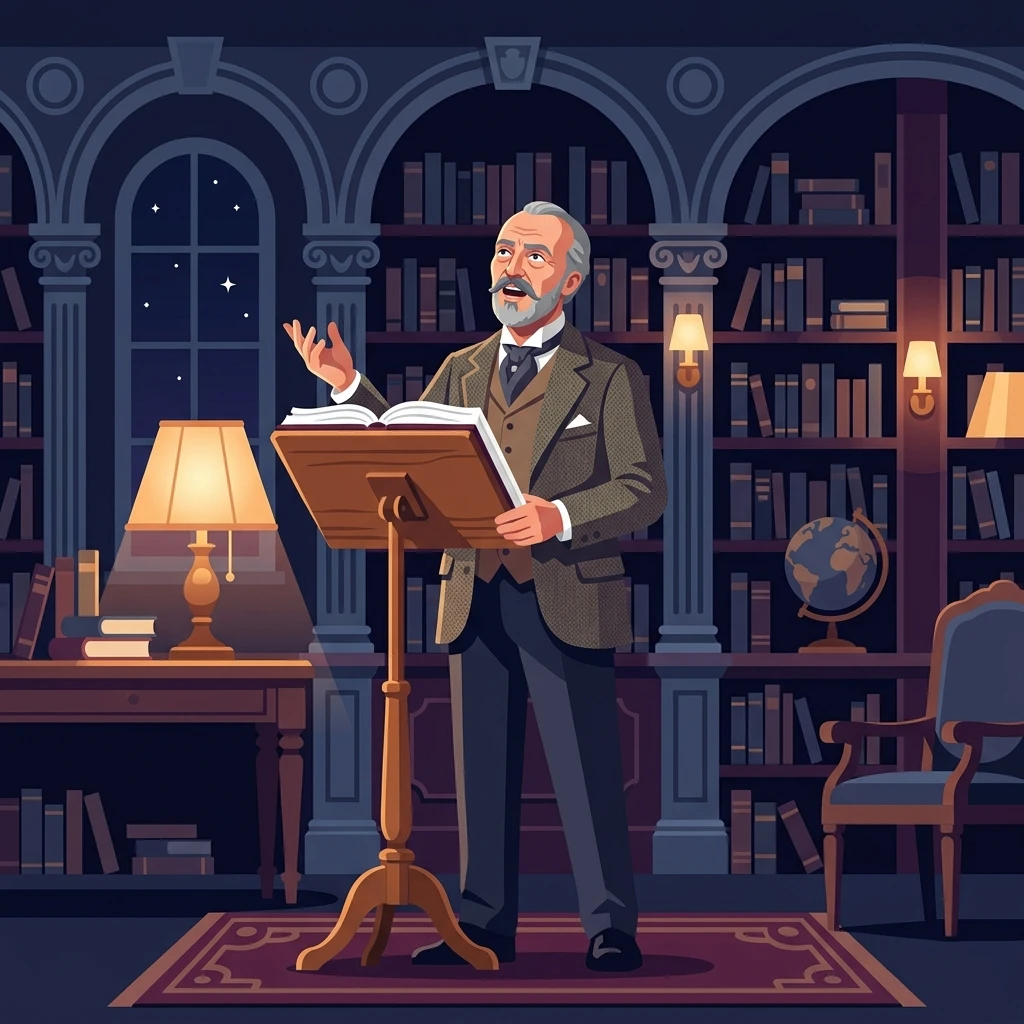
“Reading aloud, reciting at the top of my voice, and memorizing short passages—that was the sole secret to mastering 15 languages.” 🗣️
Heinrich Schliemann (1822–1890), the German archaeologist who proved Homer’s epic poems were historical fact by excavating the ruins of Troy and Mycenae. Working as a grocer’s apprentice without higher education, how did he manage to master 15 languages through self-study and achieve world-changing discoveries?
Schliemann’s secret lay in his relentlessly intense ‘Vocal Language Recitation’ routine. Every night, he read foreign texts aloud at the top of his voice and memorized whole paragraphs. His loud recitation caused so much noise that he was evicted multiple times. When learning Russian, he even hired a poor old man to sit as an audience member just so Schliemann could loudly recite Russian novels in front of him. Engaging both vocal production and auditory reception deeply imprinted foreign linguistic structures on his brain, serving as the ultimate key to reading ancient texts and locating Troy.
In today’s post, we examine the cognitive neuroscience behind Schliemann’s vocal language recitation routine and present a 3-step practical guide to rapidly acquiring languages or complex knowledge.
Historical & Academic Evidence
This content is based on Heinrich Schliemann, *Selbstbiographie* (1892) & *Cognitive Psychology Research on the Production Effect*.
 BuildSelf
Inspired by historical greats? Make it your daily habit!
BuildSelf
Inspired by historical greats? Make it your daily habit!

















1. The ‘Production Effect’ and Phonological Loop Stimulating the Brain
Silent reading relies solely on visual input, but vocalizing aloud while listening to your own voice simultaneously fires the visual cortex, motor cortex (controlling vocal articulation), and auditory cortex. Cognitive psychologists call this the ‘Production Effect’, forming robust neural pathways that transform short-term memory into long-term retention. Furthermore, it continuously activates the ‘Phonological Loop’ in Working Memory, imprinting unfamiliar grammar patterns and vocabulary into intuitive schemas.
2. 3-Step Practical Routine for Modern Professionals
Select Core Passages and Native Audio Targets
Choose short, precise paragraphs (10–15 sentences) in your target language or subject, and secure native audio recordings for reference.
Practice 20 Minutes of Daily Loud Recitation and Memorization
Read the text aloud with clear articulation at least 10 times daily, maintaining simultaneous vocal and auditory stimulation to memorize full sentences.
Record, Review, and Consolidate Phonological Memory
Record your vocal recitation using a smartphone, listen back to correct mispronunciations, and deeply imprint the correct rhythm into your phonological loop.
3. Rule: Articulate Clearly and Hear Your Own Voice Beyond Mumbling
The most important rule in vocal recitation is avoiding soft, inarticulate mumbling. Like Schliemann, clearly articulate exact pronunciations and intonations, allowing your ears to hear your own voice. If space is limited, use noise-isolating headphones while whispering clearly to maintain the link between vocal articulation and auditory processing.
📌 Frequently Asked Questions (FAQ)
How can I practice this routine in quiet environments like libraries or cafes? ▼
In quiet settings, utilize 'subvocal articulation'—moving your speech muscles precisely while whispering softly into your own ears. The key is coordinating motor mouth movements with auditory feedback.
Is this vocal method effective for academic exams or professional study beyond languages? ▼
Yes, exceptionally so. Reciting complex legal codes, medical terminology, or technical definitions aloud engages both visual and motor cortexes, more than doubling memory retention compared to silent reading.