“When trapped in complex equations, nothing awakens the brain with absolute clarity like vigorous physical movement.” ⚡
James Clerk Maxwell, revered alongside Isaac Newton and Albert Einstein as one of history’s greatest physicists, formulated the unified theory of electromagnetism. Engaging in continuous high-level theoretical physics and intricate mathematical calculations, he constantly faced severe cognitive fatigue and brain overload.
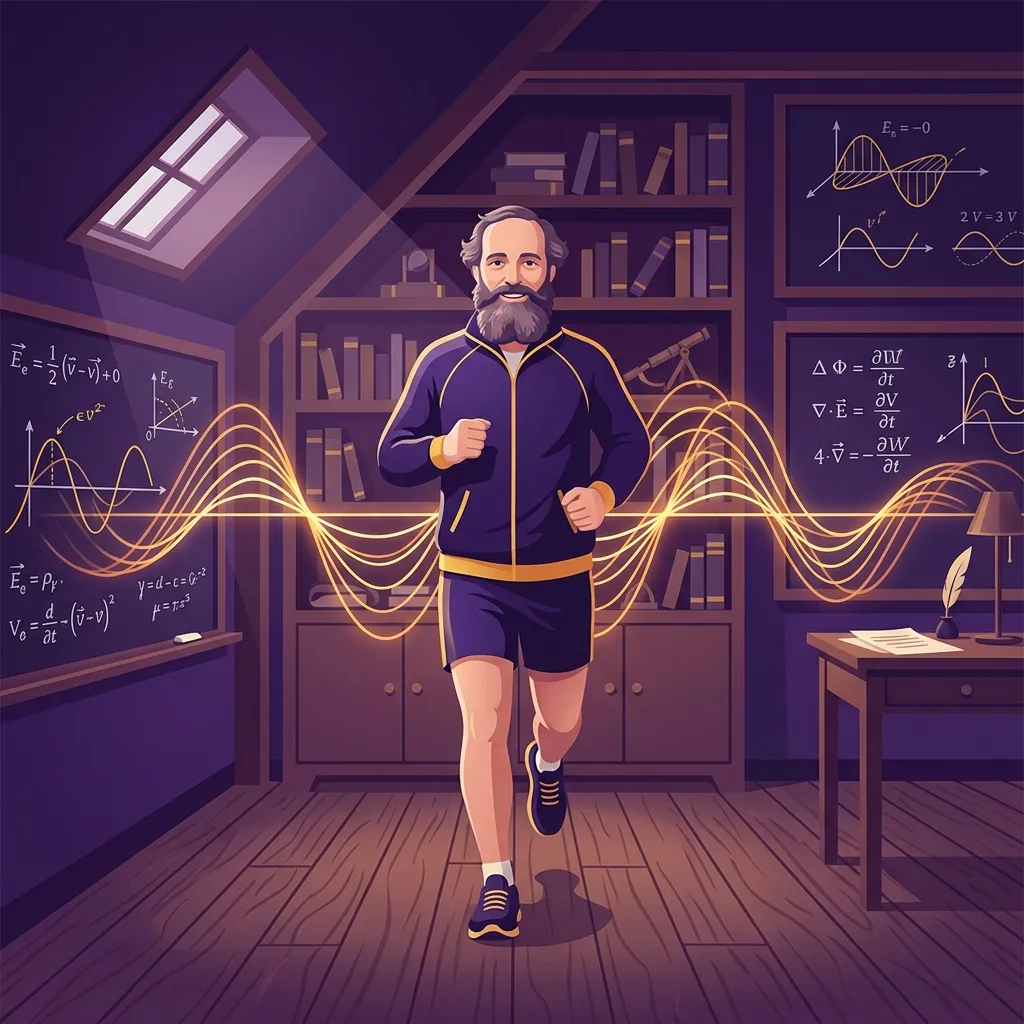
Yet Maxwell possessed a unique nighttime reset routine that maintained his research immersion at peak levels. Every night at precisely 10 PM, even while solving complex formulas, he stopped working, left his study, and headed to the long attic hallway. For 10 minutes, he ran intensely back and forth down the hallway until his footsteps echoed, finishing with quick stretching before returning to his desk.
This 10-minute high-intensity burst served as an advanced neuroscientific strategy to rapidly flush metabolic waste accumulated in the prefrontal cortex during continuous intellectual work. In today’s post, we introduce the cognitive neuroscience principles of cerebral blood flow redistribution and Cognitive Fatigue reset embedded in Maxwell’s 10 PM attic running habit.
Historical & Academic Evidence
This content is based on Lewis Campbell & William Garnett, *The Life of James Clerk Maxwell* (1882, Cambridge University Press) & Cognitive Neuroscience Research.
 BuildSelf
Inspired by historical greats? Make it your daily habit!
BuildSelf
Inspired by historical greats? Make it your daily habit!

















1. Cerebral Blood Flow Redistribution and Cognitive Fatigue Reset Driven by Short High-Intensity Aerobic Exercise
Prolonged high-level cognitive tasks accumulate metabolic byproducts in the prefrontal cortex, inducing ‘Cognitive Fatigue’ and sharply declining attentional control.
An intense 10-minute run at 10 PM redistributes stagnant cerebral blood flow throughout the body and stimulates catecholamine secretion (dopamine and norepinephrine), inducing a ‘Prefrontal Reset’. This scientific routine swiftly restores an overloaded brain into a state of high arousal, maximizing focus and immersion for late-night research.
2. 3-Step Practical Routine for Modern Professionals
Step 1: Detecting Cognitive Fatigue Signals at 10 PM (Recognizing Overload)
When focus drops sharply or you hit a wall in complex problem-solving, recognize it as a brain reset signal rather than forcing yourself through it.
Step 2: 10 Minutes of Short, Intense Physical Activity (Attic Running Application)
Engage in 10 minutes of exercise that leaves you slightly breathless—such as hallway walking/running, stair climbing, or bodyweight squats—to boost systemic blood flow.
Step 3: Re-hydrating, Returning to Work, and Achieving Hyper-Focus
Settle your body with stretching and hydration after exercise, and dive back into research with a refreshed prefrontal cortex.
3. Building a Modern Cognitive Firewall to Rest and Reactivate an Overloaded Brain
Do not force yourself to stay seated when suffering from screen fatigue and cognitive overload. The key is to shift blood flow through 5 to 10 minutes of short, intense physical activity when your brain reaches its limit.
📌 Frequently Asked Questions (FAQ)
Does high-intensity exercise at 10 PM disrupt sleep by overstimulating the autonomic nervous system? ▼
A short 10-minute aerobic burst like Maxwell's primarily improves prefrontal blood flow and flushes metabolic fatigue without inducing prolonged autonomic overarousal. However, it should be used as a mid-research reset rather than right before going to sleep.
How can I replace this routine if a treadmill or outdoor running is unavailable? ▼
Any aerobic movement that elevates your heart rate for 5 to 10 minutes—such as climbing indoor stairs, running in place, or jumping jacks—delivers the exact same cerebral blood flow redistribution benefit.