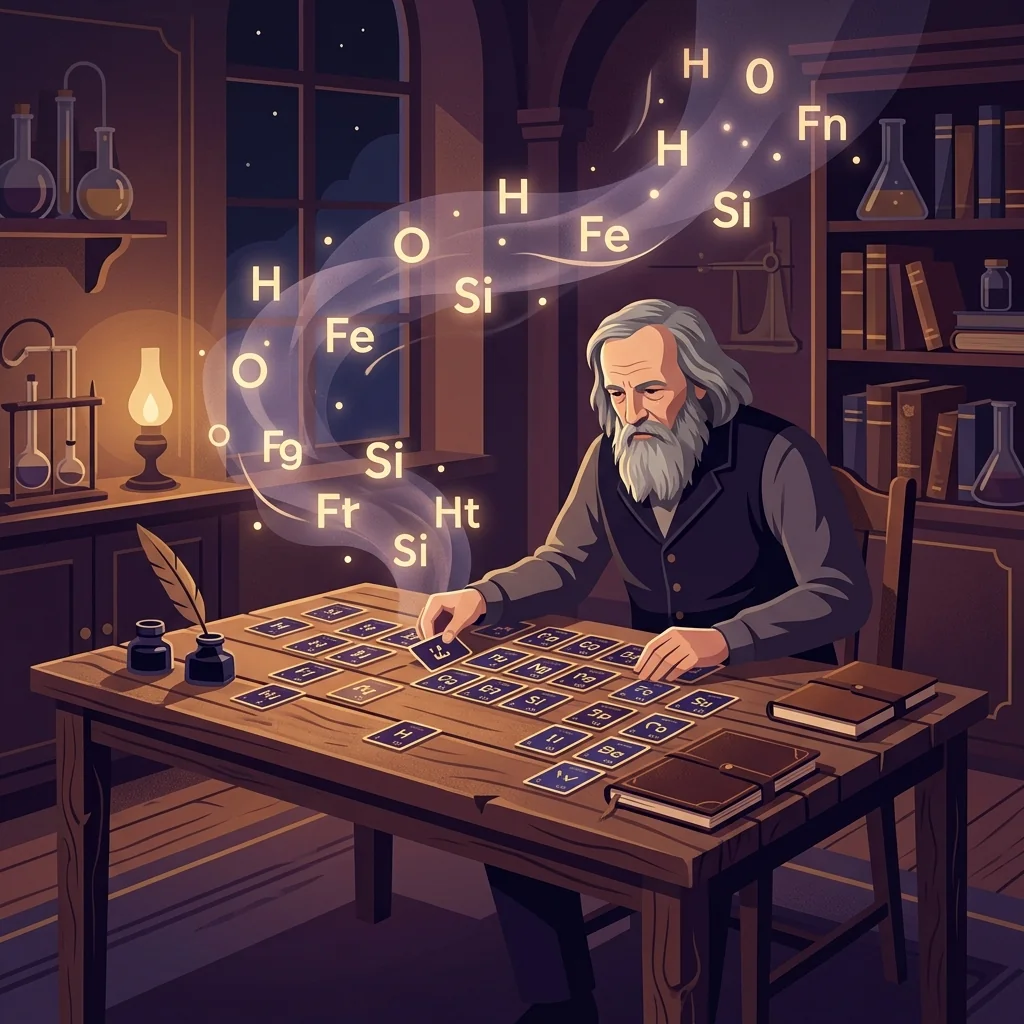
“Elements have their own natural pairs. When you shuffle and arrange the deck of cards, the perfect order decreed by Nature reveals itself.” 🃏
The Periodic Table stands as the map of matter and the crowning milestone of chemistry. Russian genius scientist Dmitri Mendeleev (1834–1907) completed this monumental breakthrough using an unexpected tool: a custom deck of 63 handmade cards representing the known chemical elements. On each card, he jotted down atomic weights and chemical properties. Carrying this deck in his coat pocket, Mendeleev laid them out on train tables and desks, endlessly rearranging them like a game of solitaire (‘patience’).
While most people struggle with complex problems by reading linear documents on screens or paper, flat text arrays limit holistic spatial synthesis. Mendeleev chunked complex information into discrete physical objects (cards) and physically manipulated them across a 3D surface. Tactile feedback paired with spatial rearrangement actively stimulated hippocampal spatial receptors and right-hemisphere pattern-matching networks, allowing him to perceive hidden periodicity across elements.
In this article, we dissect the neuroscientific utility of Mendeleev’s card solitaire routine and provide a 3-step practical framework to organize complex ideas using tactile spatial mapping.
Historical & Academic Evidence
This content is based on Mendeleev Historical Biographies & Autobiographical Records Research & Cognitive Neuroscience Studies.
 BuildSelf
Inspired by historical greats? Make it your daily habit!
BuildSelf
Inspired by historical greats? Make it your daily habit!

















1. Why Spatial Arrangement and Physical Manipulation Awaken Pattern Recognition
Flat text on screens or paper is processed by the brain as two-dimensional data, creating analytical calculation bottlenecks. In contrast, chunking information onto discrete cards and arranging them spatially across a desk activates the parietal lobes responsible for spatial positioning. Through tactile sensory signals from fingertips and 3D visual feedback, the brain perceives relational distances between concepts, enabling prefrontal and parietal networks to detect underlying patterns missed in linear reading.
2. 3-Step Practical Routine for Modern Professionals
Chunk Information into Individual Cards
Break down complex business issues, project tasks, or research data by writing a single core keyword on the front of individual sticky notes or small index cards.
Arrange and Manipulate Cards on a Physical Table
Spread the cards across a wide table. Slide them around with your fingers to group items by causal relationships, categories, or sequence.
Capture and Archive the Final Structural Layout
Once an intuitive, logical layout emerges, snap a photograph with your smartphone camera to synchronize the physical matrix with your memory.
3. Precautions and Tips
Avoid crowding excessive details onto a single card; doing so reverts the tool into a dense document, defeating the spatial manipulation benefit. Inscribe only one keyword or core concept per card to maximize the brain’s visuospatial sketchpad. Limit your active working set to 10–20 cards at a time so the brain can absorb the entire matrix at a single glance.
📌 Frequently Asked Questions (FAQ)
Can mind-mapping software replace physical sticky notes or paper cards? ▼
Mind-mapping software helps structure data, but tactile input from physically sliding cards with your fingers stimulates the motor and parietal cortices far more intensely. Neuroscientific research shows physical 3D finger manipulation induces superior neural activity for idea synthesis and memory retention compared to on-screen clicking, making physical cards much more effective.