“All truly great thoughts are conceived while walking.” 🚶♂️
Friedrich Nietzsche (1844–1900) was the iconoclastic German philosopher known as the ‘philosopher with a hammer’ who shattered traditional Western metaphysics. Having served as a professor of classical philology at the University of Basel before embarking on his solitary philosophical quest, where were his piercing insights born? Nietzsche fiercely despised conventional desk-bound study. Tormented throughout his life by debilitating migraines, eye pain, and stomach ailments, he actively mobilized his physical body to transcend suffering and liberate his intellect.
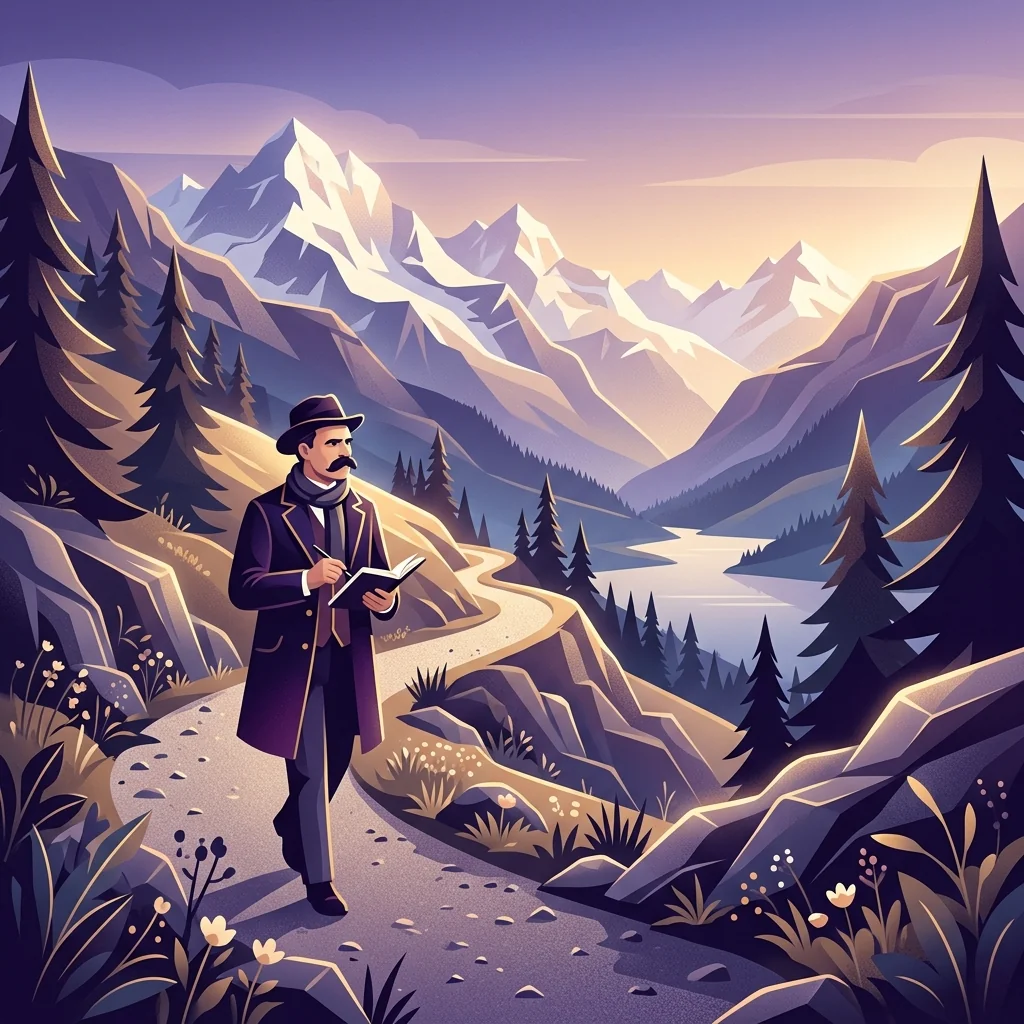
While recovering in the high Alpine village of Sils Maria, Switzerland, Nietzsche walked six to eight hours every day. He carried a small pocket notebook and pencil wherever he went, halting mid-stride to capture philosophical flashes as they struck. The foundational ideas of his masterpieces, including ‘Thus Spoke Zarathustra’, ‘The Gay Science’, and ‘Beyond Good and Evil’, erupted during these long walks along the serene shores and pine forests of Sils Maria.
In this post, we unpack the neuroscientific mechanisms behind Nietzsche’s walking-and-writing routine and explore how modern creative thinkers can leverage movement to solve complex problems.
Historical & Academic Evidence
This content is based on Historical Biographies and Autobiographical Verification of Friedrich Nietzsche & Cognitive Neuroscience Research.
 BuildSelf
Inspired by historical greats? Make it your daily habit!
BuildSelf
Inspired by historical greats? Make it your daily habit!

















1. Why Walking Rhythm Boosts the DMN and Divergent Thinking
Walking at a steady tempo moderately elevates heart rate, maximizing cerebral blood flow and oxygenation. The rhythmic movement relieves working memory overload and activates the Default Mode Network (DMN), transitioning the brain into a divergent mode that connects distant concepts.
2. 3-Step Practical Routine for Modern Professionals
Prepare Manual Writing Tools & Disconnect Digitally
Before heading out, leave your smartphone behind or enable Do Not Disturb mode. Carry only a pocket notebook and pen. The objective is total disconnection from digital triggers.
Walk at a Steady, Rhythmic Pace in Nature
Find a quiet park or natural trail. Walk at a moderate pace matching your breathing rhythm. Allow your gaze to scan the environment naturally without fixating on a single point.
Capture and Write Down Insights Immediately
The moment an idea or breakthrough flashes, halt immediately and record it in your notebook. Do not wait until returning home, as short-term creative traces decay swiftly.
3. Precautions and Practical Tips for Nietzschean Walking
Avoid looking at smartphones or digital screens during your walk. Keep only a pocket notebook and pen to block digital triggers, allowing subconscious creativity to flourish. Design an environment where action triggers naturally rather than relying solely on willpower.
📌 Frequently Asked Questions (FAQ)
When specifically during the day did Nietzsche walk? ▼
Nietzsche walked primarily between morning breakfast and lunchtime, as well as during late afternoons. He preferred mountain trails and forest paths to draw philosophical inspiration directly from nature.
Must I walk outdoors when practicing this in daily life? ▼
Outdoor nature walks are ideal; however, if unavailable, quietly pacing along an indoor hallway or open office space can still trigger cognitive shifts and reset your focus.