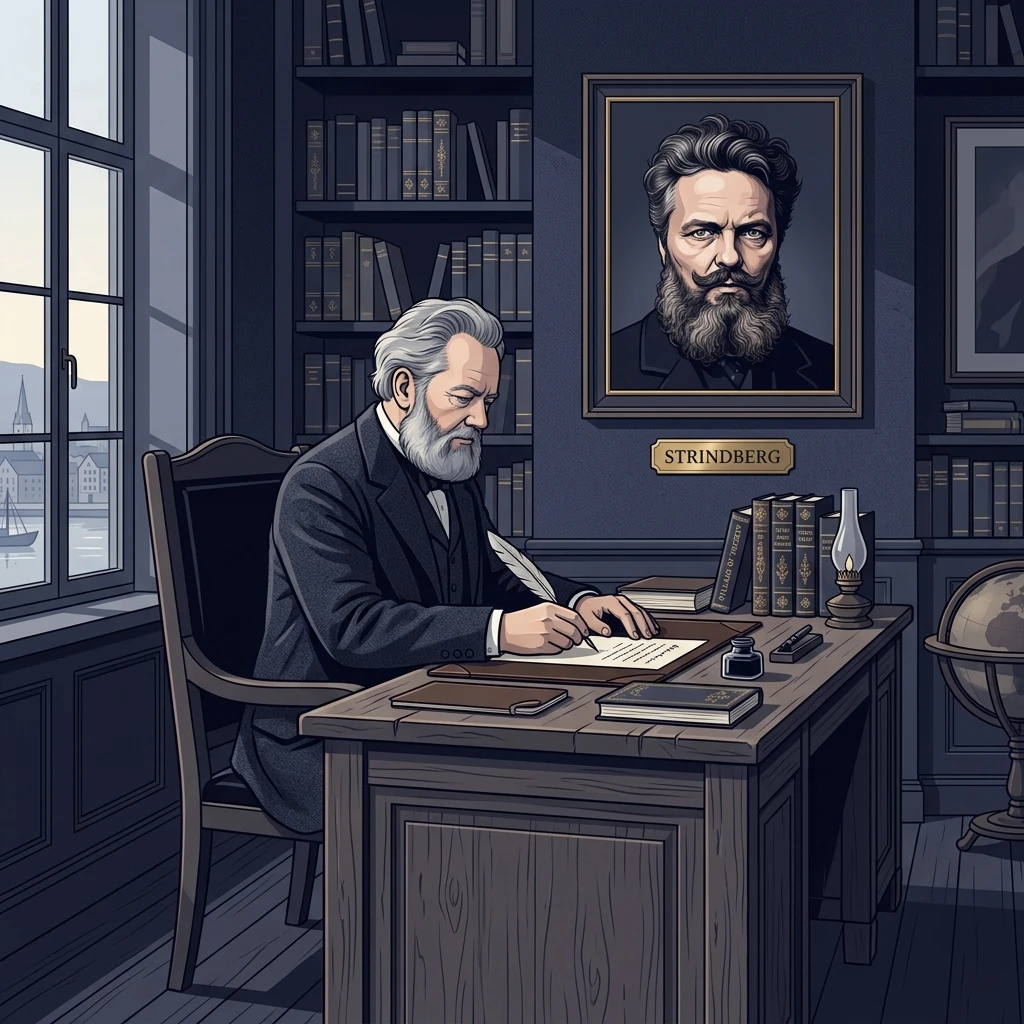
“The sharp gaze of a master standing clear before my eyes propels me past my own limitations.” 🎭
Henrik Ibsen, the father of modern drama and Norway’s globally renowned playwright, transformed the paradigm of world theater with realism masterpieces such as A Doll’s House, Ghosts, and Hedda Gabler. Sharp in his critique of social hypocrisy, Ibsen’s plays marked a pivotal milestone in the birth of modern theater.
The secret that sustained his uncompromising creative fire and fierce focus over decades lay in his routine: strict 4-hour morning writing sessions accompanied by gazing at a portrait. Every morning at 8:00 AM sharp, Ibsen sat at his desk to write for exactly four hours until noon. On the wall directly opposite his desk hung a portrait of his fiercest rival, the genius Swedish playwright August Strindberg. Whenever he felt his creative flow block, Ibsen stared directly into Strindberg’s eyes.
Ibsen used the tense creative pressure of his rival’s gaze as a catalyst to heighten his own cognitive arousal. Fearing comfortable complacency, he imposed exceptionally high standards upon himself whenever he looked at the portrait. In today’s post, we introduce the cognitive science principles of the Social Comparison Effect and Optimal Arousal regulation embedded in Henrik Ibsen’s portrait gazing routine.
Historical & Academic Evidence
This content is based on Michael Meyer, *Ibsen: A Biography* & Research in Social Comparison Effect & Arousal Regulation.
 BuildSelf
Inspired by historical greats? Make it your daily habit!
BuildSelf
Inspired by historical greats? Make it your daily habit!

















1. Social Comparison Effect and Visual Anchoring Mechanisms
Placing a portrait of a revered benchmark or rival directly facing your workspace engages the brain’s Social Comparison Effect and autonomic arousal regulation systems. Visually perceiving a rival’s presence triggers a balanced release of noradrenaline and dopamine, enhancing vigilance and prefrontal focus without inducing panic.
Furthermore, fixing your gaze on a clear visual icon (the portrait) when looking up from your work creates a Visual Anchoring effect, activating the fronto-parietal attention network to suppress mind-wandering. Combined with strict 4-hour time-boxing, this cognitive anchor helps the autonomic nervous system sustain an optimal state of creative flow.
2. 3-Step Practical Routine for Modern Professionals
Step 1: Strict 4-Hour Morning Writing Time-Boxing
Set aside four uninterrupted hours every morning when prefrontal executive resources are highest, completely blocking external distractions.
Step 2: Placing a Visual Benchmark (Portrait or Quote) Directly Opposite Your Desk
Position a portrait of a respected figure, rival, or a card with a core goal on the wall facing your desk to establish a visual anchor.
Step 3: Gazing at the Anchor During Lulls to Recalibrate Focus
When focus wanes or writer's block strikes, gaze directly at your visual anchor to reset cognitive arousal and immediately resume deep flow.
3. Transform Tension into Constructive Drive Rather Than Anxiety-Inducing Insecurity
The core of Ibsen’s portrait gazing was aesthetic tension used as a creative catalyst, not destructive self-criticism or envy. When modern individuals reference competitors or benchmarks, letting envy trigger anxiety overactivates the amygdala and shatters focus. It is crucial to harness the visual benchmark as a positive stimulant for personal growth.
📌 Frequently Asked Questions (FAQ)
Does it have to be a portrait of a rival, or can other visual materials be used? ▼
It does not need to be a rival. Any visual stimulus that provides constructive tension and focus arousal—such as a photo of a mentor, an ultimate personal goal, or a single powerful quote card—serves as an excellent visual anchor.
Why are four hours of morning focus cognitively optimal? ▼
In the morning immediately following sleep, the prefrontal cortex's Executive Function is refreshed and clear. Immersing in deep work for four hours before cognitive fatigue and willpower depletion set in is an optimal circadian strategy that yields the day's highest-density output.