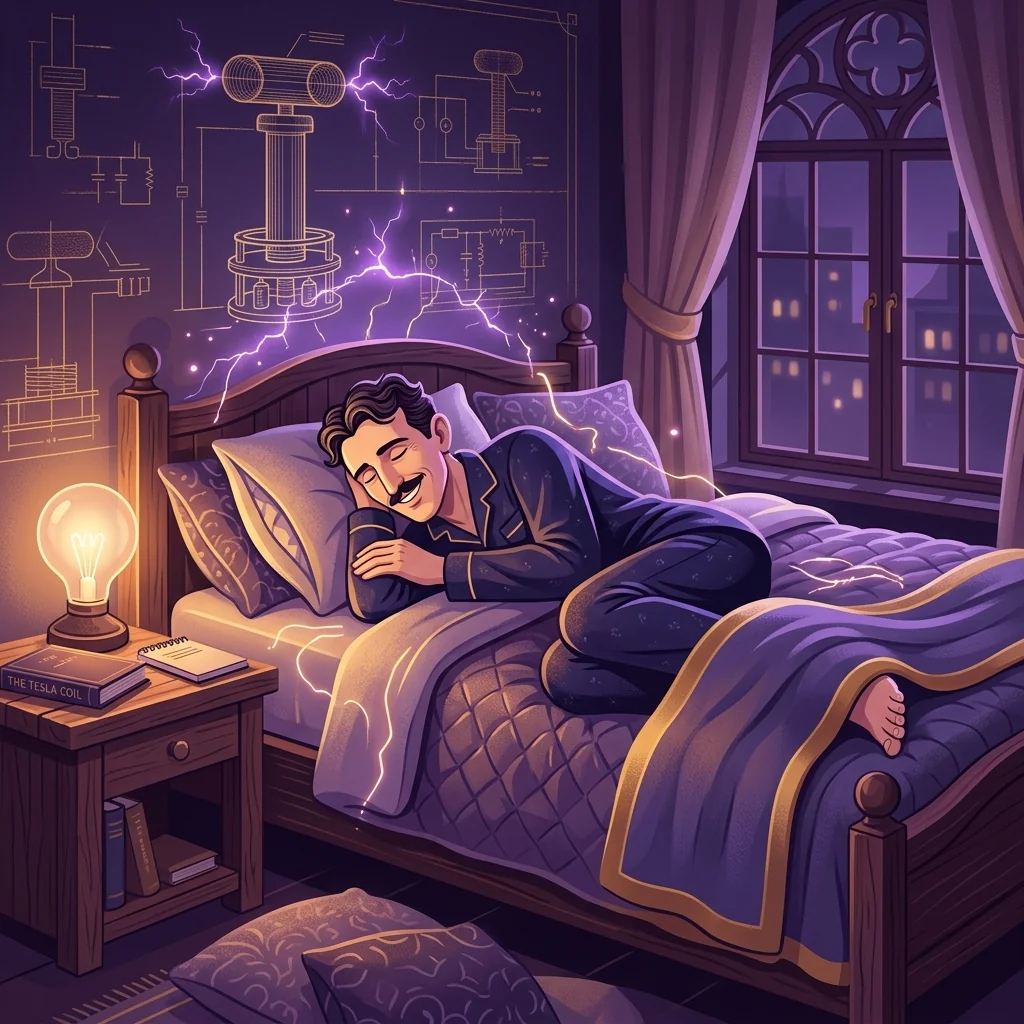
Did you know that Nikola Tesla (1856–1943), the genius scientist who illuminated the world alongside Edison and laid the foundation for alternating current (AC) power systems and wireless communication, repeated a bizarre ritual every night in bed? ⚡
While maintaining an extreme sleep pattern of sleeping just 2 hours a day, Tesla continuously produced groundbreaking inventions without fatigue. One secret to his stamina was his unique bedtime ritual: squeezing and extending his toes 100 times on each foot every night.
In this post, we explore the scientific principles behind this historic genius’s eccentric habit and how you can apply it to your daily life.
Historical & Academic Evidence
This content is based on Nikola Tesla, *My Inventions: The Autobiography of Nikola Tesla* (1919) & *JPTS Journal*.
 BuildSelf
Inspired by historical greats? Make it your daily habit!
BuildSelf
Inspired by historical greats? Make it your daily habit!

















1. Toes: The Neural Switch That Awakens Brain Cells
Tesla believed that the seemingly trivial motion of repeatedly curling his toes stimulated the numerous nerve endings concentrated at his feet, activating brain cells and resetting accumulated fatigue.
In reality, the area occupied by the feet and toes in the brain’s somatosensory cortex is surprisingly vast—almost as large as that of the hands. Intentionally moving toes that have been trapped in socks and shoes all day is an excellent way to stimulate dormant neural networks.
2. 3-Step Practical Routine for Modern Professionals
Step 1: Sleep Preparation & Position Alignment Under Blankets
Lie down in bed before sleeping and right after getting under the blanket, relax your body, and focus entirely on the sensations and nerve endings in your feet.
Step 2: The 100-Time Toe Curling Ritual
Rhythmically flex and extend the toes of both feet simultaneously 100 times, stimulating autonomic nerve pathways.
Step 3: Parasympathetic Relaxation & Transition to Deep Sleep
Feel the subtle warmth and relaxation spreading through your body after the exercise, allowing yourself to naturally drift into deep sleep upon receiving your brain's sleep signal.
3. A Neuroscientific Tip for a Successful Routine
Toe exercises promote blood circulation at the furthest point from the heart, evening out body temperature and stimulating the parasympathetic nervous system. Repeating this action at the exact same moment every night (right after getting under the blanket) trains your brain to recognize it as a powerful conditioned signal for sleep.
📌 Frequently Asked Questions (FAQ)
Does wiggling or curling toes really help activate the brain? ▼
Yes! On the somatosensory cortex map of the brain, the toe area is located near the central region. Stimulating the fine muscles of the toes subtly activates the frontal lobe via peripheral nerves.