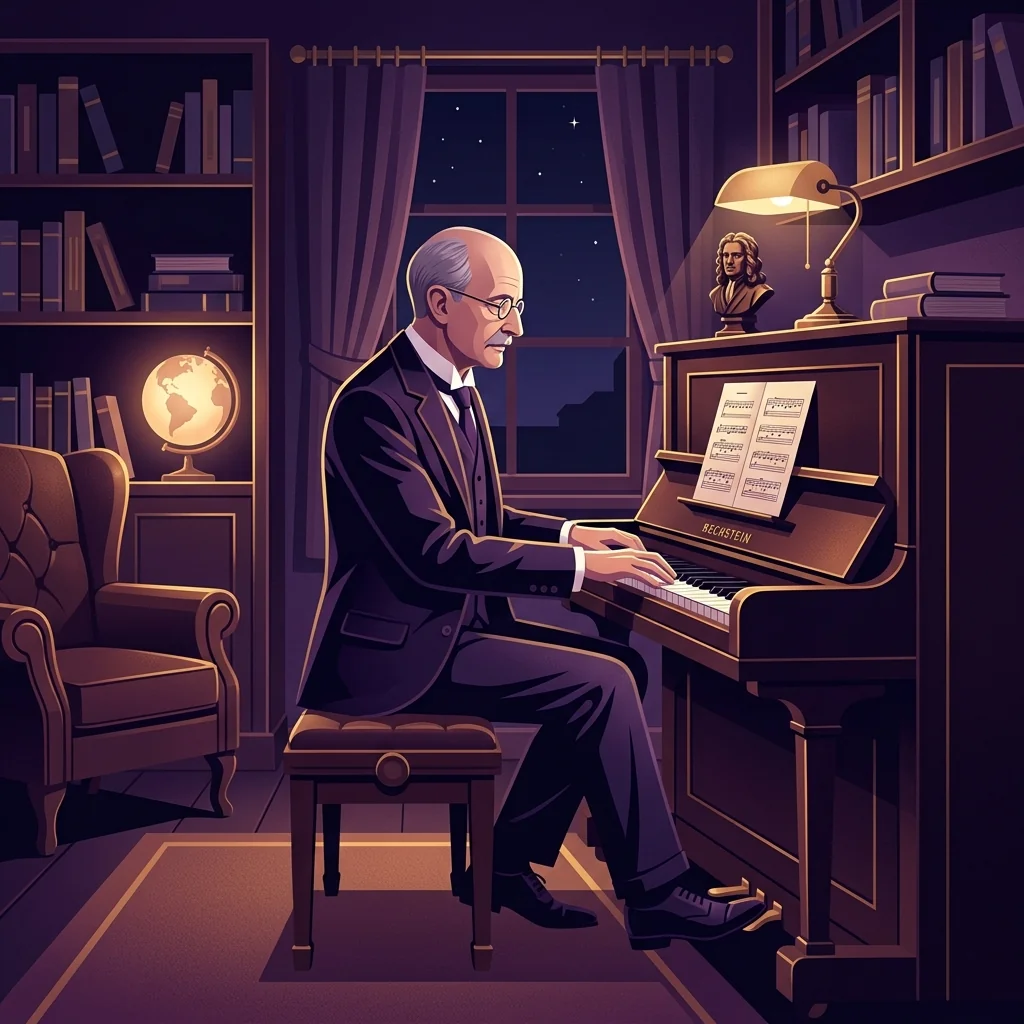
“I only stop my brain’s tension when I place my fingers on the piano keys and throw myself into free dissonances.” Max Planck, the legendary German physicist who formulated quantum theory and discovered Planck’s constant (h), bringing an end to classical physics and opening the era of modern physics. Reconstructing macroscopic and microscopic universe physics brought severe mathematical overload and brain fatigue to Planck. His sanctuary when facing mental exhaustion was his piano. A highly accomplished pianist, Planck often played piano-violin duets with his close friend and physics colleague Albert Einstein. Every day after dense theoretical work or when hitting a wall, Planck closed his sheet music and improvised freely on the keys. This post examines the neuroscientific mechanism behind how artistic cognitive switching resets the brain.
Historical & Academic Evidence
This content is based on Historical Biographies and Writings on Max Planck & Cognitive Neuroscience Research.
 BuildSelf
Inspired by historical greats? Make it your daily habit!
BuildSelf
Inspired by historical greats? Make it your daily habit!

















1. Left-Brain Inhibition and Cross-Cognitive Refresh via Right-Brain Activation
Exhausting a specific neural circuit (like mathematical logic in the left hemisphere and parietal lobe) accumulates neural fatigue metabolites such as adenosine. Rather than resting passively, engaging completely different brain regions (right hemisphere and motor-sensory cortex) through musical improvisation triggers ‘Cross-Cognitive Refresh’. Improvisation lets the brain assemble intuitive sensory waves without rigid rules, switching off overloaded logical circuits and allowing fatigued neural areas to flush out waste products.
2. 3-Step Practical Routine for Modern Professionals
Prepare an Instrument for Free Improvisation
Keep an easily accessible keyboard or piano (or synthesizer) near your workspace or living area.
5-Minute Freeform Keys Doodling
Close sheet music, switch off all analytical logic, and play freely for 5 minutes following your fingertips instinctively.
Sensory Sound Awareness and Mind Reset
Focus your attention entirely on sound waves and harmonic resonance, washing away left-brain logical fatigue to complete the reset.
3. Cautionary Tips for Cognitive Switching
When using piano improvisation to reset your brain, avoid forcing yourself to follow rigid sheet music or rules. Consuming cognitive effort on technique or rhythm makes the brain perceive it as another task, canceling the relaxation effect. The key is embracing free, doodle-like playing where you enjoy touch and sound without self-judgment.
📌 Frequently Asked Questions (FAQ)
How do I start piano improvisation without sheet music? ▼
Do not worry about melodic perfection or dissonance. Focus on the physical weight of the keys and the resonance of the sounds, pressing keys freely. This is the key to relaxing and resetting the brain's attention network.
Can I achieve cognitive reset with instruments other than the piano? ▼
Yes, string or keyboard instruments like the guitar or ukulele that engage tactile finger feedback and sound resonance provide the same cognitive attention switching effect.