“Music is perfectly tuned inside the mind before it ever settles onto paper.” 🎼
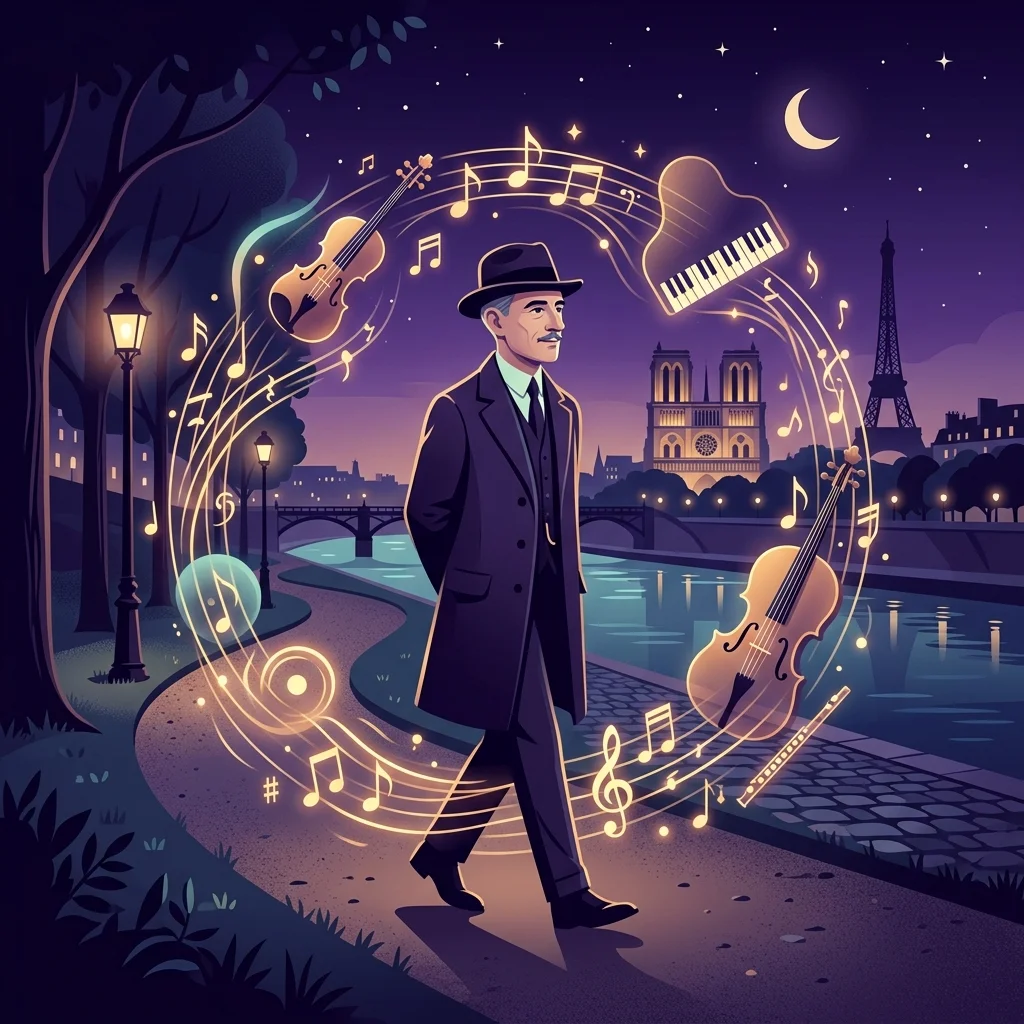
Maurice Ravel, the French master composer and 20th-century orchestration giant behind masterpieces like Boléro and Pavane for a Dead Princess. Known for crafting orchestral colors as delicate and precise as a fine jeweler, how did he perfect his finest musical inspirations on night streets without an instrument, piano, or sheet music in sight? 🎻
Every night, Ravel walked quiet trails along the outskirts of Paris and rural paths. Entirely within his mind, he simulated the precise textures, timbral blends, and volume balances of violins, oboes, flutes, and percussion. Stepping out under the quiet night sky where visual distractions faded, focusing purely on inner sounds to refine orchestral combinations—this ‘night timbre visualization training’ was the secret behind his perfectionist orchestral palette.
In today’s post, we explore the cognitive neuroscientific principles of auditory imagery and working memory integration embedded in Maurice Ravel’s night walk timbre visualization routine.
Historical & Academic Evidence
This content is based on Historical Records from Paris Conservatoire Archives (Letters) & Biography Ravel: His Life and Works by Alexis Roland, with Cognitive Neuroscience Research.
 BuildSelf
Inspired by historical greats? Make it your daily habit!
BuildSelf
Inspired by historical greats? Make it your daily habit!

















1. Neuroscience of Auditory Imagery and Auditory Cortex Integration
Mentally recalling detailed sound combinations during night walks under minimal visual stimulation directly activates the superior temporal gyrus and auditory cortex in the brain.
This training in auditory imagery—internalizing texture, timbre, and reverberation without physical auditory input—maximizes prefrontal working memory capacity and cognitive flexibility. It enables the mind to vividly construct and refine high-level creative ideas free from external noise or visual overload.
2. 3-Step Practical Routine for Modern Professionals
Step 1: Blocking External Stimuli in a Night Walking Environment
Turn off your smartphone during evening or night hours and walk quietly on low-stimulation paths to establish inner calm.
Step 2: Precise Mental Simulation of Ideas and Senses
Mentally picture the structure, tone, or fine details of your work, speech, or creative project with precision, like orchestrating an ensemble.
Step 3: Capturing and Documenting the Internalized Structure
After your walk, sit down and transcribe the mental structure you organized into text, outline, or concrete notes to solidify it.
3. Guide to Applying Internalized Simulation Routines to Modern Life
Avoid continuous exposure to external digital stimuli or visual media. The key is carving out quiet walks or commute times to mentally simulate the structure and fine details of your ideas in your mind.
📌 Frequently Asked Questions (FAQ)
Can non-musicians without perfect pitch apply this auditory imagery simulation? ▼
Absolutely. Beyond musical timbre, mentally simulating vocal tone for speeches, conversation flow in meetings, or spatial design in projects activates working memory and dramatically sharpens cognitive execution.
Why is a night walk more effective for mental simulation than walking during the day? ▼
Nighttime offers a quiet environment with minimal visual complexity and auditory noise. Reducing visual cortical load allows the brain to maximize internal processing in the auditory cortex and prefrontal executive networks.