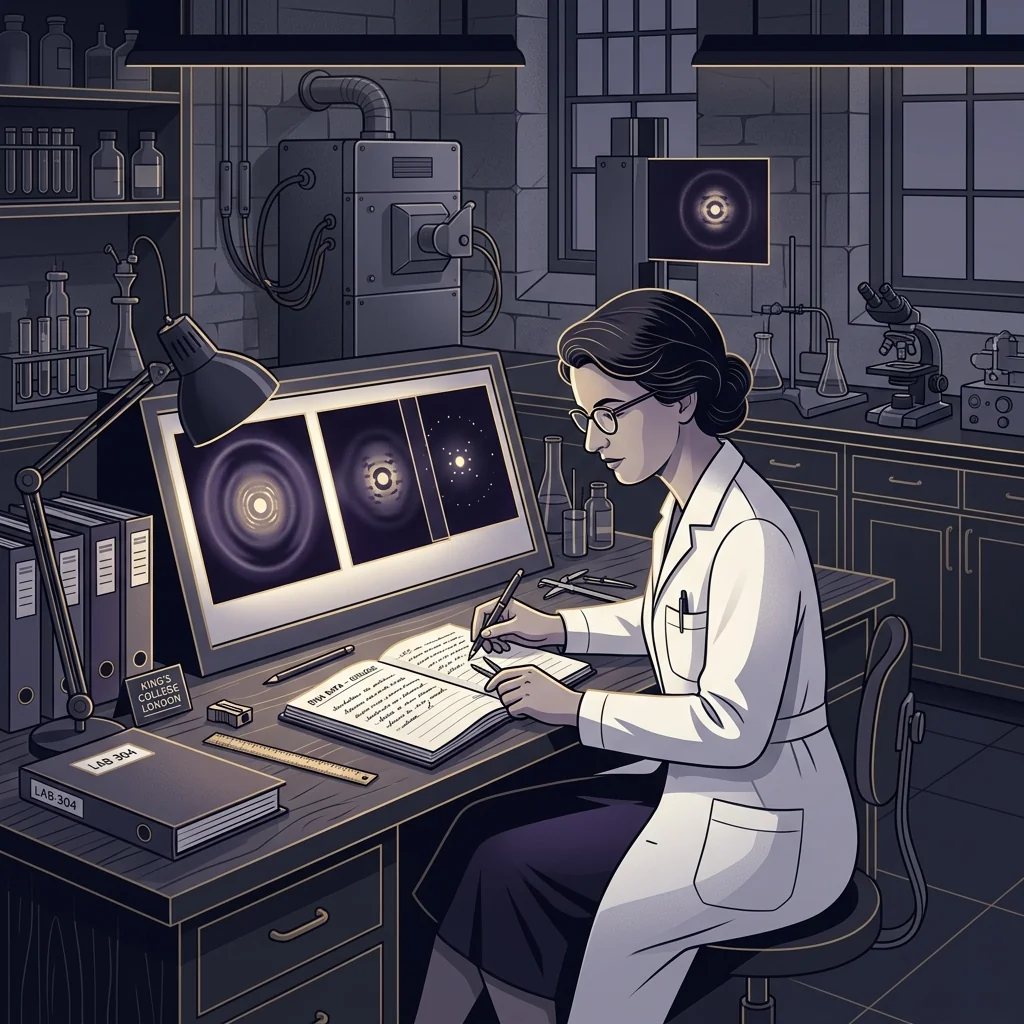
Rosalind Franklin (1920–1958) was a brilliant British physical chemist who captured ‘Photo 51’—the critical key to decoding the DNA double helix structure, regarded as one of the greatest scientific discoveries of the 20th century. Amidst severe prejudice and challenging research conditions, her experimental data permitted not even a 0.01% margin of error. 🧬
In a dimly lit basement laboratory at King’s College London, Franklin spent hundreds of hours adjusting the angle of an X-ray diffraction camera in precise 0.1-degree increments. She carefully cross-checked film measurement values against mathematical calculations by hand down to the micrometer level. Rejecting speculation and relying solely on rigorous empirical verification, her quantitative checking habit uncovered the gold particle that unlocked the secrets of life.
In this post, we explore Rosalind Franklin’s 0.1-degree precision checking routine and introduce a guide to strengthening parietal spatial cognition and ensuring 100% work quality.
Historical & Academic Evidence
This content is based on Historical Biography & Autobiographical Verification of Rosalind Franklin & Cognitive Neuroscience Research.
 BuildSelf
Inspired by historical greats? Make it your daily habit!
BuildSelf
Inspired by historical greats? Make it your daily habit!

















1. Blocking Cognitive Errors via Parietal Spatial Numerical Matching
When performing familiar tasks, the brain falls prey to heuristics (‘it’s probably fine’), easily overlooking critical typos or numerical errors.
Hand-checking values 1-to-1 against raw source data—like Franklin’s ‘Quantitative Data Micro-Matching’—simultaneously activates left-brain logic and parietal spatial cognition. This blocks premature cognitive assumptions and achieves near-zero error rates.
2. 3-Step Practical Routine for Modern Professionals
Secure a 10-Minute Precision Golden Window
Reserve the final 10 minutes right before submitting a report, deploying code, or finalizing a proposal strictly for error checking.
Perform 1-to-1 Physical Matching of Metrics and Numbers
Point with a pen or finger at each value or word on your screen, cross-checking 1-to-1 against raw source data.
Sign Off Check and Finalize Quality
After finishing the review, write 'Zero-Error Checked' or sign your notebook, wrapping up your task with absolute quality assurance.
3. Prioritize Certainty Over Speed in the Final Phase
Rushing at the last moment allows typos or calculation mistakes to ruin the credibility of your entire work. Slow down during the 10-minute check phase and focus entirely on thoroughness. Rather than relying solely on willpower, build environmental cues that make precision automatic.
📌 Frequently Asked Questions (FAQ)
Doesn't thoroughly checking every time take too much time? ▼
The time spent fixing typos, apologizing, and reworking errors later is 10 times greater. Spending 10 minutes checking upfront is ultimately the fastest route.
Can quantitative matching be applied to general text or non-scientific roles? ▼
Yes! Create a quantitative checklist focusing on 3 error-prone key elements (e.g., dates, spelling, attachment links, client names) and apply the exact same method.