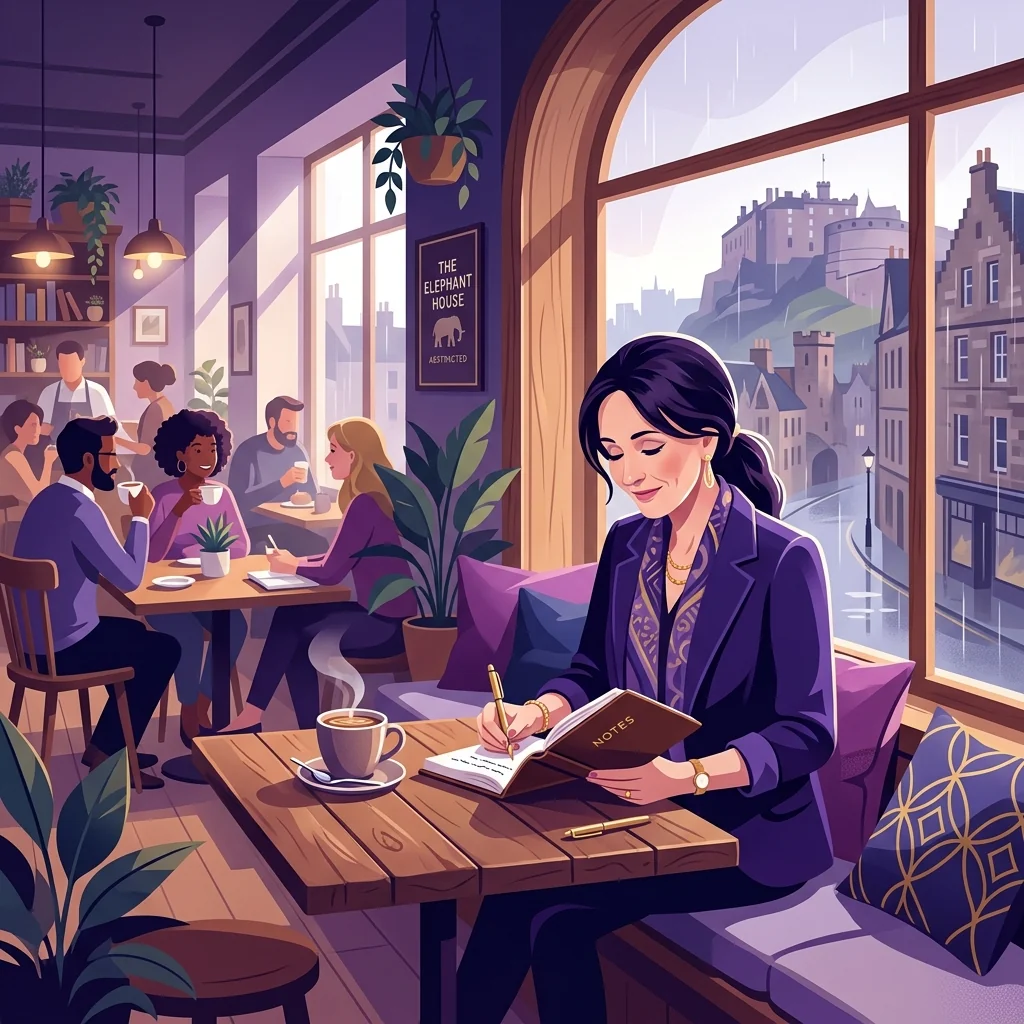
“The moderate noise and solitude of a café freed my brain, allowing me to imagine the world of wizards seamlessly.” ☕
J.K. Rowling invited hundreds of millions of readers into a world of magic, becoming the world’s first billionaire author and launching a global fantasy phenomenon. How did a struggling single mother in a modest Edinburgh flat craft the vast wizarding universe of Hogwarts so seamlessly?
To overcome the suffocating silence of her flat and the psychological pressure of financial uncertainty, Rowling pushed her daughter’s stroller to a neighborhood café (such as Nicolson’s Café and The Elephant House). Sitting in a corner filled with clinking teacups, gentle murmurs, and coffee machine hums, these ambient sounds served as an ideal ‘ambient noise’ that lowered hyper-arousal. Concealed within the noise, she felt secure and energized, expanding her imagination to write the opening lines of Harry Potter.
In this post, we explore the neuroscientific mechanisms behind J.K. Rowling’s café ambient noise routine and how modern individuals can harness it to boost creativity.
Historical & Academic Evidence
This content is based on Historical Biography & Autobiographical Verification of J.K. Rowling & Cognitive Neuroscience Research.
 BuildSelf
Inspired by historical greats? Make it your daily habit!
BuildSelf
Inspired by historical greats? Make it your daily habit!

















1. ‘Cognitive Disfluency’ Promoting Abstract Brain Activation
When engaging in creative tasks (brainstorming, writing, planning), many seek silent, enclosed spaces like study rooms, but this can backfire. Extreme silence applies subtle pressure, over-tightening attention filters and reducing mental flexibility.
Rowling’s routine illustrates the cognitive benefits of ~70 dB ambient noise. Studies from the University of Chicago show that moderate noise creates ‘Cognitive Disfluency’—a mild impediment to direct processing. In overcoming this minor distraction, the brain skips obsessive detail filtering and activates ‘Abstract Processing’, allowing macro-level, innovative connections to form fluidly.
2. 3-Step Practical Routine for Modern Professionals
Set Up an Ambient Noise Environment ( ~ 70 dB)
Find a quiet corner in a bustling local café, or play natural café chatter or rain white noise at ~70 dB through speakers if working from home.
Set Digital Isolation Within Auditory Shield
Mute your phone and display only your writing document or journal on screen. Allow the ambient noise to act as a comforting psychological boundary.
Unbound Imagination and Macro Thinking
With mild noise stimulation in the background, break free from granular details to expand macro architectures or storylines creatively.
3. Moderate Ambient Noise Opens the Doors of Thought
For Rowling, café chatter was not a distraction, but a cozy shield of noise that offset solitude and gently lubricated creative circuits. When your thoughts feel stuck in a silent room, head to a café or fill your room with ambient white noise.
📌 Frequently Asked Questions (FAQ)
Does listening to loud heavy metal or dance music produce the same effect? ▼
No. Music with lyrics or loud, patterned noise (>85 dB) invades working memory in the prefrontal cortex, causing fatigue and disrupting focus. Only unpredictable, lyric-free ambient noise triggers positive cognitive disfluency.
Is listening to ambient white noise through earphones in a quiet study room helpful? ▼
Yes. Playing white noise in a solitary room provides a mild distraction shield. Combining auditory white noise with occasional visual change (like the open view of a café) maximizes sensory diversity and creativity.