“Knowledge is not merely read; it truly becomes yours when categorized and organized by your own hand.” 📜
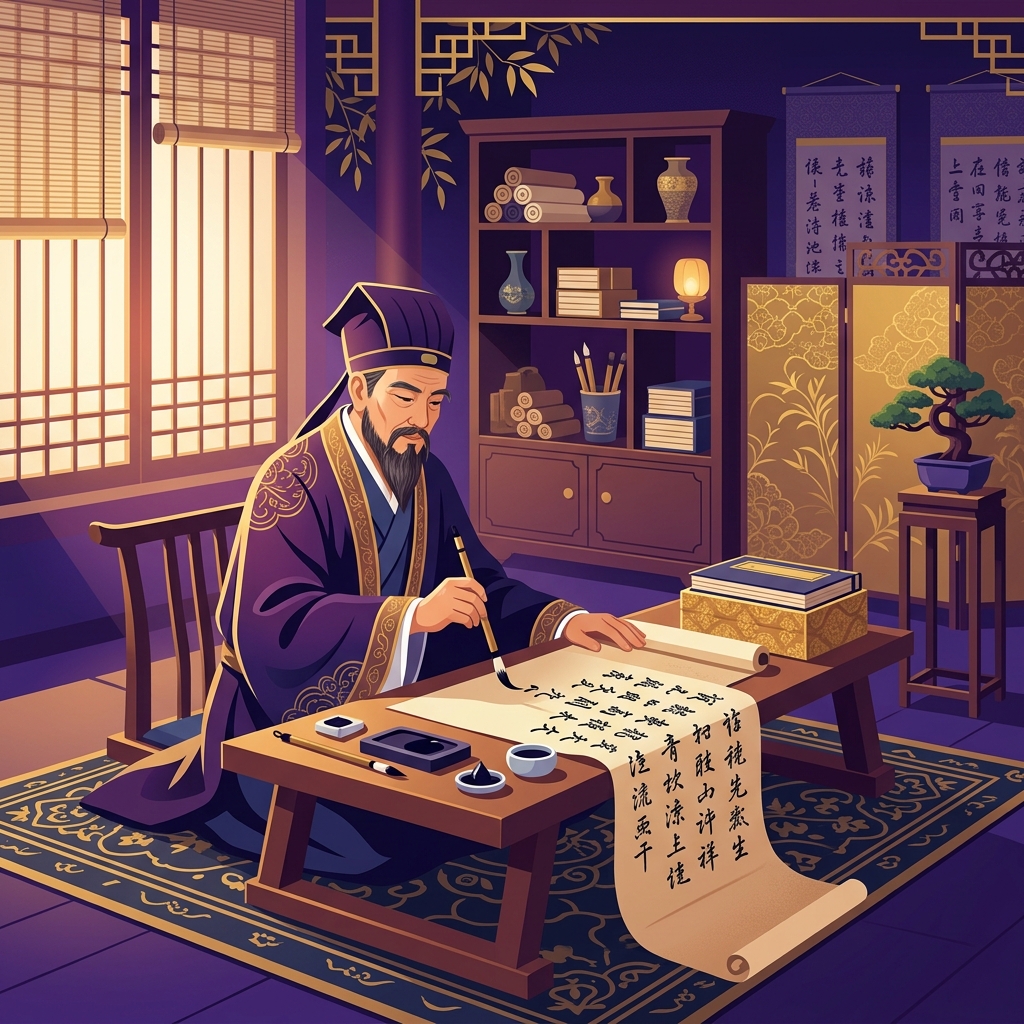
Su Dongpo (Su Shi), a monumental literary figure and statesman of the Northern Song Dynasty, left genius literary achievements across poetry, prose, calligraphy, and painting. The core intellectual bedrock supporting his vast erudition was none other than his ‘Choso copying method.’
When tackling massive amounts of history and scholarship, including the Seven Classics and official histories, Su Dongpo never read passively with his eyes alone. He categorized knowledge into thematic bins—such as ‘Politics,’ ‘Governance,’ ‘Goods,’ and ‘Geography’—opened his notebooks, and transcribed characters by hand across three cycles. Through this process, he constructed a precise ‘cognitive index’ (an intellectual search engine) in his mind, allowing him to retrieve knowledge from tens of thousands of volumes effortlessly.
In today’s post, we introduce the cognitive science principles of Chunking, Elaborative Rehearsal, and Long-Term Memory Consolidation embedded in Su Dongpo’s routine of thematic copying and 3-pass reviews.
Historical & Academic Evidence
This content is based on Official History 'Book of Song' () Vol. 338
 BuildSelf
Inspired by historical greats? Make it your daily habit!
BuildSelf
Inspired by historical greats? Make it your daily habit!














1. Powerful Cognitive Indexing Effects Created by Knowledge Chunking and Elaborative Rehearsal
When vast information is received in a disconnected state, the brain fails to process it and loses it. Categorizing knowledge into themes and writing it down by hand triggers neuroscientific mechanisms of ‘Chunking’ and ‘Elaborative Rehearsal’.
By grouping information into meaningful thematic units, the prefrontal cortex strongly connects new information to existing long-term memory structures. Repeatedly transcribing this by hand stimulates neural plasticity between the hippocampus and the cerebral cortex, perfecting a cognitive retrieval structure (Cognitive Indexing) that pulls up knowledge instantly when needed.
2. 3-Step Practical Routine for Modern Professionals
Categorize Learning Material into Thematic Bins (3–5 Categories)
Before reading vast materials or books, establish core thematic categories in advance (e.g., Core Concepts, Case Studies, Execution Strategies).
Transcribe Key Sentences Directly into Categorized Notebooks by Hand
As you read, classify important insights into designated category nodes and write them down meticulously by hand to build knowledge veins.
Review and Elevate Knowledge Structure via 3-Pass Multi-Cycle Re-Reading
Re-read and refine the categorized notes over spaced intervals across 3 cycles, solidifying the mental index network and fully converting it into long-term memory.
3. Avoid Mindless Transcription and Focus on Categorization and Understanding
The core of Su Dongpo’s Choso method is not blindly copying characters, but the rigorous classification work of deciding ‘into which category this knowledge belongs.’ Mechanical copying only induces finger fatigue without cognitive elaboration; focus deeply on understanding content structure and categorization.
📌 Frequently Asked Questions (FAQ)
Does tag-based organization in digital tools (Notion, Obsidian) yield the same effect as handwriting? ▼
Digital tagging is highly effective for knowledge indexing. However, handwriting simultaneously stimulates the brain's motor and somatosensory cortices, enhancing long-term memory consolidation and immersive focus. When using digital tools, summarize and categorize in your own words rather than simply copying and pasting.
What is a practical adaptation for modern individuals who lack time to copy vast amounts 3 times? ▼
You do not need to transcribe entire texts. Employ a 'selective Choso method' by picking only the most critical sentences and concepts from a book and transcribing them into a 3-to-5 category summary notebook, achieving powerful indexing effects in a short time.