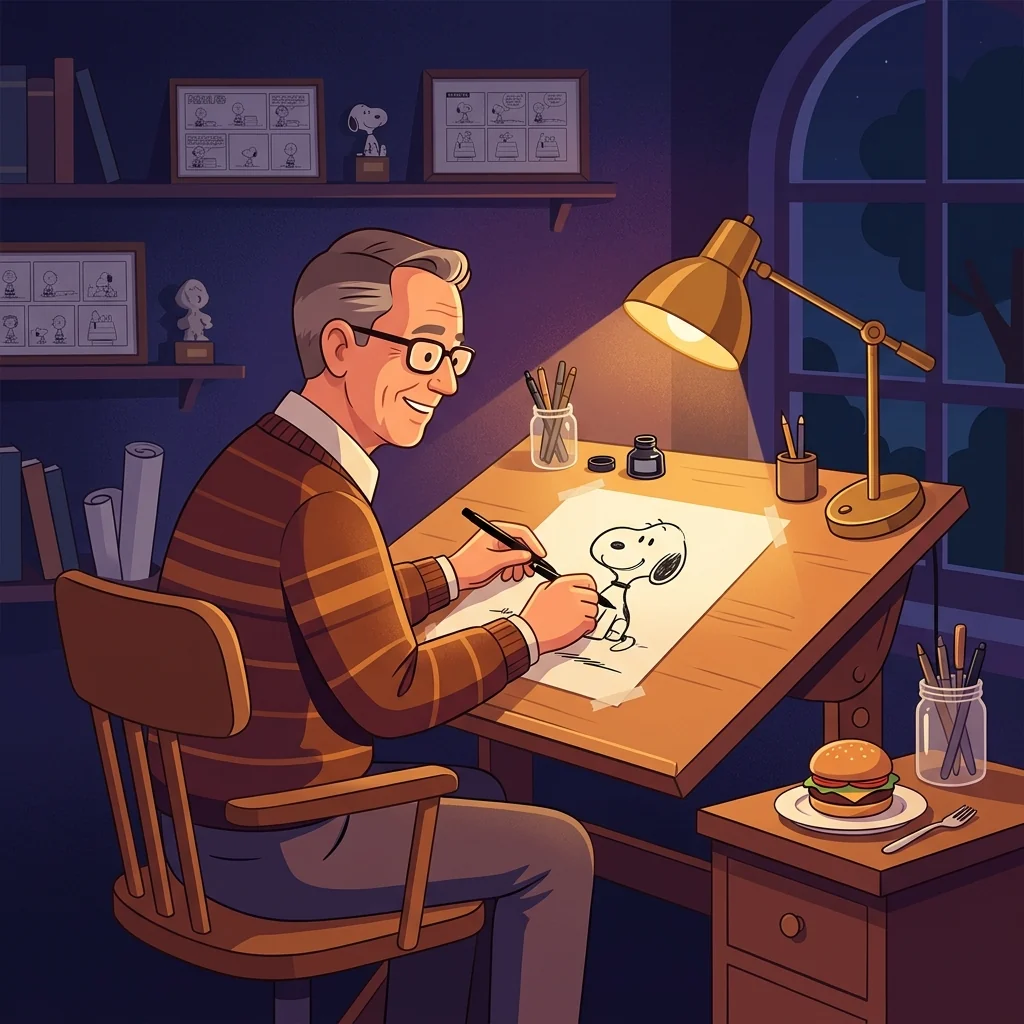
“I sit at my desk at 9 o’clock every morning and pick up my pen. And for lunch, I always eat a hamburger. Simplifying my daily life is the secret to maintaining my creativity.” 🍔
‘Peanuts’, the iconic syndicated comic strip capturing the daily lives of Snoopy and Charlie Brown, warmed the hearts of millions worldwide. Behind this masterpiece stood Charles M. Schulz, a true paragon of routine who handled planning, drawing, and inking entirely alone without a single assistant for 50 years. To preserve brain power amidst immense deadline pressures and creative strain, Schulz practiced a remarkably streamlined habit. He worked at the exact same desk from 9 AM to 4 PM every day, and for lunch, he ate the exact same hamburger next to his drawing board without wasting a second of decision-making. In this article, we examine how this single-meal routine protects analytical brain regions from a neuroscientific perspective.
Every day we make endless trivial decisions: what to wear, what to eat for lunch, which route to take. Yet the brain depletes finite neural resources on every choice no matter how minor, draining energy needed for complex logic and creative tasks.
In today’s post, we investigate how Charles Schulz’s decision-minimization routine prevents ego depletion and provide a 3-step actionable framework to eliminate minor decisions and maximize core focus.
Historical & Academic Evidence
This content is based on Historical biographies, autobiographical records of Schulz's hamburger routine & Cognitive Neuroscience research.
 BuildSelf
Inspired by historical greats? Make it your daily habit!
BuildSelf
Inspired by historical greats? Make it your daily habit!

















1. Preventing Ego Depletion and Preserving Prefrontal Energy
The prefrontal cortex is the brain center for planning, emotional control, and decision-making. Neuroscientific studies show that every decision—even picking a lunch menu—drains finite executive resources, a state called ‘Decision Fatigue’ or ‘Ego Depletion’. By fixing minor daily options like clothing and lunch beforehand as Schulz did, you completely block neural energy leakage on trivial matters and channel maximum cognitive power into core creative work.
2. 3-Step Practical Routine for Modern Professionals
Fix Non-Essential Life Elements in Advance
Define a daily work 'uniform' or pre-assign simple recurring lunch menus for each day of the week to eliminate morning decision friction.
Anchor Work Time and Space Consistently
Build the habit of sitting at the exact same desk at the same time every day, prompting the brain to enter 'work mode' instantly without draining willpower.
Deploy Preserved Cognitive Energy Into Core Deep Work
Direct the fresh focus saved by removing minor daily choices directly into your most critical strategic planning, design, or writing tasks first thing in the day.
3. Precautions and Tips
If you force routine too rigidly and eliminate 100% of variance, the brain may fall into rut and experience cognitive dullness. Therefore, apply decision automation strictly to non-essential areas (meals, clothing, environment), while keeping deliberate space for exploration and variance in creative tasks, hobbies, and leisure time.
📌 Frequently Asked Questions (FAQ)
Is eating the same lunch daily unhealthy? How can we modernize Schulz's habit? ▼
Schulz ate traditional hamburgers, but modern practitioners can substitute balanced 3-meal rotations or healthy salad subscriptions. The core objective is removing 'the decision process of picking what to eat'. Fixing 2 to 3 healthy, rotating menu choices preserves both nutritional health and cognitive energy.