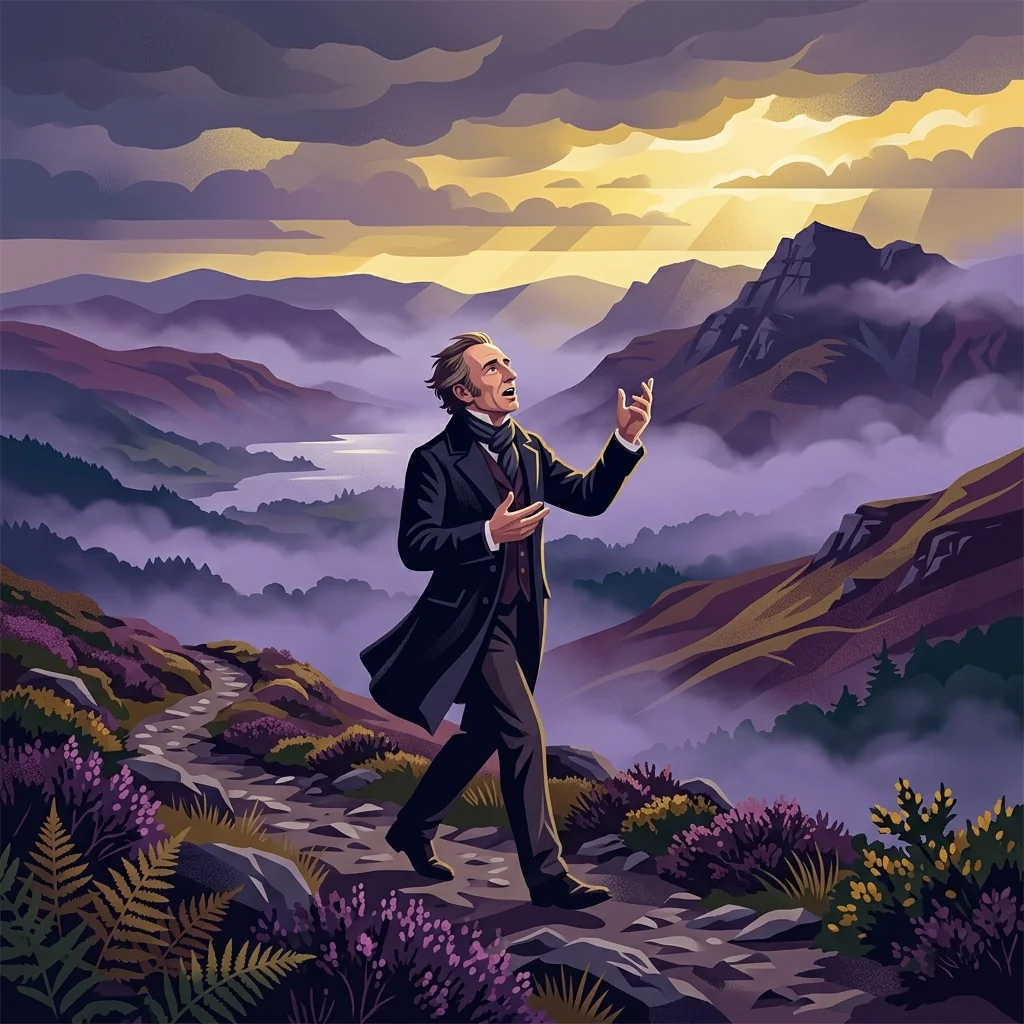
“Poetry is the spontaneous overflow of powerful feelings: it takes its origin from emotion recollected in tranquility.” 🚶♂️
William Wordsworth (1770–1850) was a giant of English literature who launched the Romantic Age alongside Samuel Taylor Coleridge with ‘Lyrical Ballads’ and served as Poet Laureate of the United Kingdom. His celebrated masterpieces such as ‘Daffodils’ (‘I Wandered Lonely as a Cloud’) and ‘The Rainbow’ were composed not at a dark desk, but to the rhythmic footsteps echoing along the mountain trails of the Lake District.
Wordsworth rarely sat still at a study desk when writing poetry. Whenever poetic ideas emerged, he walked tens of kilometers along the rugged paths of England’s Lake District. While walking, he didn’t just ponder silently; he recited emerging verses aloud to the trees and mountains. The steady cadence of his footsteps served as poetic meter, matching language to physical movement. His sister, Dorothy Wordsworth, noted in her journals that she could tell her brother was refining poetic rhythm just by listening to his footsteps and loud recitations from outside.
This post explores the neurological mechanisms behind William Wordsworth’s lifelong ‘walking recitation’ habit and explains how modern writers can leverage walking cadence to craft flowing prose.
Historical & Academic Evidence
This content is based on Historical records from William Wordsworth biographies & Cognitive Neuroscience research.
 BuildSelf
Inspired by historical greats? Make it your daily habit!
BuildSelf
Inspired by historical greats? Make it your daily habit!

















1. Synergy Between Rhythmic Walking and the Articulatory Auditory Loop
During walking, repetitive foot strikes generate rhythmic signals that strongly activate the Cerebellum, which regulates movement loops and timing. These motor-rhythm signals synchronize with cortical language regions, physically tuning sentence prosody and stress patterns.
Furthermore, reciting thoughts aloud engages the brain’s Phonological/Auditory Loop. Hearing one’s own voice provides real-time acoustic feedback, enabling the brain to instantly detect awkward phrasing or unnatural tone. Thus, instead of draining left-brain logic by writing passively on paper, Wordsworth tapped into motor-auditory integration to compose poetic masterpieces.
2. 3-Step Practical Routine for Modern Professionals
Loading Core Sentences and Changing Physical Space
Memorize 1–2 draft sentences or display them on your smartphone screen, then head out to a quiet hallway or trail suitable for walking.
Rhythmic Walking Recitation at a Steady Pace
Walk slowly at a steady pace of 1–1.5 steps per second, reciting the draft sentence clearly aloud, fitting breath and syllables to your cadence.
Refining Articulation and Entering Final Prose
If you stumble over words or feel awkward rhythm while reciting aloud, adjust to more natural words as you walk. Return to your desk and record the polished, smooth sentences into your document.
3. The Power of Reading Aloud
Relying purely on silent writing makes it hard to feel how text sounds to a reader, resulting in dry and stiff prose. When drafting speech scripts or presentation notes, walk around in a quiet space and recite them aloud to maximize impact and flow.
📌 Frequently Asked Questions (FAQ)
How did Wordsworth's sister Dorothy record his walking poetry composition method? ▼
In her journals, she wrote: 'William walked up and down the garden path hundreds of times this morning reciting poetry,' describing vividly how his walking speed varied in direct proportion to the tempo of his recitations.
Does walking and reciting on an indoor treadmill produce the same effect? ▼
Yes! Since the core physiological mechanism relies on systemic circulation from gait and cerebellar activation, walking slowly on a treadmill while reciting triggers the exact same brainwave synchronization and articulatory feedback.