“Cinema is not just about pictures; it is a visual language written with a camera.” 🎬
Martin Scorsese, revered as one of the greatest directors in world cinema history through masterpieces like Taxi Driver, Raging Bull, and Goodfellas. Where did his untiring creative fire and unmatched mastery of dynamic framing, rhythmic camera movement, and immersive storytelling originate? 🎥
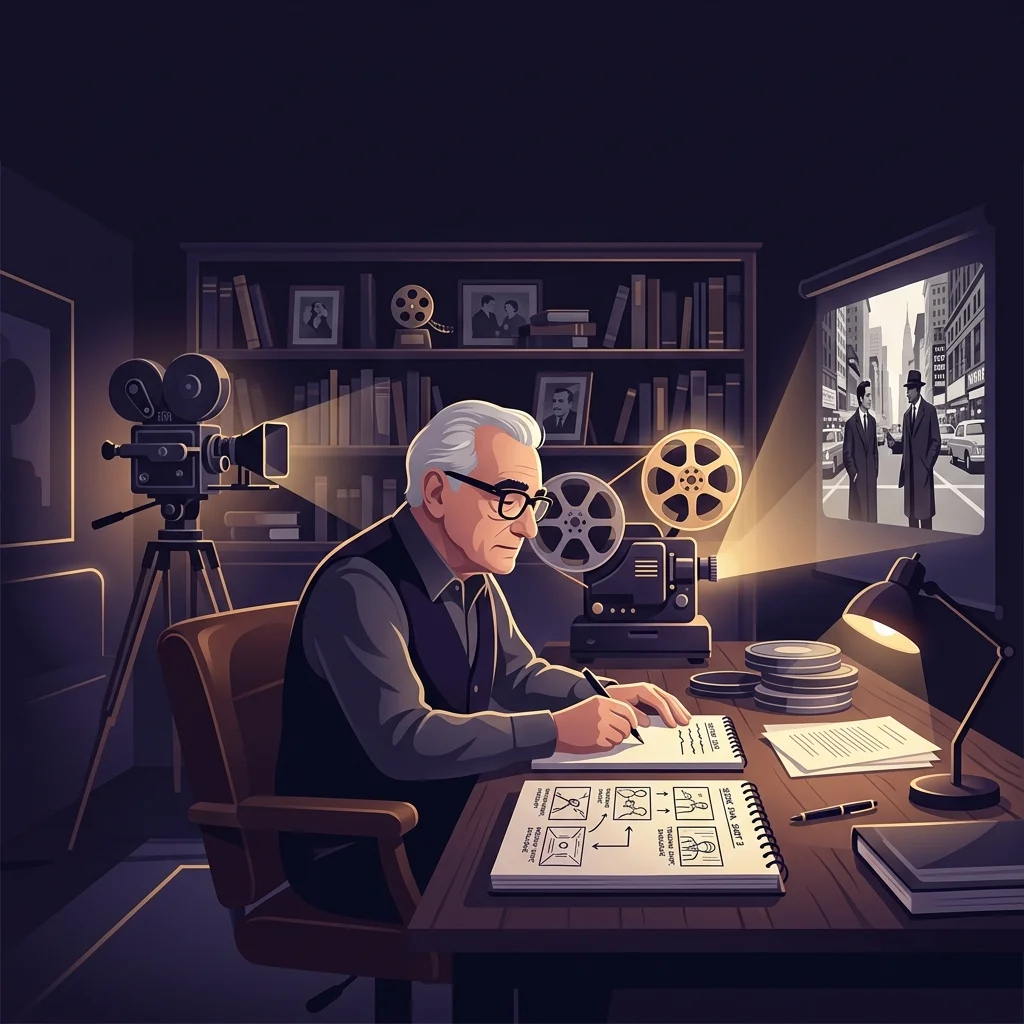
Every night, after completing his daily filmmaking duties and demanding shoots, Scorsese sat in his study to deeply analyze a classic film. Rather than passively watching, he opened his notebook to sketch camera setups, lighting nuances, and character blocking, meticulously compiling detailed shot lists. Deconstructing and reconstructing master cinematography line by line was his ultimate training routine for honing an unmatched visual sensibility.
In today’s post, we explore the cognitive neuroscientific principles of visuospatial sketchpad stimulation and perceptual schema construction embedded in Martin Scorsese’s nightly film analysis and shot list logging routine.
Historical & Academic Evidence
This content is based on Historical Records from American Film Institute (AFI) Archives, Scorsese on Scorsese (Faber & Faber), and Mary Pat Kelly's Martin Scorsese: A Journey with Cognitive Neuroscience Research.
 BuildSelf
Inspired by historical greats? Make it your daily habit!
BuildSelf
Inspired by historical greats? Make it your daily habit!

















1. Neuroscience of Visuospatial Sketchpad Activation and Perceptual Schema Construction
Deconstructing visual media into handwritten sketches and structural notes intensely activates the visuospatial sketchpad, a fundamental component of working memory.
This deliberate practice engages the mirror neuron system, allowing the brain to internalize complex directorial choices and spatial blocking. Over time, it constructs refined perceptual schemas deep within the brain, enabling creators to pull spontaneous, innovative framing and spatial dynamics during execution.
2. 3-Step Practical Routine for Modern Professionals
Step 1: Focused Observation of Benchmark Masterpieces
Dedicate 30–60 minutes at night to intently watch high-quality films, visual references, or creative benchmarks.
Step 2: Hand-Sketching Framing, Lighting & Shot Logging
Sketch camera angles, lighting shifts, and spatial blocking into simple grid diagrams and bulleted shot lists in a notebook.
Step 3: Extracting Directorial Intent & Archiving Creative Schemas
Reflect on why specific angles or lighting were chosen, saving these visual patterns into your personal creative mental library.
3. Guide to Applying Visual Deconstruction to Modern Creative Work
Avoid passive consumption of visual media. Select exceptional benchmark works and establish a deliberate observation system where you deconstruct camera movement, rhythm, and structure into actionable insights.
📌 Frequently Asked Questions (FAQ)
Can creators in non-film fields, such as designers or writers, benefit from shot list logging? ▼
Absolutely. Deconstructing visual or narrative structures into written diagrams enhances working memory and spatial reasoning, proving immensely valuable for designers, writers, architects, and marketers alike.
How can I maintain this habit if analyzing an entire movie every night feels overwhelming? ▼
You don't need to analyze a full feature film. Selecting a single 3-to-5-minute sequence or scene and spending 10–15 minutes deconstructing just 3–4 key shots is more than sufficient to trigger visuospatial prefrontal engagement.