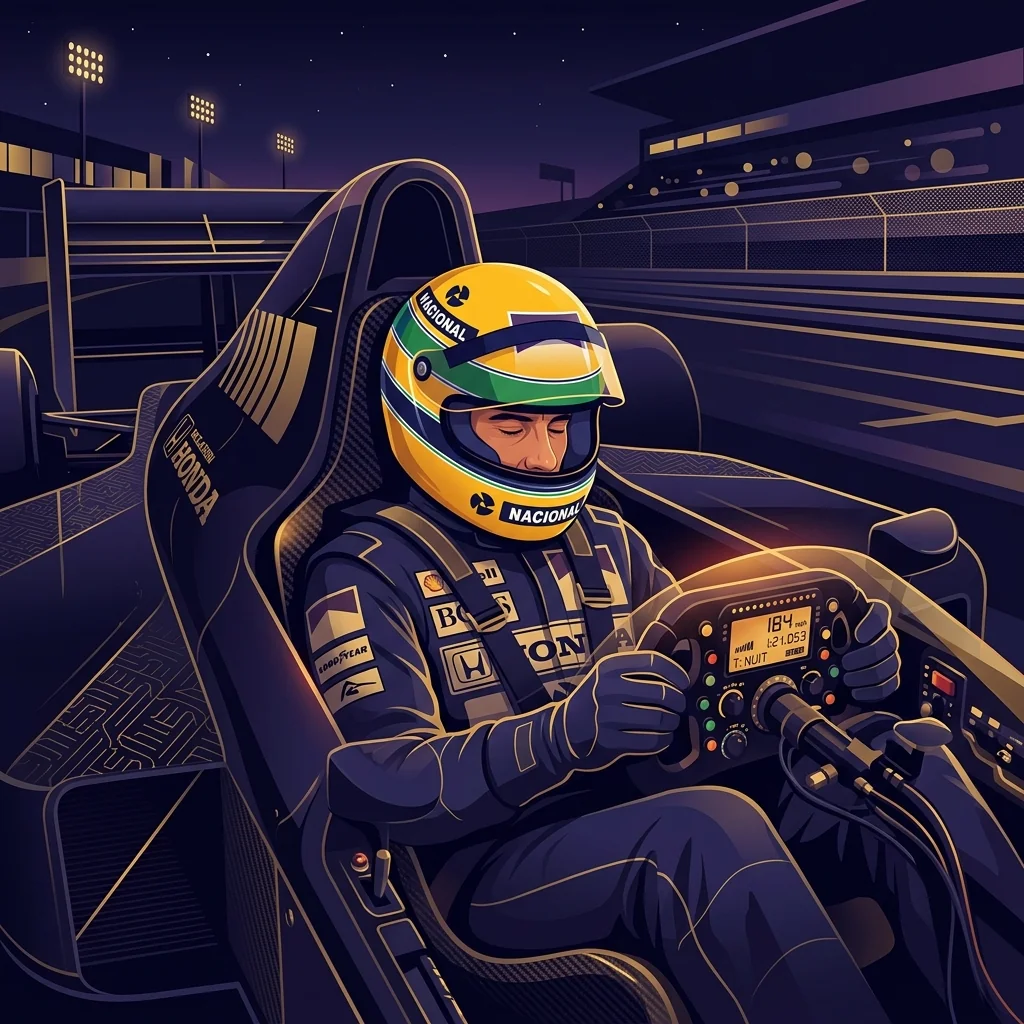
“I have already driven through that corner perfectly hundreds of times in my head. My body merely recreates that trajectory.”
Brazilian hero Ayrton Senna, revered as the fastest and most brilliant champion in Formula 1 history, claimed three World Championships with his exquisitely precise and daring driving at extreme speeds exceeding 300 km/h, where split-second decisions separate life from death.
Before starting the engine for any race, Senna performed a powerful secret ritual: ‘Pre-race Visualization Meditation’ inside his cockpit. Wearing his helmet, Senna closed his eyes and vividly simulated in 3D high definition every aspect of the upcoming circuit—the road surface texture, entry and exit angles for every corner, gear shift timings, and tire grip limits on wet tracks. Before touching the pedals, he had already completed a flawless drive in his mind.
Here we analyze the neurological mechanism behind Senna’s mental rehearsal and how to apply it before important presentations or execution tasks in daily life.
Historical & Academic Evidence
This content is based on Historical biographies of Ayrton Senna, F1 race records & Cognitive Neuroscience motor psychology studies.
 BuildSelf
Inspired by historical greats? Make it your daily habit!
BuildSelf
Inspired by historical greats? Make it your daily habit!

















1. Visual Simulation and Motor Neuron Activation in the Supplementary Motor Area (SMA)
Even without physically moving, imagining a motion in extreme detail (Mental Imagery) activates the brain’s Supplementary Motor Area (SMA) and primary motor cortex. Over 90% of the neuronal circuitry used during actual physical movement lights up during vivid visualization.
This mental rehearsal enhances neural signaling efficiency, shortening muscle response times and blocking reflex errors during actual execution. Furthermore, it prevents the autonomic nervous system from overreacting into fight-or-flight mode, stabilizing heart rate and maintaining calm alpha waves to conquer high-stress situations.
2. 3-Step Practical Routine for Modern Professionals
Block Visual Noise and Stabilize Breathing
10 minutes before an important performance, lean back in a quiet space or close your eyes, taking 3 deep abdominal breaths to calm your brainwaves.
First-Person 3D Simulation of the Process
From a first-person perspective, visualize the opening screen, first sentence, and initial gestures slowly in your mind like a detailed 3D movie.
Pre-input Contingency Handling Responses
Intentionally picture unexpected hiccups (e.g., stumbled words or tech glitches) and simulate remaining composure, taking a light breath, and smoothly executing the backup response.
3. Simulate the Process, Not Just the Outcome
A common mistake during mental simulation is imagining only the outcome (e.g., successful speech, winning). To activate the brain’s motor cortex and eliminate errors, you must simulate the causal process details (e.g., specific opening phrases, exactto tough questions). Only process visualization yields neuroplastic priming benefits.
📌 Frequently Asked Questions (FAQ)
What should I do if visual simulation increases my anxiety instead? ▼
Increased anxiety happens when the brain fixates on negative scenarios (failing). Stop visualizer practice immediately and perform sensory grounding—focusing on your breathing sound or the physical touch of your palm—followed by light stretching to relax your body first.
What is the recommended duration for each mental rehearsal session? ▼
A short, intense session of 3 to 5 minutes is most effective without needing lengthy practice. Working memory resources required for high focus are limited, so simulating only core steps 5 minutes before a speech or meeting is ideal.