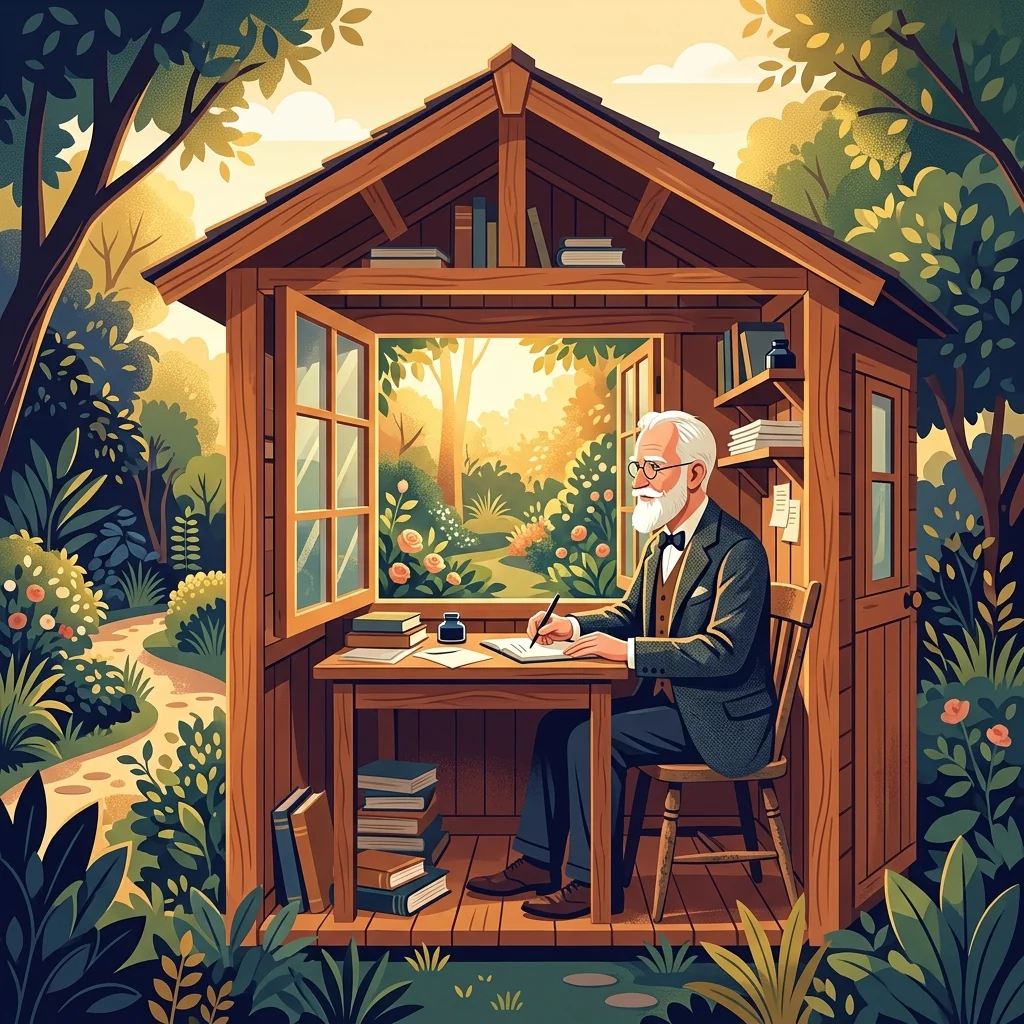
“I do not go far away to work. I merely enter a small, mysterious hut in my garden and close the door. That is entirely my own universe.” 🏠
George Bernard Shaw, the Nobel laureate playwright famous for works such as ‘Pygmalion’ and ‘Man and Superman’, captivated the world with his witty and biting prose, yet was obsessively rigorous when it came to writing. To completely block human interruption during work hours, he built a small wooden hut in a corner of his garden at Ayot St Lawrence. This hut featured a special mechanism mounted on a turntable that allowed it to rotate 360 degrees manually. As the sun moved across the sky, Shaw rotated the hut to bathe in rich, natural daylight all day long. He even instructed his secretary to tell callers he was away on business in London to evade visitors. In this article, we psychologically unpack his unique secret to focus, combining physical isolation with natural light.
Historical & Academic Evidence
This content is based on Historical biographies, autobiographical records of Shaw's rotating hut focus & Cognitive Neuroscience research.
 BuildSelf
Inspired by historical greats? Make it your daily habit!
BuildSelf
Inspired by historical greats? Make it your daily habit!

















1. Daylight Exposure and Minimizing Cognitive Switching Costs
Continuous exposure to natural daylight stimulates retinal ganglion cells, maximizing serotonin synthesis that drives alertness—an effect indoor artificial lighting cannot replicate. Furthermore, whenever the brain faces minor external interruptions (e.g., questions, knocks, phone chimes), it consumes substantial energy (switching costs) to realign working memory context. Placing the brain in a physically isolated environment like Shaw’s rotating hut eliminates external cognitive interference at the source, preventing working memory loss and allowing hours of sustained deep work.
2. 3-Step Practical Routine for Modern Professionals
Define Your Personal Focus Sanctuary (Shed)
Designate the quietest spot in your home or office with minimal foot traffic as your personal sanctuary. Space size does not matter; use room dividers or desk privacy panels to block peripheral visual distractions during work.
Enforce Digital Blocking and Commit to Focus Sessions
Place smartphones in another room or switch to Airplane Mode. Set a timer for 90 minutes (a natural ultradian rhythm for deep focus) and resolve not to answer messages or browse the web during this interval.
Position Your Desk to Maximize Natural Daylight
Arrange your desk near a window to receive full natural sunlight. Allowing sunlight into your field of vision early in the day boosts serotonin synthesis, energizing the brain for challenging long-term tasks.
3. Precautions and Tips
A key caveat when applying physical isolation is bringing smartphones and social media notifications into the isolated space. Even if physical blockades prevent external intruders, carrying digital distractions inside leaves the brain trapped in unconscious impulses to check notifications, triggering multitasking fatigue. Therefore, upon entering your focus zone, turn off all device notifications (Do Not Disturb) or work offline. True digital detox combined with physical isolation is necessary to experience the full benefit of the rotating hut effect.
📌 Frequently Asked Questions (FAQ)
What if I live in a one-room apartment or share space with family, making physical room isolation difficult? ▼
If physical wall separation is unavailable, build a 'virtual sound wall' using noise-canceling headphones with gentle white noise or classical music. Additionally, place a 'Do Not Disturb' sign on your desk or utilize early morning hours to secure 2 hours of undisturbed focus before others wake up.