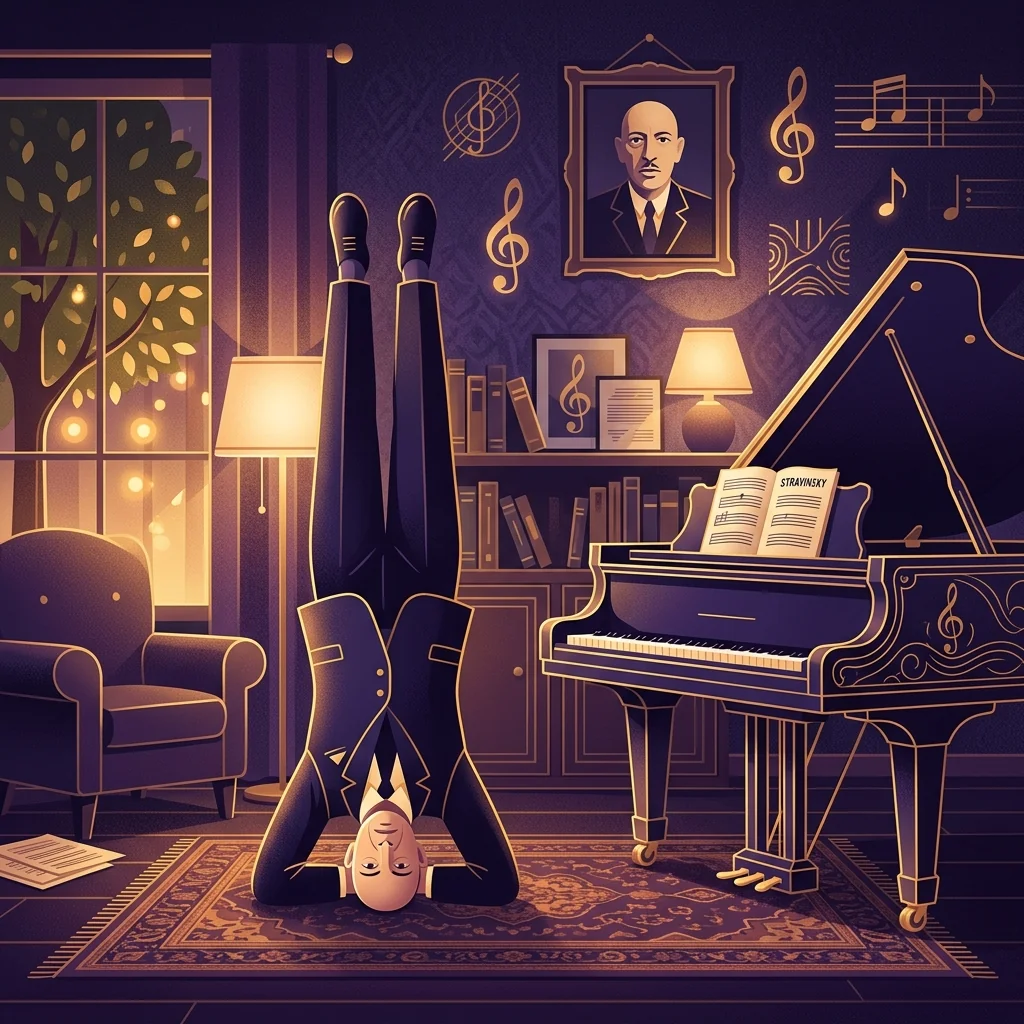
“When ideas stall, turn your head toward the floor. Your brain will immediately start thinking differently.” 🤸♂️
Igor Stravinsky (1882–1971), the Russian master composer who reshaped 20th-century classical music with avant-garde masterpieces such as ‘The Rite of Spring’, ‘The Firebird’, and ‘Petrushka’. Behind his astonishing musical experiments lay a unique physical routine: whenever inspiration ran dry or his head felt heavy while composing, he would immediately do a headstand in the open space beside his piano. He believed standing upside down awakened the brain and broke mental blockades.
While many artists sit passively during a slump, Stravinsky disrupted cognitive stagnation by physically inverting his body by 180 degrees. This headstand was not a mere eccentricity, but a sophisticated mechanism for delivering powerful physiological stimuli to the brain.
In this post, we uncover the mechanics of Stravinsky’s headstand routine and provide a safe 3-step guide for modern professionals to refresh their brains and unlock breakthroughs in just 1 minute.
Historical & Academic Evidence
This content is based on Historical Autobiography of Igor Stravinsky & Cognitive Neuroscience Studies.
 BuildSelf
Inspired by historical greats? Make it your daily habit!
BuildSelf
Inspired by historical greats? Make it your daily habit!

















1. How Headstands Reset Cerebral Blood Flow and Vestibular Senses
When your brain is stuck on a single thought, vertically inverting your posture triggers two neuroscientific changes: First, gravity directs increased blood flow to the head, delivering an immediate rush of oxygen and nutrients to the frontal lobe. Second, the inner ear’s vestibular system detects an unfamiliar gravitational signal, awakening spatial orientation networks in the cerebellum and cerebral cortex. This releases rigid attention filters and encourages creative association.
2. 3-Step Practical Routine for Modern Professionals
Step 1: Prepare a Safe Inversion Environment & Mat
Clear space along an empty wall free from obstacles and place a thick yoga mat or cushion on the floor to protect your head.
Step 2: Short-Duration Wall Headstand Execution
Place your hands on the floor and lean your feet or back against the wall to stand upside down. Maintain this position for 30 to 60 seconds while taking deep abdominal breaths.
Step 3: Slow Recovery & Observation of Cognitive Shift
Carefully lower your feet and lie prone for 30 seconds instead of standing up immediately. Then sit on a chair and focus on the feeling of mental clarity and shifted perspective.
3. Precautions & Tips
If you have neck or blood pressure issues, substitute a full headstand with a gentle half-inversion, such as resting your legs on a chair or wall. Keep the duration under 1 minute so cerebral blood pressure can adapt, and after finishing, lie prone for 30 seconds before slowly standing up.
📌 Frequently Asked Questions (FAQ)
What should beginners who cannot do a headstand at all do? ▼
Even if you cannot lean against a wall, simply adopting a Dolphin Pose (lifting hips toward the ceiling on a mat) or elevating your legs on a bed/chair while bending your upper body downward provides the exact same benefits: increased frontal lobe blood flow and vestibular stimulation.