“He who examines every morning the boundaries he set for himself will not be swayed by daily impulses and can fully govern his own life.” 📜
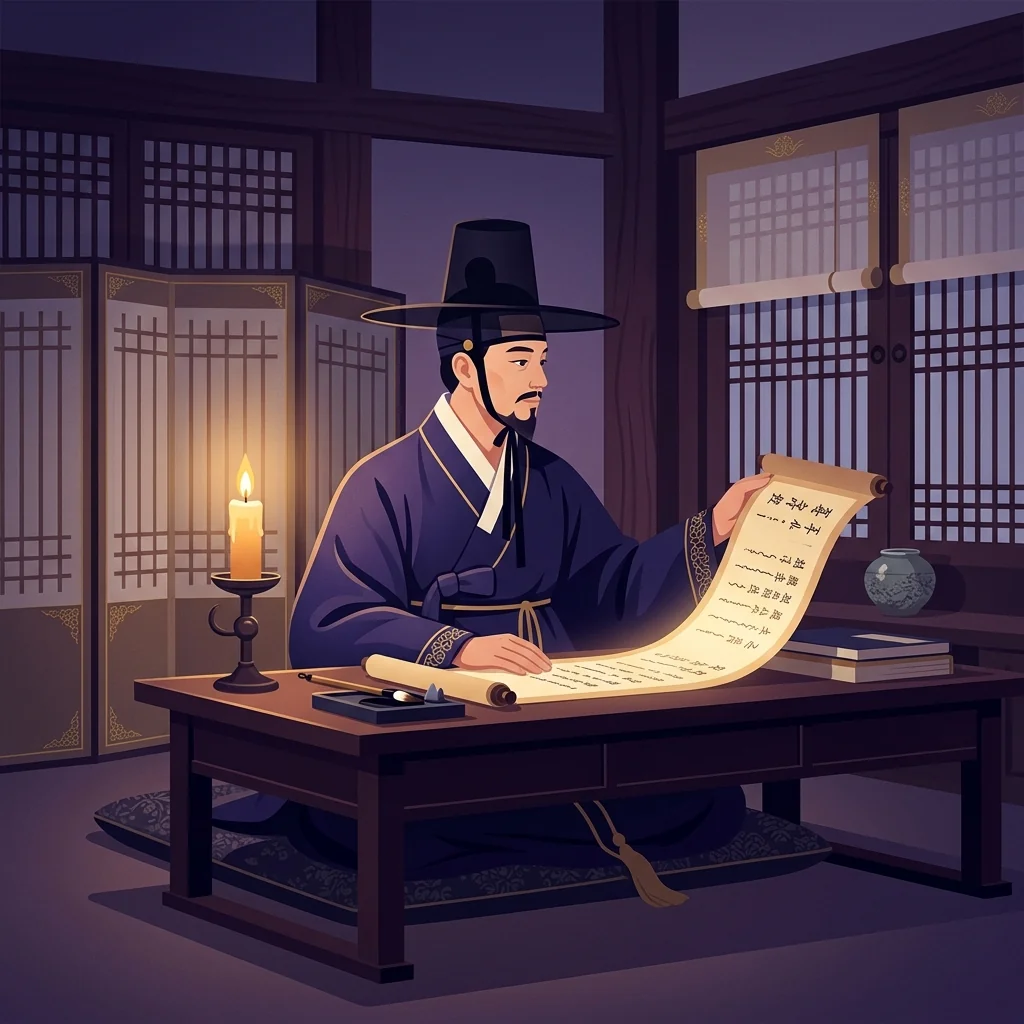
Yi I (Yulgok) was a paramount Neo-Confucian scholar and statesman during the Joseon Dynasty. Known as ‘Gudo Jangwon-gong’ for placing first in nine state civil service examinations, he dedicated his life to reforming state governance. Behind his monumental academic and political achievements lay ‘Jagyeongmun’ (Self-Warning Text)—a personal manifesto and rigorous behavioral code he wrote at age 20 to end his period of wandering after the death of his mother, Shin Saimdang. Yi I recited these self-imposed moral and practical rules every morning throughout his life.
While many modern individuals set morning goals, they quickly forget them when faced with immediate distractions. Rather than obeying rules enforced by others, Yi I conducted a daily ritual of instilling self-defined rules into his mind. Neuroscientifically, this daily declaration activates the prefrontal planning network, maintaining peak cognitive control. This post analyzes the self-reference effect and willpower control behind Yi I’s Jagyeongmun routine, offering a 3-step modern practice guide.
Historical & Academic Evidence
This content is based on Historical Biographies & Autobiographical Records of Yi I's Self-Warning & Cognitive Neuroscience Research.
 BuildSelf
Inspired by historical greats? Make it your daily habit!
BuildSelf
Inspired by historical greats? Make it your daily habit!
















1. The Brain Science of the Self-Reference Effect and Goal-Directed Declarations
In neuroscience, the Self-Reference Effect describes how processing information in relation to oneself activates the medial prefrontal cortex (mPFC), leading to stronger long-term memory and value internalization. Yi I’s daily reading of his self-imposed rules continually reinforced this neural pathway. Instilling these principles into the brain every morning activates cognitive control networks, serving as an internal GPS to manage impulses and align decisions with long-term goals.
2. 3-Step Practical Routine for Modern Professionals
Draft Your Personal Code of Conduct (Jagyeongmun)
Write down 3 to 5 clear and specific core rules for personal cultivation (e.g., focus, time management, attitude) using your own language.
Read Silently or Declare as Your First Morning Routine
Immediately upon waking and before checking digital devices, slowly read through your written principles or recite them quietly to set your mindset for the day.
Evening Reflection & Feedback Recording
Before bed, briefly reflect on how well you followed your morning declaration. Record 1 or 2 lines in a journal or app regarding areas for tomorrow's improvement.
3. A Word on Self-Vigilance and Preserving Autonomy
More important than setting principles is the honesty of reminding yourself of them every morning. Only standards you personally agree with and declare—not rules imposed by others—will powerfully motivate your brain and give you control over your day.
📌 Frequently Asked Questions (FAQ)
What kind of content is most effective to include in Jagyeongmun? ▼
Focusing on personal weaknesses you struggle to control (e.g., limiting smartphone use, punctuality) written as specific, action-oriented positive statements provides the clearest neural stimulation.