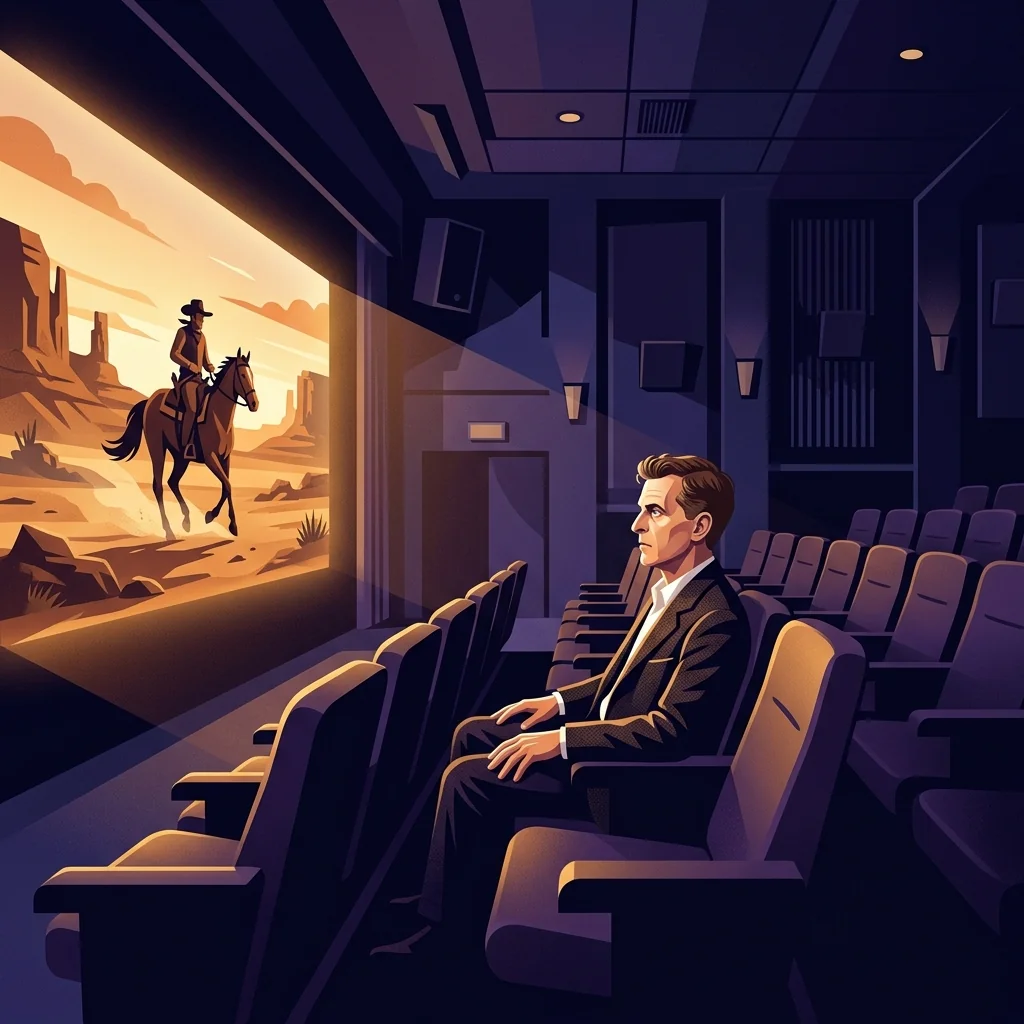
“When philosophical research makes me feel insane, the simplicity of American Westerns faced in the front row of a cinema is the only elixir that revives my brain.” 🤠
Ludwig Wittgenstein (1889–1951) was an Austrian-British genius philosopher who reshaped 20th-century logic and analytic philosophy, astonishing Bertrand Russell and Gottlob Frege. Authoring landmark works at Cambridge such as ‘Tractatus Logico-Philosophicus’ and ‘Philosophical Investigations’, he pushed the boundaries of language and thought, suffering extreme mental burnout and cognitive exhaustion in the process.
To overcome this destructive cognitive overheating, Wittgenstein adhered to a strict evening routine during his Cambridge years. The moment his intense research ended, he rushed to a local cinema, sat in the very front row, and stared intently at simple American Western cowboy films. From a brain science perspective, this post explores how intense yet straightforward visual immersion completely cools down an exhausted prefrontal cortex.
After intense work, modern people often suffer ‘brain fog’. Many lie in bed attempting to rest while scrolling through social media or falling into anxious rumination. However, trying not to think actually triggers random thoughts that continuously drain prefrontal energy. To give the brain a clear ‘stop signal’, an artificial and compelling alternative visual stimulus is required.
This post analyzes how Wittgenstein’s Western movie detox routine resets brain stress and provides a 3-step action plan to block information overload and restore peak cognitive performance.
Historical & Academic Evidence
This content is based on Historical records from Ludwig Wittgenstein biographies & Cognitive Neuroscience research.
 BuildSelf
Inspired by historical greats? Make it your daily habit!
BuildSelf
Inspired by historical greats? Make it your daily habit!

















1. Brain Circuit Reset and Incubation via Forced Attention Redirection
When our prefrontal cortex focuses obstinately on a complex subject for extended periods, it suffers cognitive fatigue from information overload. Even if we try to passively rest, unconscious rumination circles in our minds. Wittgenstein’s front-row Western movie routine achieves ‘forced attention redirection’ via a strong alternative stimulus. By occupying vision and hearing with simple, dynamic screens, prefrontal analytical circuits shut off, allowing the Default Mode Network (DMN) to activate. During this incubation period, the unconscious mind reorganizes complex problems, often yielding unexpected breakthroughs.
2. 3-Step Practical Routine for Modern Professionals
Setting Up Visually Immersive Relaxation Environment
Turn off lights and sit before a large screen or TV, filling your field of vision to create a highly immersive relaxation space.
Selecting Simple, Low-Cognitive Content
Choose straightforward action movies, lighthearted popcorn films, or peaceful nature documentaries with no plot twists.
Halting Analytical Thinking and Sleeping Immediately After Viewing
Refrain from critically evaluating the plot, simply let your gaze follow the moving images for 30–60 minutes to reset, then immediately go to sleep without engaging in further mental stimulation.
3. Cautions and Tips
When choosing media for brain detox, avoid mind-bending thrillers, complex art films, or heavy tragedies that impose additional cognitive loads. Media requiring plot analysis or emotional judgment drains cognitive energy. Choose straightforward content like light action films, simple good-vs-evil storylines, or nature documentaries that require no analytical effort.
📌 Frequently Asked Questions (FAQ)
Does endlessly watching smartphone Shorts or Reels after work produce a similar brain reset effect as Wittgenstein's routine? ▼
No, absolutely not. Short-form videos flood the brain with entirely new, novel stimuli every few seconds. Every swipe triggers dopamine spikes and forces rapid contextual re-evaluations, making brainwaves more scattered. The core of Wittgenstein's routine is immersing in continuous, slow, simple stimuli to pause cognitive processing. Rapid short-form media exhausts the brain rather than resting it.