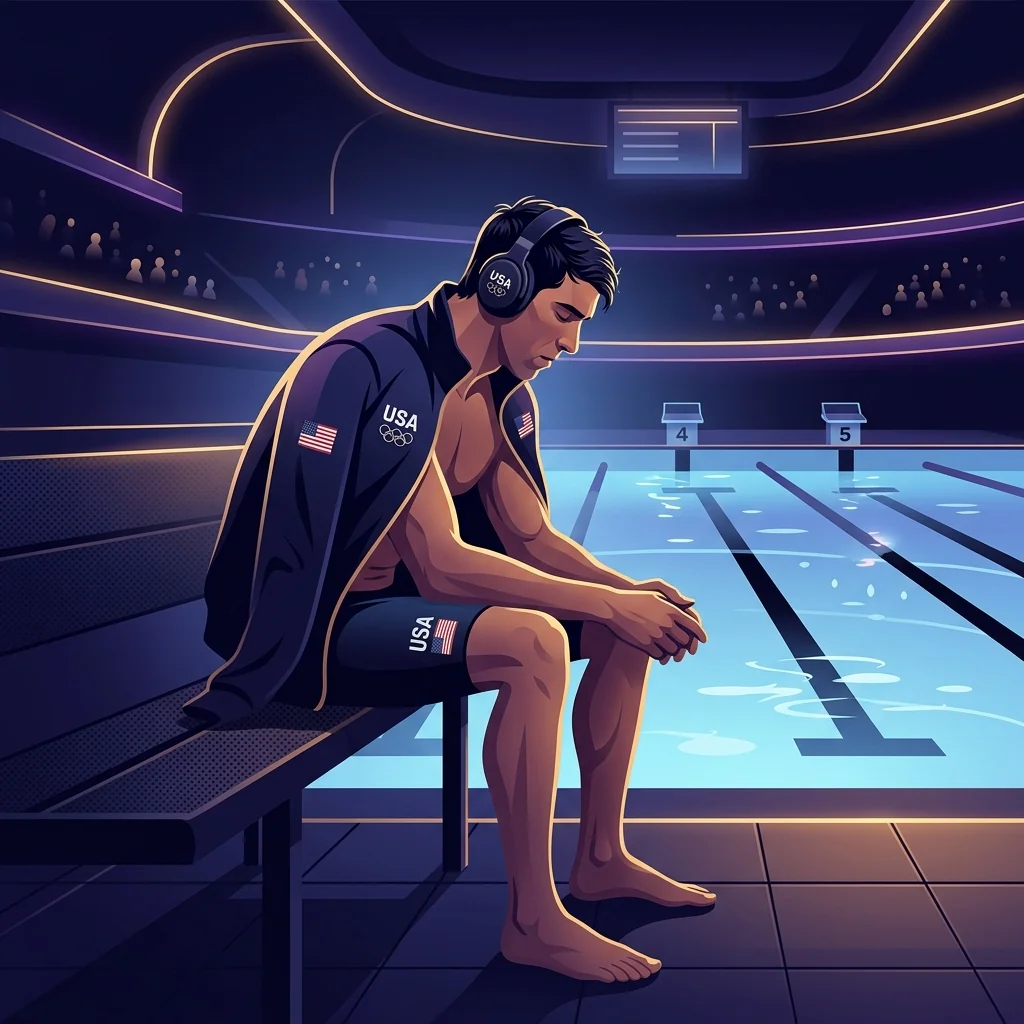
“Before I stepped into the water, I had already swum a flawless race countless times in my mind.” 🏊♂️
Michael Phelps (born 1985), the most decorated Olympian of all time with an unparalleled 28 medals (23 gold), often dubbed the ‘G.O.A.T. of Swimming’. Even before the high-stakes starting blocks facing the world’s elite swimmers, he maintained an astonishingly cool and calm sense of control.
Behind his flawless mental fortitude was a hyper-precise behavioral routine developed with coach Bob Bowman that unfolded without a second of error starting exactly 2 hours before race time. Arriving 2 hours prior, Phelps listened to music through the exact same headphones, completed a precise 45-minute warm-up swim, stretched joints in an invariant sequence, put on his swimsuit, and stepped onto the block. Paired with intense mental rehearsal visualising every stroke, this completely mastered extreme stress.
In this post, we explore the neuroscientific mechanisms behind Michael Phelps’ ‘2-Hour Pre-Race Hyper-Cognitive Routine’ and present a 3-step practical framework for modern individuals to eliminate anxiety before major presentations, interviews, or high-stakes challenges.
Historical & Academic Evidence
This content is based on Historical biography and autobiographical records verification of Michael Phelps & Cognitive Neuroscience research.
 BuildSelf
Inspired by historical greats? Make it your daily habit!
BuildSelf
Inspired by historical greats? Make it your daily habit!

















1. The Science of How Ultra-Precise Pre-Routines Calm Brain Anxiety
Before a competition or presentation, the most dangerous state for the brain is ‘uncertainty’ and its accompanying anxiety. In unpredictable environments, the brain’s emotional alert center, the amygdala, overheats and floods the body with stress hormones. However, executing a fully controllable set of physical actions repeated over a hundred times leads the brain to perceive it has full control, reducing amygdala hyperactivity and optimizing adrenaline secretion.
2. 3-Step Practical Routine for Modern Professionals
Establish a Fixed Time Block Before Entering the Event
Block out 30 minutes to 2 hours before a major competition, presentation, or exam strictly as your personal isolated time.
Execute Sensory Isolation and Mechanical Routines
Listen to specific music via noise-canceling headphones or carry out designated joint stretches in precise sequence without a second of deviation.
Mind Rehearsal and Entering Amygdala Stabilization
After physical routines, mentally visualize a flawless success scenario for the upcoming event to soothe anxiety centers and reach complete readiness.
3. Precautions and Tips
Please note that this routine is not a superstition or magic charm. Michael Phelps built strong synaptic connections between his routine and physical relaxation through long-term mechanical training and repetition. Therefore, do not be disheartened if it fails initially; consistent practice is essential to solidify your personal routine.
📌 Frequently Asked Questions (FAQ)
What happens if a step in the routine is accidentally skipped? ▼
The brain may react hypersensitively to unexpected deviations, temporarily increasing anxiety. In such cases, smoothly restart from the beginning or flexibly move on to the next attempt.