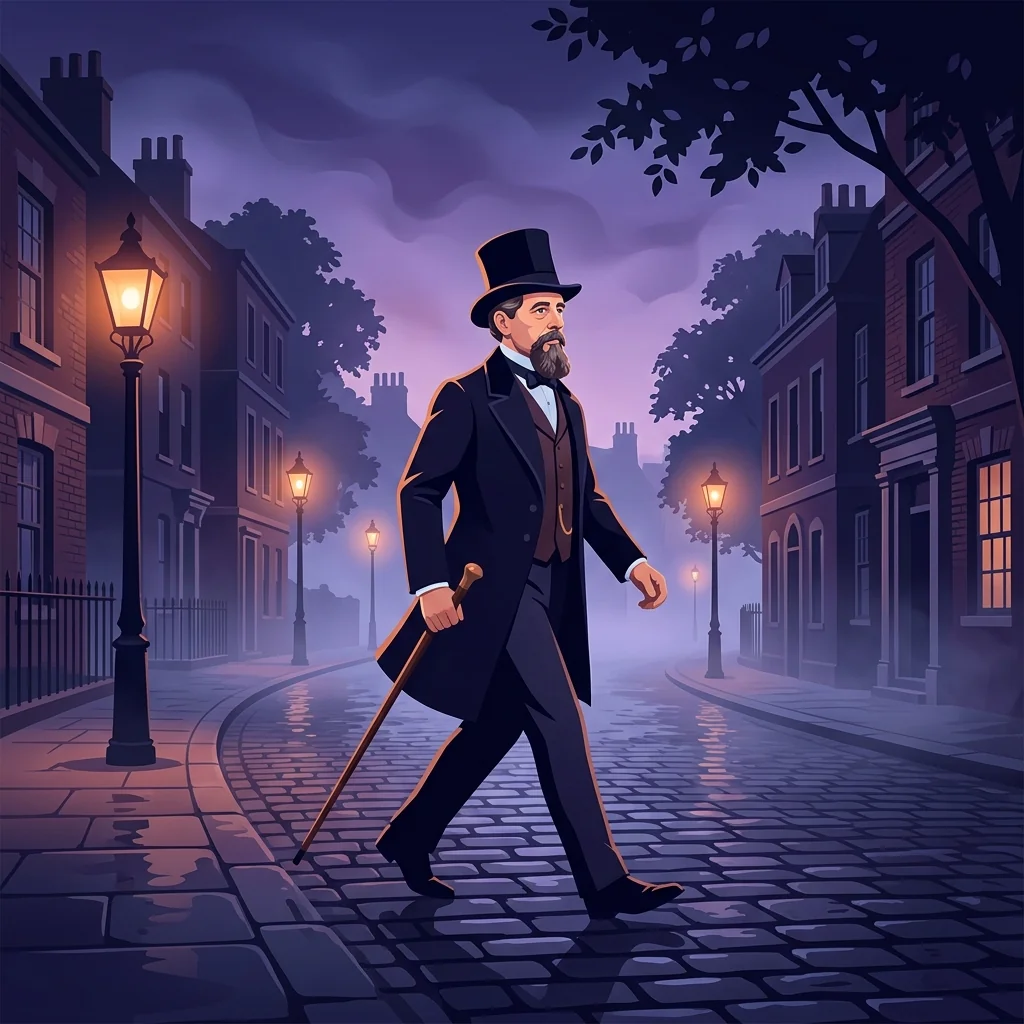
“If I couldn’t walk fast and far, I should just explode and perish.” 🚶♂️
Charles Dickens (1812–1870) was the literary titan of Victorian England whose iconic works—such as ‘Oliver Twist’, ‘Great Expectations’, and ‘A Christmas Carol’—captivated readers worldwide. How did he conceive hundreds of vivid, multi-dimensional characters and intricately woven narrative arcs?
His core creative engine was an unyielding daily 3-hour afternoon walk. After finishing an intense 5-hour writing session at 2:00 PM, Dickens immediately stepped outside. For exactly three hours, he covered up to 12 miles (about 20 km) at an exceptionally fast pace. Walking through London’s crowded slums or Kent’s quiet forests, he organized chaotic dialogue and plot connections in his mind. For Dickens, walking was far more than physical exercise; it was an essential neuro-restorative mechanism that cooled down an overheated brain and distilled raw imagination into structured literary masterpieces.
In today’s post, we analyze the brain science underlying Charles Dickens’s ‘3-hour afternoon walk’ routine and present a 3-step practical guide for modern professionals to flush cognitive fatigue and elevate creative thinking.
Historical & Academic Evidence
This content is based on Historical Verification from John Forster's Biography *The Life of Charles Dickens* & Cognitive Neuroscience Research.
 BuildSelf
Inspired by historical greats? Make it your daily habit!
BuildSelf
Inspired by historical greats? Make it your daily habit!

















1. Catalyst for Divergent Thinking: DMN Activation and BDNF Secretion via Stimulus-Free Walking
Rhythmic aerobic walking significantly boosts cerebral blood flow and triggers the release of Brain-Derived Neurotrophic Factor (BDNF), enhancing neuroplasticity and fostering Divergent Thinking. Crucially, walking without external sensory distractions—such as smartphones or audio inputs, as Dickens practiced—strongly recruits the Default Mode Network (DMN). Operating when the brain is disengaged from focused task execution, the DMN spontaneously reorganizes fragmented memory traces and morning ideas, fusing them into novel creative breakthroughs. A dedicated afternoon walk clears working memory (RAM) fatigue, restoring prefrontal executive resources for optimal mental clarity.
2. 3-Step Practical Routine for Modern Professionals
Step 1: Blocking Dedicated Afternoon Walk Time & Heading Outdoors
Block 20 minutes to 1 hour for an outdoor walk between 2:00 PM and 4:00 PM when post-lunch cognitive fatigue peaks. Put on walking shoes and step outside.
Step 2: Completely Blocking Smartphone Screens & Audio Stimuli
Store your smartphone deep inside a pocket or bag. Remove earphones and eliminate all incoming linguistic or auditory streams (music, podcasts, news) to create a sensory vacuum.
Step 3: Contemplative Walking & Capturing Emergent Insights
Anchor your attention loosely on the physical rhythm of your steps and ambient scenery. When DMN activation surfaces a breakthrough idea or solution, record the core keyword within 5 seconds in a mini notebook or voice memo.
3. Caution & Tips: Isolating Digital Stimuli & Creating Sensory Vacuum
The foundation of a thinking walk is granting your brain an ‘uninterrupted cognitive pause’. Checking your smartphone, scrolling feeds, or listening to podcasts/music while walking forces the prefrontal cortex to process external information, shutting down DMN activation and diminishing BDNF benefits. To clear your brain like Dickens, disconnect from earphones and store smartphones away for even 20 to 30 minutes, allowing your senses to rest on physical walking rhythms and environmental surroundings.
📌 Frequently Asked Questions (FAQ)
Is it acceptable to listen to calm classical music on my smartphone while walking? ▼
No, it is significantly better to avoid audio completely. Auditory input—even calm music or podcasts—forces the auditory cortex and executive networks to continuously analyze sound patterns, suppressing full DMN engagement. To achieve total cognitive reset, remove earphones and let your mind wander amidst natural ambient sounds.
It is unrealistic for busy modern professionals to walk 3 hours daily like Dickens. Is there a practical alternative? ▼
Yes, absolutely. The core mechanism is not the 3-hour duration, but 'stimulus-free, solitary aerobic walking'. Walking briskly for just 20 to 30 minutes after lunch or during a commute—without checking your smartphone—triggers DMN activation and releases BDNF, delivering a complete cognitive reset.