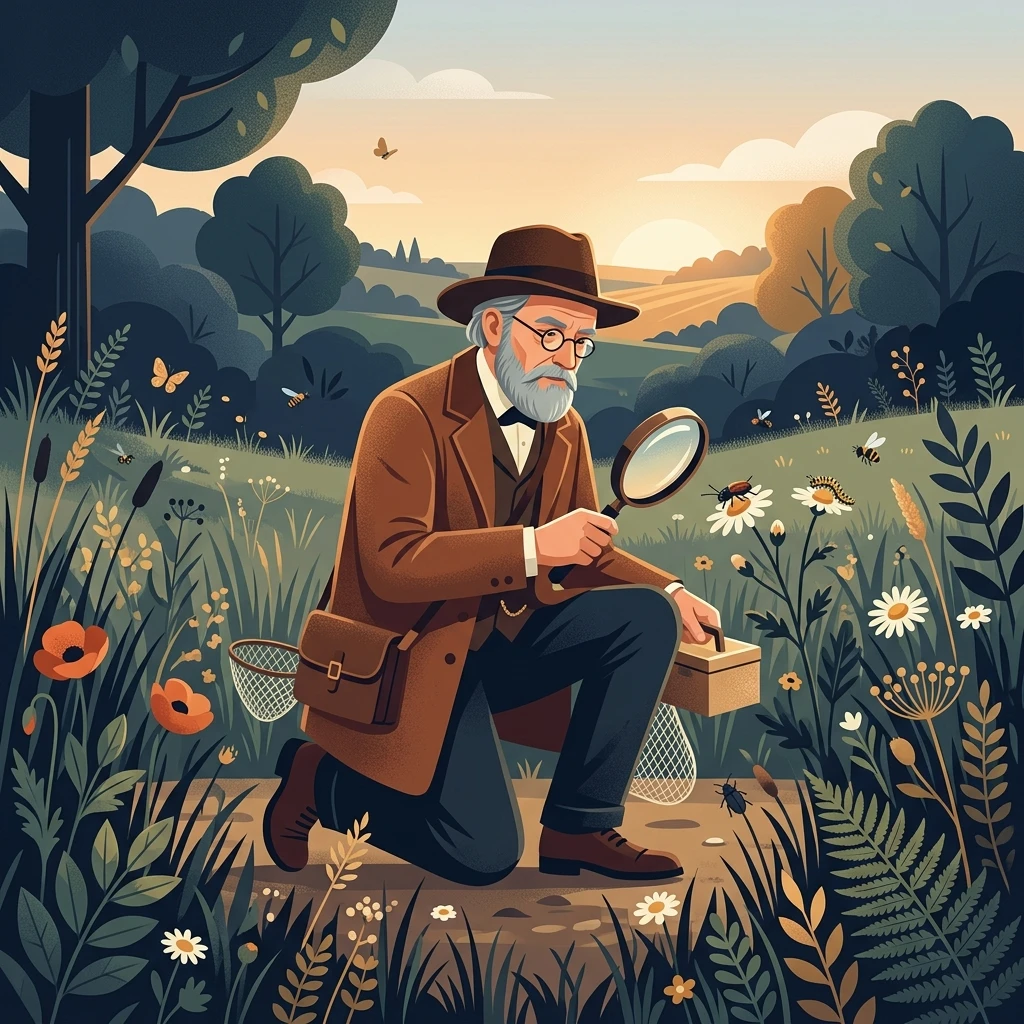
“True nature is revealed not in the dead specimens of a laboratory, but when recording the living moments of wild life.” 🔍
Jean-Henri Fabre, the celebrated French biologist, entomologist, and author of the immortal masterpiece Souvenirs Entomologiques. Breaking away from the prevailing 19th-century Western practice of dissecting dead, mounted specimens, Fabre observed the ecology and behavioral patterns of living insects in their natural habitats, meticulously documenting them in evocative language and laying the foundation for modern entomology. Charles Darwin praised him as “an inimitable observer,” making Fabre synonymous with extraordinary dedication and observational precision.
Despite poverty, harsh conditions, and initial indifference from the academic establishment, the secret behind his ability to accumulate decades of monumental observational records lay in his ‘Daily Morning Insect Observation & Field Log’ routine. Every morning before sunrise, Fabre walked out to his garden at Harmas armed with a magnifying glass, writing utensils, and a field notebook. Seated in the exact same spot, he kept his eyes fixed for hours on the subtle behavioral changes of dung beetles, paper wasps, and praying mantises.
He never relied on memory. Every minute movement, wingbeat rhythm, and prey capture was instantly recorded with precision in his outdoor field notes. These handwritten logs accumulated over years, ultimately culminating in his 10-volume masterpiece, Souvenirs Entomologiques. In today’s post, we introduce the cognitive science principles of Sustained Attention and Visual Pattern Recognition embedded in Jean-Henri Fabre’s morning observation routine.
Historical & Academic Evidence
This content is based on Jean-Henri Fabre's original work *Souvenirs Entomologiques* preface, preserved historical records of the French National Museum of Natural History (MNHN) & Cognitive Psychology Research.
 BuildSelf
Inspired by historical greats? Make it your daily habit!
BuildSelf
Inspired by historical greats? Make it your daily habit!

















1. Sustained Attention and Visual Pattern Recognition Mechanisms
Observing minute subjects outdoors for extended periods and immediately recording them by hand is a high-level cognitive task that intensely trains the brain’s Sustained Attention and the visual processing functions of the Visual Cortex. As the brain detects subtle changes in the subject, the Fronto-Parietal Attention Network is activated, dramatically enhancing higher-order pattern recognition capabilities.
Furthermore, writing down observations immediately on-site engages the somatosensory cortex and Working Memory simultaneously, precisely encoding visual data into long-term memory circuits. This virtuous cycle of observation and instant documentation prevents cognitive bias and ‘reconstructive memory errors’, maximizing the accuracy of empirical data accumulation.
2. 3-Step Practical Routine for Modern Professionals
Step 1: Quiet Observation of Subjects at Fixed Times and Areas
Every morning, in a distraction-free area, select a specific subject (insect, plant, or subtle phenomenon) and focus quietly using a magnifying glass or bare eyes.
Step 2: Immediate On-Site Handwriting of Minute Behaviors and Changes
Promptly record movements, morphological shifts, and responses over time in a notebook on-site without postponing to a later time.
Step 3: Long-Term Data Accumulation and Systematic Pattern Synthesis
Periodically review accumulated field logs to systematically synthesize recurring behavioral patterns or hidden regularities of your subjects.
3. Avoid Impatience and Focus on Selecting a Precise Subject
Fabre’s observation stemmed from patience—waiting quietly for natural changes without jumping to hasty conclusions. If modern individuals rush for quick results, the visual cortex can tire easily. It is best to start by choosing a small subject or simple phenomenon (e.g., plant growth, brief natural interaction) and observing and logging it for 10 to 15 minutes.
📌 Frequently Asked Questions (FAQ)
Can this method be applied to general work or study fields outside of natural science? ▼
Absolutely. Selecting an observation target within your field—such as a work process, market trend, or minute error in code or design—and establishing a habit of immediate on-site field logging dramatically improves your observation skills and problem-detection ability.
Can digital devices or photographs substitute handwritten field notes? ▼
While photos and digital notes serve well as supplementary materials, handwritten field logging offers unique cognitive benefits. Writing by hand to articulate thoughts strongly stimulates the somatosensory cortex and working memory, leading to deeper comprehension and longer retention of observed details.