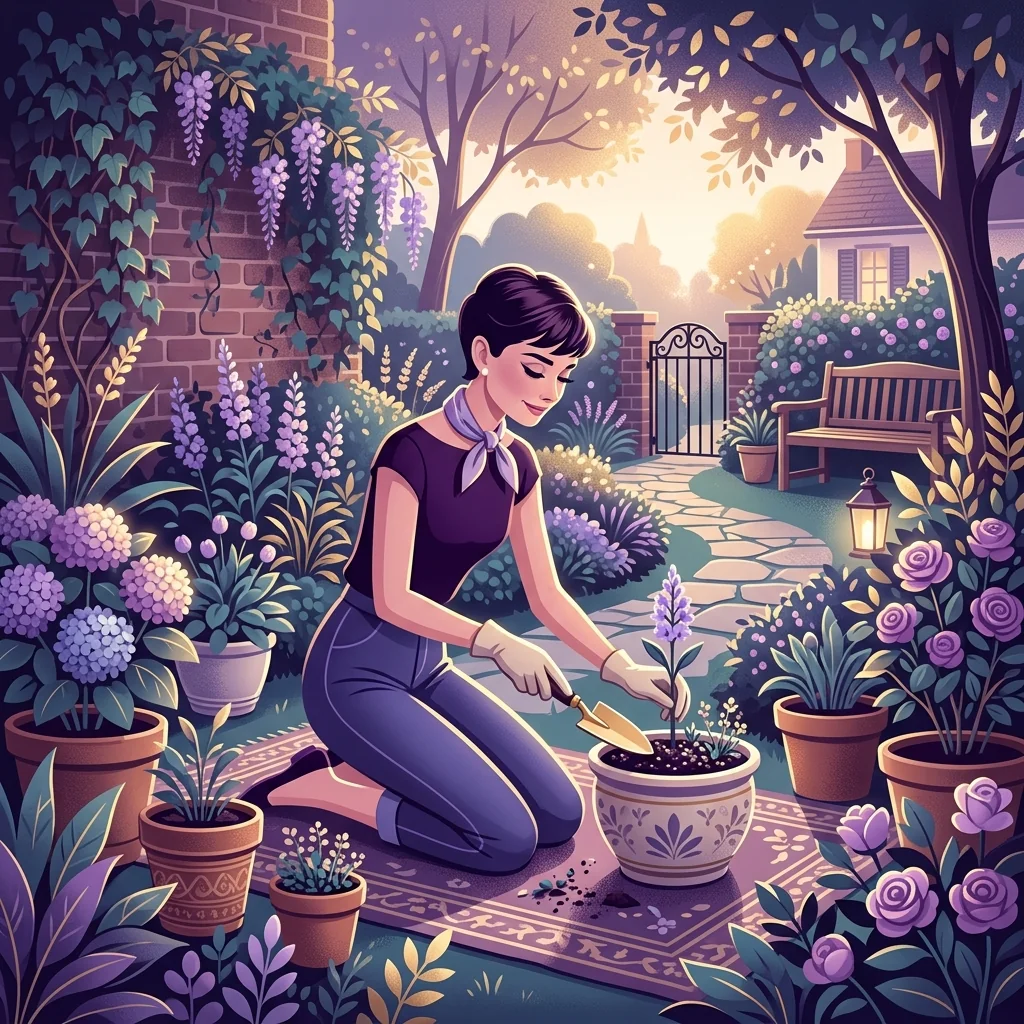
“To plant a garden is to believe in tomorrow. When I touch the soil, my soul is at its quietest.” 🌿
Audrey Hepburn (1929–1993) was the legendary Hollywood icon of Roman Holiday and Breakfast at Tiffany’s who later devoted her final years as a UNICEF Goodwill Ambassador, advocating tirelessly for impoverished children across Africa, Asia, and Latin America. Enduring intense media scrutiny, lifelong public evaluations, and a painful battle with cancer in her final years, where did she find the inner resilience to maintain her unshakeable composure and grace?
Hepburn found her sanctuary in the garden of her estate, ‘La Paisible’ (‘The Peaceful Place’), located in the quiet village of Tolochenaz, Switzerland. Every afternoon, she immersed herself in touching the earth, planting fruit trees, and pruning roses. Holding a trowel, digging through soil, and tending to living plants allowed her to completely step away from the glare of fame and connect with the raw rhythm of nature. Touching the cool earth provided a profound cognitive restoration protocol, recharging her drained mental bandwidth and instilling deep psychological peace.
In today’s post, we examine the cognitive neuroscience and environmental psychology behind Audrey Hepburn’s ‘gardening mindfulness’ routine and present a practical 3-step action guide to restore emotional equilibrium.
Historical & Academic Evidence
This content is based on Historical Verification from Audrey Hepburn Biographies, Tolochenaz Estate Archives (Switzerland) & Cognitive Neuroscience and Environmental Psychology Research.
 BuildSelf
Inspired by historical greats? Make it your daily habit!
BuildSelf
Inspired by historical greats? Make it your daily habit!

















1. Mycobacterium vaccae and the Neuroscience of Serotonin Secretion
Humans evolved to experience psychological calm through direct connection with the earth. Neuroscientific and microbiological studies demonstrate that handling garden soil exposes us to a beneficial soil bacterium named Mycobacterium vaccae. Entering through skin contact and respiration, this bacterium stimulates immune pathways that trigger brainstem raphe nuclei to release serotonin—the neurotransmitter responsible for emotional stability and mood elevation. Consequently, gardening provides a dual neurobiological benefit: triggering Attention Restoration in the Prefrontal Cortex while simultaneously soothing autonomic nervous system hyper-arousal.
2. 3-Step Practical Routine for Modern Professionals
Step 1: Setting the Gardening Space & Physical Isolation from Smartphones
Step into a garden, balcony, or quiet indoor space with potted plants. Leave your smartphone indoors or store it deep inside a bag so push notifications do not disrupt your soil contact.
Step 2: Soil Contact, Repotting, and Repetitive Watering Work
Use a trowel or bare hands to loosen soil, plant seeds, or repot vegetation. If repotting is unnecessary, gently groom plant soil or pour water at a slow, rhythmic pace.
Step 3: 10 Minutes of Analog Tactile and Olfactory Relaxation Immersion
Center your entire sensory awareness for 10 minutes exclusively on organic physical stimuli—the cool moisture of earth on your fingertips, soil grain texture, and the earthy aroma (geosmin) released by wet soil.
3. Caution: Excluding Distractions to Immerse Fully in the Analog Tactile Sensations of Soil
To capture genuine emotional relaxation through gardening, anchor your full awareness onto sensory experience itself. Ruminating over work deadlines while touching soil blocks the brain’s Attention Restoration mechanisms. Focus completely on physical tactile feedback—the cool dampness of earth, the rough texture of sand, or the soft surface of a leaf—allowing your prefrontal cortex to disengage and enter deep parasympathetic relaxation.
📌 Frequently Asked Questions (FAQ)
Is this method effective indoors or in apartments without a private garden? ▼
Yes, absolutely! Filling small indoor pots on a balcony or living room desk with potting soil and planting small herbs or air-purifying plants delivers identical tactile stimulation and soil bacterium exposure. The core mechanism is physical contact with living earth, regardless of plant size.
Are there hygiene risks or bacterial infection concerns when touching soil with bare hands? ▼
Commercially available potting soil is pasteurized, making it far safer than wild soil. Beneficial microorganisms in soil actually help condition skin microflora and immune function. If hygiene is a concern, wearing thin gardening gloves still provides rich tactile feedback. Simply washing your hands with soap and water after gardening resolves all hygiene concerns completely.