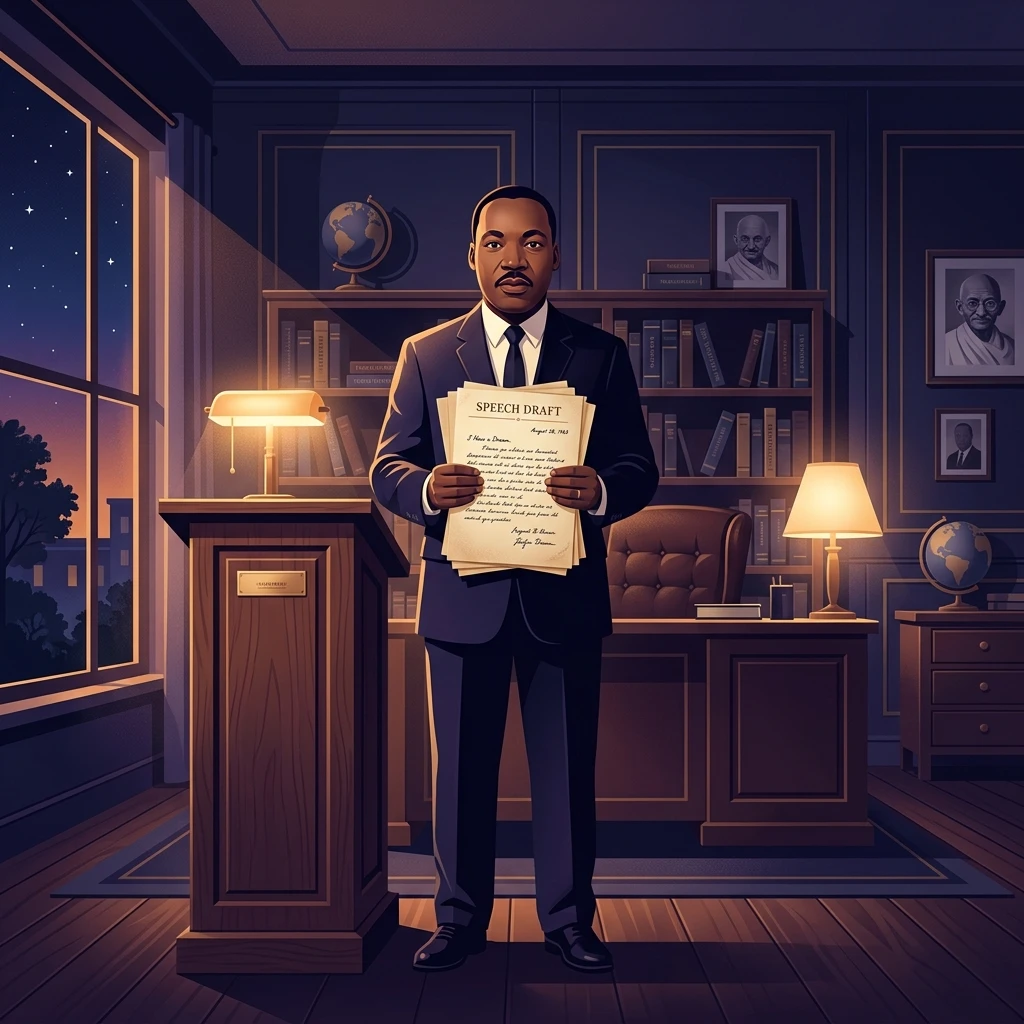
“When you hear the rhythm and resonance of words with your own ears, language gains the power to move souls.” 📜
Martin Luther King Jr., an icon of the American civil rights movement and recipient of the 1964 Nobel Peace Prize, dedicated his life to nonviolent resistance against racial segregation and for equal civil rights, etching his name in history as one of the 20th century’s greatest orators and ministers. His messages—most notably the historic “I Have a Dream” speech at the 1963 March on Washington—inspired millions and catalyzed a monumental social transformation toward justice.
Amid constant death threats, intense political conflict, and the crushing pressure of leading a national movement, the secret behind his ability to deliver profound thought and resonant eloquence lay in his morning routine. On the morning of a major rally or sermon, Dr. King woke before dawn to immerse himself in the silence of Psalms and classical passages. He would then recite his handwritten speech drafts aloud, over and over.
He never read his text merely with his eyes. Through vocal recitation, he used his own ears to test the harmony, prosody, cadence, breath control, and emotional resonance that would reach his audience, meticulously refining every single word. In today’s post, we introduce the cognitive linguistics of the Auditory Feedback Loop and language refinement embedded in Martin Luther King Jr.’s pre-dawn recitation routine.
Historical & Academic Evidence
This content is based on Taylor Branch, *Parting the Waters: America in the King Years 1954-63* (Pulitzer Prize Winner), *The Autobiography of Martin Luther King, Jr.* & Cognitive Linguistics Research.
 BuildSelf
Inspired by historical greats? Make it your daily habit!
BuildSelf
Inspired by historical greats? Make it your daily habit!

















1. Auditory Feedback Loop and Brain Prosody Processing Mechanisms
Reading written text aloud is not a mere vocal exercise; it is a high-level cognitive task that simultaneously activates the brain’s Auditory Feedback Loop and Auditory Cortex. As you speak sentences aloud and process them through hearing, the brain evaluates tone, rhythm, tempo (prosody), and instantly detects awkward phrasing or grammatical dissonance.
Furthermore, reciting deep narratives from classical prose and Psalms organizes synaptic networks, creating synergy between the prefrontal cortex’s language planning and emotional regulation centers. This maximizes both logical clarity and emotional empathy, dramatically enhancing audience cognitive receptivity.
2. 3-Step Practical Routine for Modern Professionals
Pre-Dawn Reading of Classics and Psalms in Silence
Early in the morning, amidst silence free from external noise, slowly read Psalms or classical human literature to awaken the brain's language circuits and settle your mind.
Reciting Drafts Aloud to Refine Breath and Prosody
Read your drafted speech or manuscript aloud multiple times to personally verify where breaths break, sentence rhythm, word nuances, and vocal resonance with your own ears.
Precise Edits via Auditory Feedback
When you identify awkward or ineffective phrasing during recitation, immediately refine it with a pen to polish the logic and emotional resonance of your text.
3. Reduce Vocal Strain and Focus on Rhythmic Cadence
Dr. King possessed vocal cords and vocal control honed through years of preaching and public speaking. If someone suddenly recites loudly for extended periods, it can cause vocal fatigue or strain. It is safer to begin in a soft, subvocal tone, focusing on cadence and breath control, before gradually increasing recitation duration.
📌 Frequently Asked Questions (FAQ)
Is this routine only effective if practiced during pre-dawn hours? ▼
The key lies in a 'state of minimal distraction and high focus' rather than the specific clock time. Pre-dawn hours offer fewer cognitive distractions and a clear prefrontal cortex, maximizing auditory feedback and language refinement. If pre-dawn is impractical, selecting the quietest window of your day works equally well.
What is the difference between reviewing text visually versus reciting it aloud? ▼
When reading visually, the brain engages in 'predictive automation,' unconsciously skipping words or self-correcting awkward contexts. Conversely, reciting aloud activates both the auditory and speech motor cortices simultaneously, allowing you to catch unnatural vocabulary, bloated sentence structures, and tonal dissonance that the eyes miss.