“To me, the bed is the finest laboratory and creative workshop in the world.” 🛌
Mark Twain (Samuel Langhorne Clemens, 1835–1910), the author who opened a new horizon in American literature with novels such as ‘The Adventures of Tom Sawyer’ and ‘Adventures of Huckleberry Finn’, is regarded as one of history’s greatest humorists and satirists. Surprisingly, his sharp humor and vivid descriptions were born in the most comfortable and lazy of places: his warm ‘bed’.
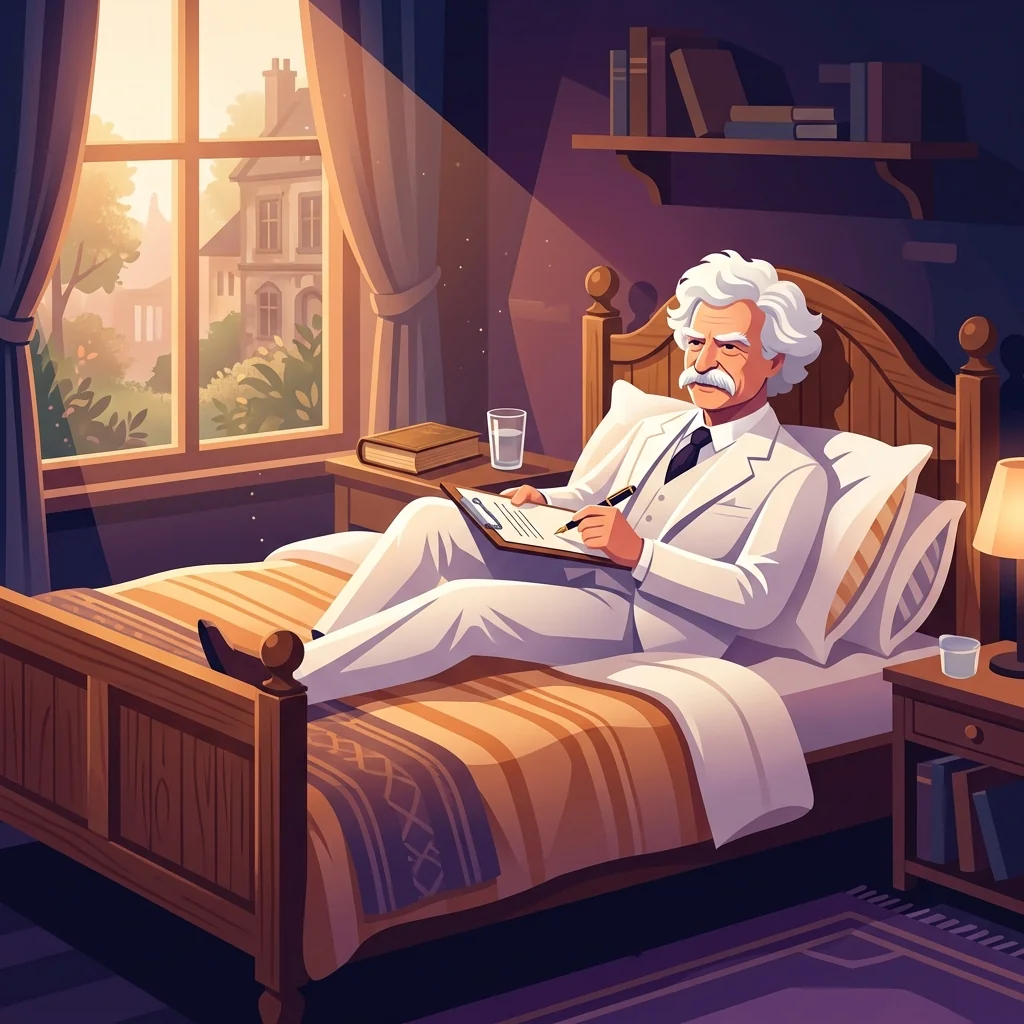
Every morning after enjoying a hearty breakfast, instead of heading to his study, Twain returned to his bedroom, leaned back against several soft pillows, and reclined. Placing a thick cardboard sheet on his knees, he wrote with a pen. Until his family called him for lunch, he maintained this reclining posture perfectly and focused entirely on writing. Twain believed that extreme physical relaxation was the key to freeing the mind and sparking inspiration. In today’s post, we introduce the physiological principles behind Twain’s ‘bed writing’ routine and how modern individuals can maximize their creativity through physical relaxation.
Historical & Academic Evidence
This content is based on Historical biographies and autobiographical records of Mark Twain's bed writing & Cognitive Neuroscience research.
 BuildSelf
Inspired by historical greats? Make it your daily habit!
BuildSelf
Inspired by historical greats? Make it your daily habit!

















1. ‘Associative Thinking’ that Relaxes the Brain and Connects Thoughts
When we lie horizontally or recline, the heart’s burden to pump blood throughout the body is significantly reduced compared to standing or sitting. This increases cerebral blood flow, stabilizes heart rate, and strongly stimulates the parasympathetic nervous system. When the body is completely relaxed, the brain suppresses the secretion of cortisol, a stress-regulating hormone.
The relaxed brain moves away from a tense state (beta waves) and emits abundant ‘Alpha waves’ and ‘Theta waves’ that induce creativity and deep insight. Psychologically, this state breaks rigid logical thinking frameworks and promotes ‘Associative Thinking’, which flexibly combines seemingly unrelated ideas. The secret to Mark Twain’s ability to seamlessly generate rich ideas and vivid descriptions while writing in bed lies in this combination of physical relaxation and cerebral blood flow mechanisms.
2. 3-Step Practical Routine for Modern Professionals
Forming an Upper Body Support Posture with Pillows
Stack several large, firm pillows at the head of the bed, and comfortably lean back against them supporting your lower back, upper back, and neck so that your spine remains straight.
Preparing Clipboard, Tools, and Blocking Digital Distractions
Prepare a sturdy clipboard (writing surface) with paper and pen, or a notebook, to place on your knees. Place your smartphone on the far side of the room out of reach to completely cut off digital connections that disrupt immersion.
Recording Free Associations in Comfort
Calm your breathing in the relaxed posture, and write down thoughts flowing from your mind in their raw form without logically censoring them. Any format such as sentences, drawings, or mind maps is fine. Externalize your thoughts freely for at least 15 minutes.
3. Support Your Posture and Prevent Smartphone Distractions
Reclining in bed can put significant strain on the spine or neck, so use several firm pillows behind your back to firmly support your spine and keep it straight. Additionally, to prevent the comfort of the bed from becoming an escape where you mindlessly scroll on social media, place your smartphone completely out of reach before lying down.
📌 Frequently Asked Questions (FAQ)
Doesn't working in bed make you sleepy or lazy? ▼
It can. Therefore, this routine is not simply about lying down, but maintaining an 'alert relaxation' state by firmly supporting the upper body with pillows. Additionally, it is essential to set a dedicated focus time with digital distractions completely blocked.