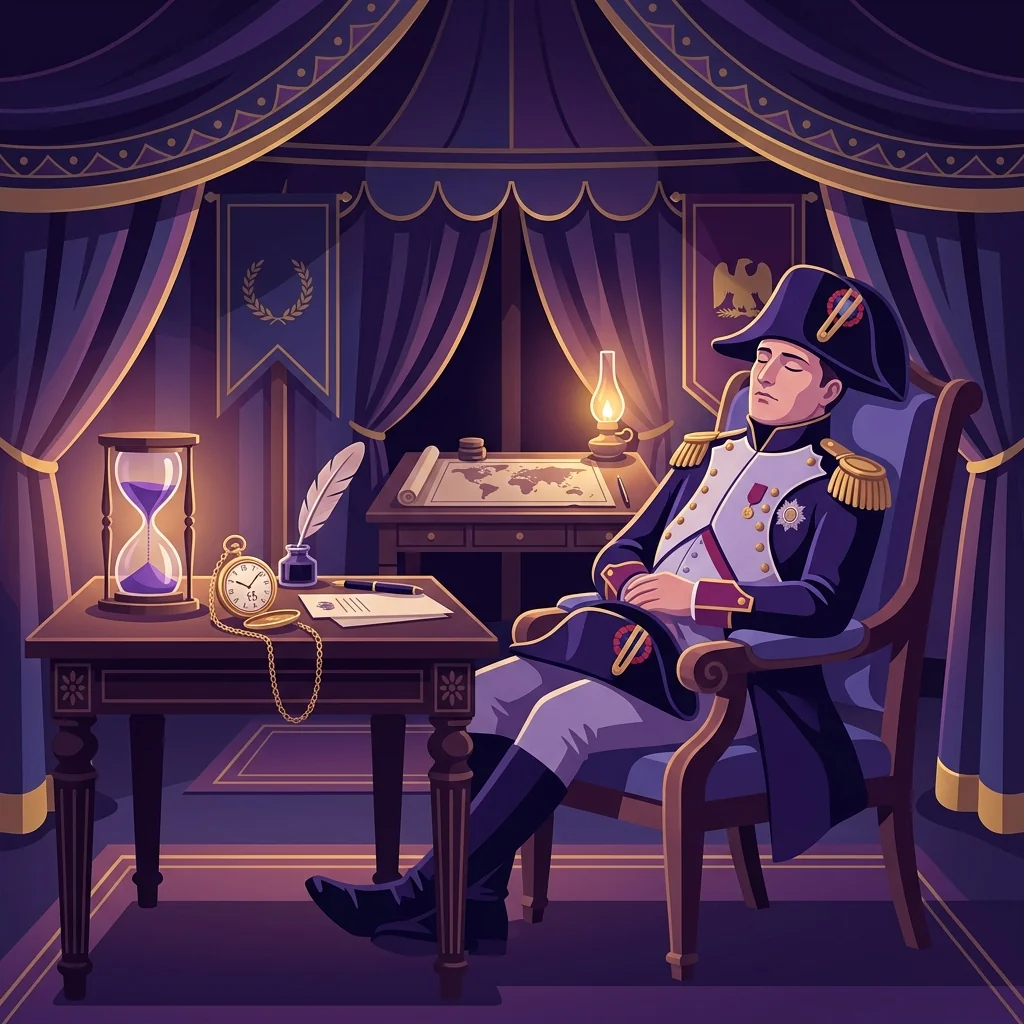
Even amid the extreme tension of a battlefield echoing with artillery fire, there was an emperor who completely reset his energy with a brief 15-minute sleep: France’s legendary military strategist and emperor, Napoléon Bonaparte (1769–1821). 💤
Napoleon, who brought order to the chaos of the French Revolution and conquered most of continental Europe, not only established the framework for modern judicial and administrative systems by codifying the Napoleonic Code, but was also a historic figure who led dozens of military campaigns to victory through unmatched strategic insight.
Napoleon is widely known for efficiently managing vast state council meetings and military commands while sleeping merely four hours a day. The true secret behind his ability to endure massive intellectual and physical overload while preserving peak cognitive tactical performance was not his overnight sleep, but the ‘micro-naps’ he practiced throughout the day.
During intense tactical meetings, lulls in battle, or even inside a moving carriage, he closed his eyes whenever the opportunity arose and rested in a light nap for 15 minutes. During these brief moments, he allowed his brain to disengage completely and woke up exactly 15 minutes later with lucid mental clarity, as if he had slept for half a day, to issue precise military commands.
In today’s post, we examine the scientific mechanism behind Napoleon’s micro-nap routine and explore how modern professionals can apply it to rapidly clear cognitive fatigue amid heavy workloads.
Historical & Academic Evidence
This content is based on Napoleon Micro Nap historical critical biography & autobiographical records verification & Cognitive Neuroscience research.
 BuildSelf
Inspired by historical greats? Make it your daily habit!
BuildSelf
Inspired by historical greats? Make it your daily habit!

















1. Cognitive Recovery via Micro-Naps and Brainwave Optimization
A 10-to-15-minute micro-nap limits sleep to NREM stages 1 and 2, preventing groggy sleep inertia while clearing accumulated adenosine to instantly restore alertness. According to neuroscientific research, this practice suppresses unnecessary anxietyin the amygdala and activates the visuospatial sketchpad circuit, dramatically enhancing long-term executive function.
2. 3-Step Practical Routine for Modern Professionals
Rapid Blocking of Sensory Inputs
Use an eye mask or noise-canceling earphones to immediately block light and ambient noise, signaling to the brain that it is time to rest.
Strict 15-Minute Sleep Duration Limit
Set a timer for precisely 15 minutes to prevent slipping into deep slow-wave sleep beyond 20 minutes.
Awakening and Rapid Alertness Triggering
As soon as the alarm sounds, stand up immediately, expose yourself to bright light, and wash your face with cold water to awaken your autonomic nervous system.
3. Timing Cautions for Healthy Napping Habits
Sleeping for more than 20 to 30 minutes enters deep slow-wave sleep, causing heavy grogginess upon waking. Strictly enforce a timer and avoid napping after 4:00 PM. Do not rely solely on willpower; designing physical environments and habit cues in advance to trigger action naturally is key to sustainability.
📌 Frequently Asked Questions (FAQ)
Did Napoleon actually take naps during active battles? ▼
Yes, according to historical accounts, Napoleon possessed the extraordinary ability to fall asleep instantly even on battlefields with artillery fire roaring, waking up exactly 15 minutes later with a clear mind to issue tactical orders.