“Man is condemned to be free.” ☕
Jean-Paul Sartre (1905–1980) was a prominent French existentialist philosopher, playwright, and novelist who reshaped 20th-century Western thought. He authored monumental works such as ‘Being and Nothingness’ (L’Être et le Néant), ‘Nausea’ (La Nausée), and ‘No Exit’ (Huis Clos), dissecting human agency and existence, and was awarded the Nobel Prize in Literature in 1964.
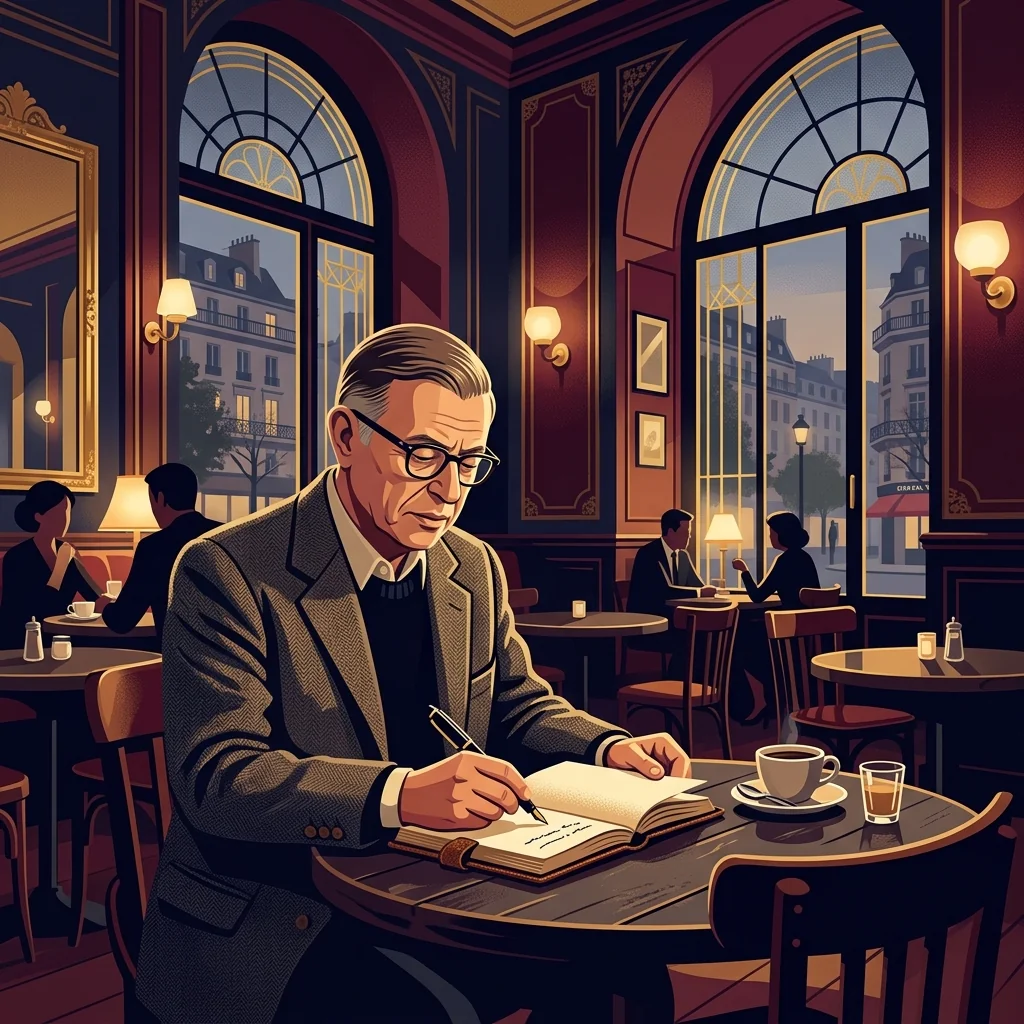
In 1940s occupied Paris, Sartre and his lifelong companion Simone de Beauvoir made famous Saint-Germain-des-Prés cafés—such as Café de Flore and Les Deux Magots—their personal office and study. Leaving unheated apartments behind, Sartre sat at his reserved café table daily from 9 AM to 12 PM and 3 PM to 8 PM, writing quietly amidst gentle ambient noise, the aroma of coffee, and human warmth.
For Sartre, the moderate café hum and solitude functioned as an environmental anchor that optimally aroused cortical attention and fueled executive function. Through this reserved seat routine, he maintained deep immersion despite external turmoil, producing the foundational texts of existentialism.
In this post, we explore the creative cognitive mechanisms behind Sartre’s café writing routine and introduce practical environmental cognitive anchoring strategies for modern life.
Historical & Academic Evidence
This content is based on Historical Biography of Jean-Paul Sartre & Cognitive Neuroscience Research.
 BuildSelf
Inspired by historical greats? Make it your daily habit!
BuildSelf
Inspired by historical greats? Make it your daily habit!

















1. Spatial Cognitive Anchoring and Conditioned Focus Reflex
Our brain possesses strong contextual plasticity, linking specific spaces with the actions performed within them. For instance, beds are associated with sleep, and dining tables with eating.
Sartre’s insistence on reading and writing exclusively at a specific table in a specific café imprinted ‘Spatial Cognitive Anchoring’ onto his frontal lobe. Simply sitting at that seat triggered a conditioned reflex, automatically activating ‘focus mode’ without warmup delay. Combined with time-blocking that strictly bounded morning and afternoon focus sessions, his peak concentration efficiency was consistently preserved.
2. 3-Step Practical Routine for Modern Professionals
Establish a Designated Seat for Focus
Designate 'your own reserved seat' at home, the library, or a favorite café where you exclusively engage in productive cognitive work such as studying or writing.
Assign Focused Time Blocks
Set aside consistent daily time blocks (e.g., 9 AM to 12 PM) for deep focus, blocking notifications from electronic devices and interruptions from others during this time.
Immediately Vacate for Non-Target Actions
Strictly engage only in work or study while seated; if you feel sleepy or want to check your phone, immediately stand up and rest outside the designated area.
3. Prohibit Non-Target Behaviors at Your Reserved Seat
For spatial cognitive anchoring to remain effective, you must maintain a strict rule: perform ‘only target behaviors (studying, writing)’ in that designated space. If you surf the web, answer calls, or play games at your reserved seat, the brain’s space-behavior link weakens and breaks the anchoring effect. When taking a break, always step away and rest elsewhere.
📌 Frequently Asked Questions (FAQ)
Is an environment with ambient white noise like a café better for focus than a completely silent place like a study room? ▼
It varies individually. Research indicates that moderate ambient noise around 50–70 dB slightly diffuses auditory attention, paradoxically enhancing creative problem-solving. However, the most fundamental factor is establishing cognitive rules and anchoring by starting the same action in the same place every day, regardless of noise levels.
Wouldn't changing your designated seat daily or periodically be better for stimulating the brain? ▼
In the creative brainstorming stage, a novel environment triggers fresh dopamine release. However, when executing high-intensity learning or completing established writing tasks, Sartre-style seat anchoring is far more efficient as it reduces unnecessary exploratory energy and triggers immediate reflex immersion.