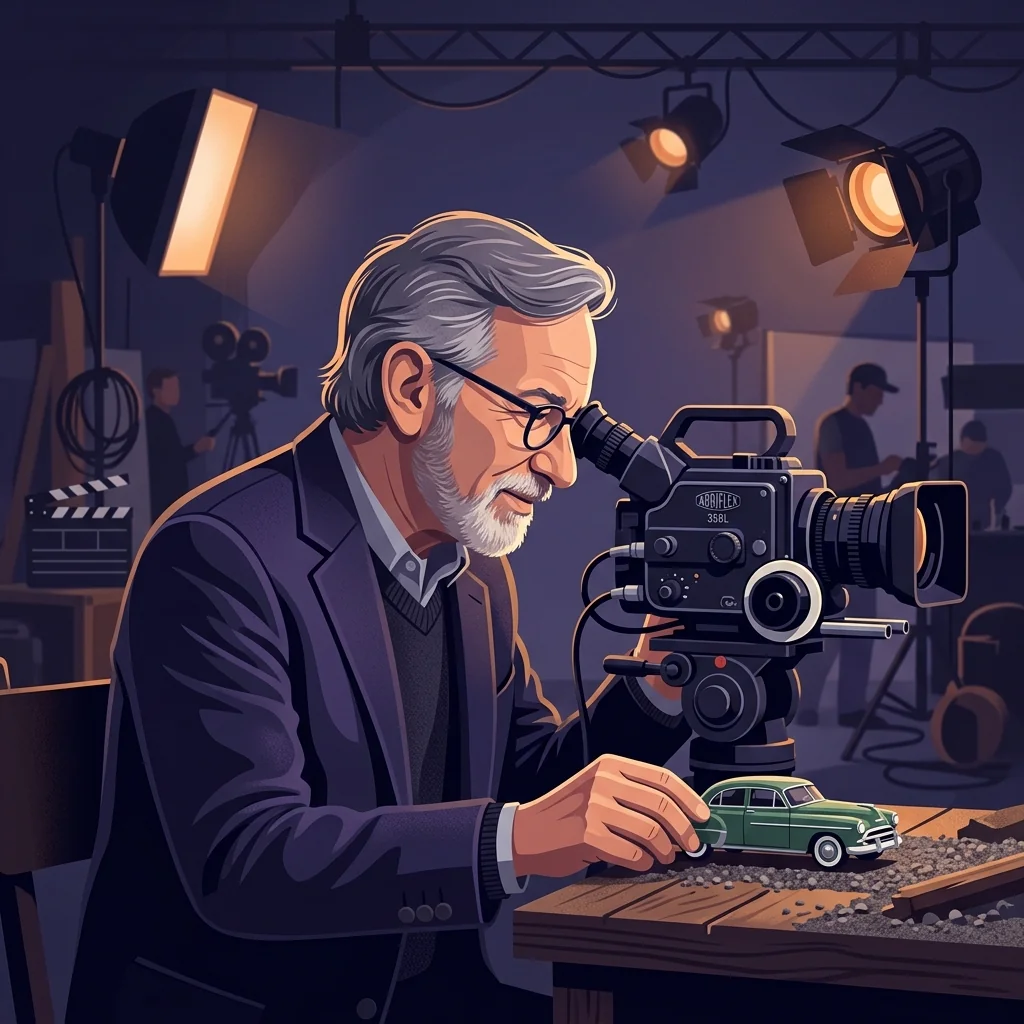
Steven Spielberg is a world-renowned master who swept Academy Awards and pioneered the history of modern cinema with timeless masterpieces such as Jaws, E.T., Jurassic Park, Indiana Jones, and Schindler’s List. From what behavioral patterns were his overwhelming planning abilities and creativity born—redefining imagination into reality by blending emotional narrative with innovative visual direction? 🎬
Whenever facing a cognitive slump while drafting storyboards or getting stuck on complex camera movement pathways, Spielberg immediately pulled out a compact analog director’s viewfinder lens and small model props (such as a miniature toy car) from his pocket. He turned and felt the complex shapes and textures of the models with his fingertips and pressed the lens close to his eye to observe surrounding objects within an extremely narrow field of view. Spielberg recalled that physically narrowing his sight and manipulating analog models with his fingertips immediately unlocked stagnant 3D spatial calculations in his head visually and tactilary.
In today’s post, we examine the neuroscientific roots of Spielberg’s ‘analog viewfinder and tactile model stimulation’ routine, along with practical methods for modern people to break through creative bottlenecks in daily life.
Historical & Academic Evidence
This content is based on Historical biography & autobiographical records verification of Steven Spielberg & Cognitive Neuroscience research.
 BuildSelf
Inspired by historical greats? Make it your daily habit!
BuildSelf
Inspired by historical greats? Make it your daily habit!

















1. Somatosensory Cortex Stimulation and Parietal Lobe Spatial Computation Acceleration
Sophisticated haptic feedback from finely touching the complex 3D contours of a model with fingertips strongly excites the brain’s somatosensory cortex. This simultaneously stimulates the parietal lobe association area of the right brain, which is responsible for spatial reasoning and three-dimensional composition of scenes. Furthermore, visual reframing—blocking the field of view through an analog viewfinder lens or a narrow gap and focusing on a single object—filters out vast visual noise heading to the frontal lobe, concentrating cognitive resources on computing the structural composition of the target.
2. 3-Step Practical Routine for Modern Professionals
Securing an Analog 3D Tactile Tool
Place simple analog props with distinct physical contours on your desk, such as a miniature model car, a director's viewfinder lens, or wooden cube pieces. This is the preparation stage to selectively awaken tactile and visual senses at any time.
10-Minute Tactile Exploration and Field of View Narrowing
When facing a planning bottleneck during design, finely touch the edges and cross-sections of the model with your fingertips to convey tactile feedback. Simultaneously, narrow your field of view through a small hole punched in paper or a magnifying glass and gaze quietly at a single object for 1 minute. This is a deep work preparation process that stimulates brain association areas and reduces visual noise to zero.
Re-entering Structural Spatial Design
After the tactile stimulation ends, immediately begin revising and expanding your process blueprints or coding logic diagrams based on the warmed-up spatial computing power of your parietal lobe. The brain receives physical sensory feedback to draw a more intuitive structure.
3. Traps of Excessive Tactile Tools and Planning Connection Tips
When using fidget toys to stimulate your fingertips, if the tool is overly fancy or contains complex mechanisms, cognitive dispersion occurs as the brain becomes fascinated by the fun of operating the tool itself. Therefore, for brain stimulation purposes, using simple shapes and solid materials such as cold metal models or wooden toys is much more advantageous for cognitive offloading. Also, limit the touching time to no more than 10 minutes.
📌 Frequently Asked Questions (FAQ)
Does spinning a fidget spinner or a regular pen with fingers produce the same effect? ▼
Simply rotating a spinner or pen repetitively is classified as an unconscious motor habit, stimulating only the basal ganglia circuit of the brain, and yields very low somatosensory cortex stimulation (haptic feedback) to induce high-level spatial computation in the parietal lobe. Therefore, touching analog model toys or cubes directly—where clear geometric shapes and contours force the brain to coordinate fine fingertip movements to recognize forms—produces far superior intellectual arousal effects.
Are there other tips for narrowing field of view in daily life when an optical viewfinder lens is unavailable? ▼
Even without Spielberg's viewfinder lens, you can achieve the exact same visual framing effect by cutting a finger-joint-sized square hole in the center of a paper card and looking at objects through it, or by closing one eye and making a circle with your fingers (like an OK sign) pressed against your eye like a telescope. The principle of filtering out unnecessary cognitive noise pouring into the cerebral visual cortex is physically identical.