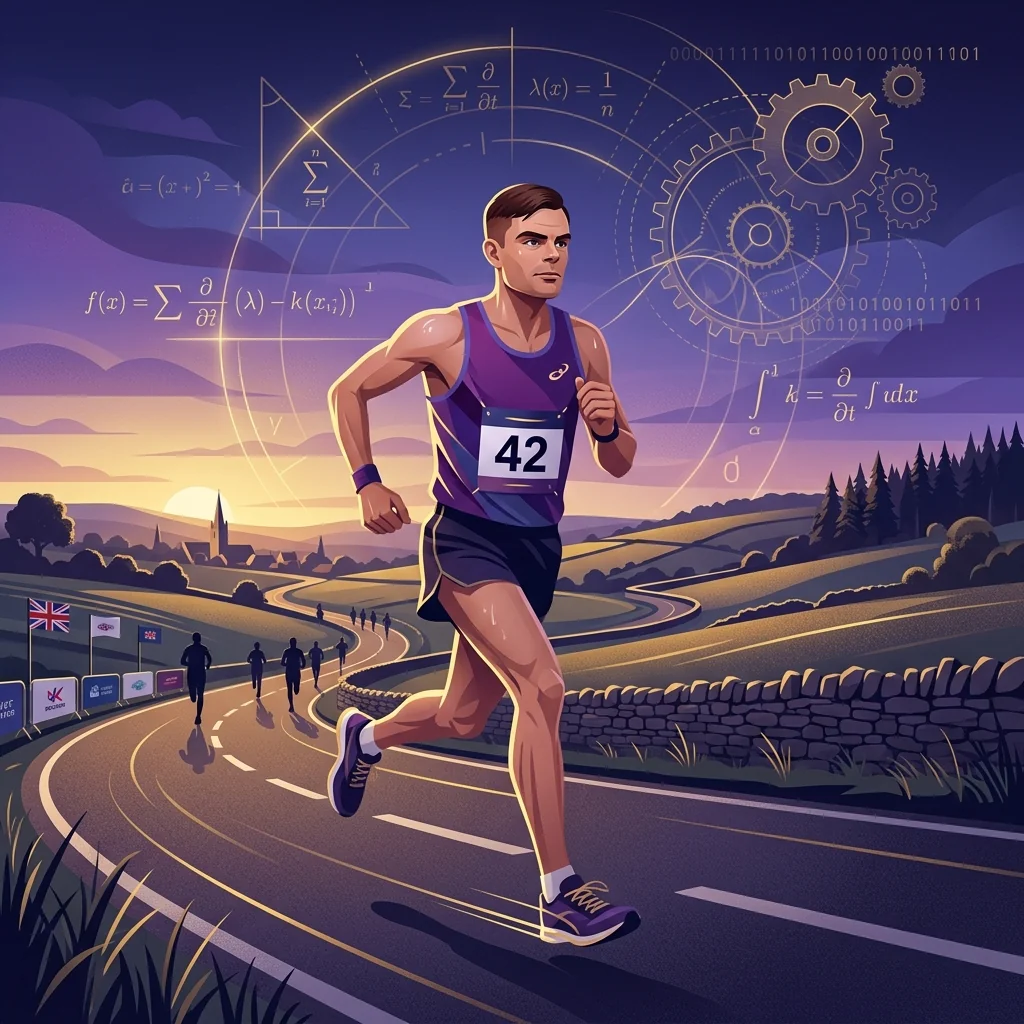
“For me, running is the most beautiful time to clear my complex mind and immerse myself in pure thought.” 🏃♂️
Alan Turing (1912–1954), the brilliant British mathematician who deciphered the notorious German Enigma code during World War II and laid the foundations of computer science, constantly suffered from brain overload due to complex calculations, machine designs, and cryptanalysis. Amid such immense intellectual pressure, the secret that allowed him to maintain mental equilibrium and sustain creative ideas was none other than ‘marathon running’.
Turing maintained a rigorous long-distance running routine of running over 10 miles (approx. 16 km) every day. In fact, he was an elite runner who finished 5th in the 1948 British Olympic marathon trials with an impressive time of 2 hours, 46 minutes, and 3 seconds. For Turing, running was not merely exercise, but an essential pathway of contemplation that paused prefrontal cognitive activity and purified the brain.
In today’s post, we examine the neuroscientific mechanisms behind Alan Turing’s running routine and provide a 30-minute running guide for intellectual awakening in modern individuals.
Historical & Academic Evidence
This content is based on Historical biographies and autobiographical records of Alan Turing & Cognitive Neuroscience research.
 BuildSelf
Inspired by historical greats? Make it your daily habit!
BuildSelf
Inspired by historical greats? Make it your daily habit!

















1. Aerobic Exercise Promoting Neurogenesis and Cognitive Refreshment
Consistent daily aerobic running induces the synthesis of Brain-Derived Neurotrophic Factor (BDNF), a crucial substance for brain health. BDNF promotes the generation of new neurons in the hippocampus, which handles memory and learning, expanding cognitive working memory space.
Furthermore, while running, the prefrontal cortex responsible for cognitive control enters a temporary resting state, stimulating the Default Mode Network (DMN) that utilizes subconscious resources. Thanks to this phenomenon, complex calculations or creative ideas that remained unsolved when racking one’s brain suddenly spark and activate immediately after finishing a run.
2. 3-Step Practical Routine for Modern Professionals
Step 1: Digital Disconnection and Starting the Run
Start running without streaming music or podcasts, putting your smartphone in your pocket or setting it to Do Not Disturb mode to completely block external digital stimuli.
Step 2: Maintaining a Conversational Steady Pace
Run consistently for 30 minutes at a steady pace (Heart Rate Zone 2) where your breathing is slightly elevated but you can still converse comfortably with someone beside you.
Step 3: Post-Run Cooldown and Analog Note-Taking of Ideas
After running, cool down with light stretching and breathing exercises, then write down ideas or solutions that surfaced from your subconscious onto a paper notebook by hand.
3. Pacing Control for Optimal Cognitive Awakening
Pacing control is vital during running intended to refresh the brain. If you run excessively hard and reach an anaerobic threshold state where your heart feels like bursting, the brain devotes all cognitive resources purely to physical survival, hindering contemplation and DMN activation. Running steadily at a pace where light conversation is possible is most effective.
📌 Frequently Asked Questions (FAQ)
Does stationary cycling or swimming produce the same brain refresh effect as running? ▼
Yes, any continuous aerobic exercise that engages cardiopulmonary function and raises BDNF levels, such as cycling or swimming, provides similar cognitive recovery benefits. However, outdoor running maximizes the relaxation and idea activation of the Default Mode Network (DMN) when sensory stimuli like wind and natural scenery reach the brain.
Does listening to music while running hinder brain recovery? ▼
Music with lyrics or intense beats forces the prefrontal cortex to auditorily filter and process information, preventing complete brain rest. Listening to natural ambient sounds or focusing solely on your breathing without music is the key to fully activating the DMN and recharging attention.