“Anything one man can imagine, other men can make real.” 🗺️
Jules Verne (1828–1905) was a premier 19th-century French novelist and the father of science fiction literature. Weaving visionary adventures and brilliant imagination into prose through masterpieces such as ‘Twenty Thousand Leagues Under the Seas’, ‘Around the World in Eighty Days’, and ‘From the Earth to the Moon’, he remarkably foresaw modern inventions including satellites, submarines, and lunar spacecraft with astonishing precision. Where did his uniquely elaborate background knowledge originate?
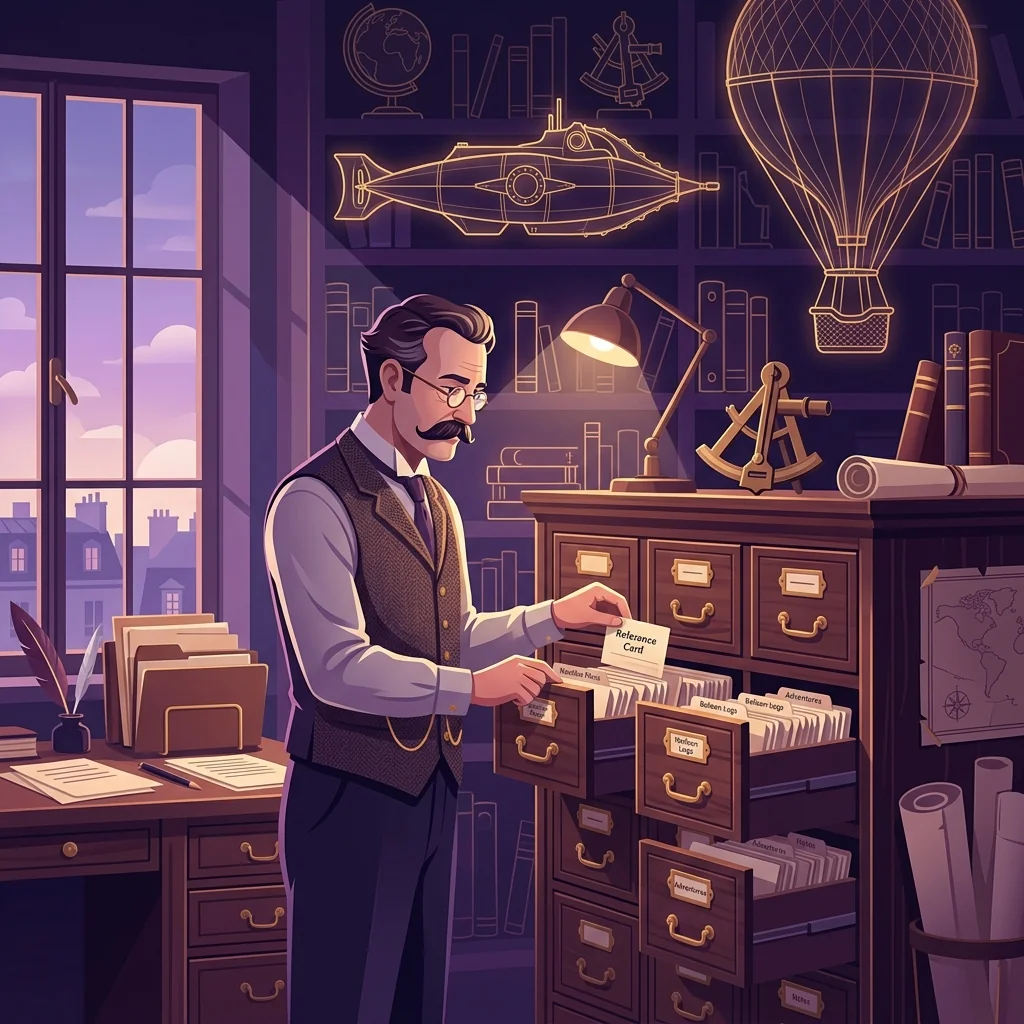
Verne turned on the lights in his study every morning at 5 AM. For six hours before breakfast, he thoroughly combed through the latest scientific journals, academic papers, and geography magazines, summarizing minor details and scientific laws by hand onto small 10cm index cards. Verne organized these paper slips into filing drawers according to his own categorization system, eventually accumulating a staggering total of over 20,000 index cards. He freely combined this knowledge archive to infuse his novels with overwhelming plausibility and realism.
In today’s post, we explore the scientific principles behind Verne’s 5 AM knowledge archiving habit and how modern individuals can apply it to acquire and synthesize complex information.
Historical & Academic Evidence
This content is based on Historical biographies and autobiographical records of Jules Verne & Cognitive Neuroscience research.
 BuildSelf
Inspired by historical greats? Make it your daily habit!
BuildSelf
Inspired by historical greats? Make it your daily habit!
















1. ‘Elaborative Categorized Archiving’: Strengthening Semantic Memory
Instead of merely skimming acquired knowledge, the process of manually condensing information onto key index cards and categorizing them dramatically strengthens the brain’s semantic memory network. In cognitive psychology, this is known as ‘Elaborative Rehearsal’, a technique that tightly weaves new information pieces into existing cognitive structures for long-term retention. Physically sorting index cards stimulates both visual and motor pathways in the brain, fostering recognition of structural connections. This habit activates associative memory retrieval pathways, facilitating the fluid assembly of creative ideas.
2. 3-Step Practical Routine for Modern Professionals
Create Daily Condensed Information Cards
Summarize articles or scientific facts acquired during study or research onto 10cm analog note slips or digital note apps, noting 2–3 keywords and the source.
Categorize and Archive the Cards
Label your knowledge cards with main categories (e.g., Cognitive Science, Marketing, Geography) and subcategory tags, then systematically file them in designated drawers or digital folders.
Weekly Card Fusion and Review
On weekends or set times, randomly pull 5–6 saved cards from your drawer, re-read them, and synthesize seemingly unrelated pieces of information to generate thought synergies or write practical outputs.
3. Preventing Collector’s Fallacy and Maximizing Practical Utility
The main pitfall of a clipping routine is falling into the ‘Collector’s Fallacy’, feeling a false sense of accomplishment merely by gathering and storing knowledge. Creating cards must serve as a means to deeply bind and apply knowledge in the brain. Summaries should be refined in your own words, and you must regularly review your card archive to output and connect relevant insights into writing or discussions.
📌 Frequently Asked Questions (FAQ)
How does Niklas Luhmann's Zettelkasten note-taking method differ from Jules Verne's index card clipping? ▼
While Zettelkasten focuses on creating an interconnected web of thought through permanent numeric cross-references between cards, Jules Verne's cards focused on systematically accumulating encyclopedic scientific and geographical facts by category to reinforce technical description and narrative plausibility in his novels.