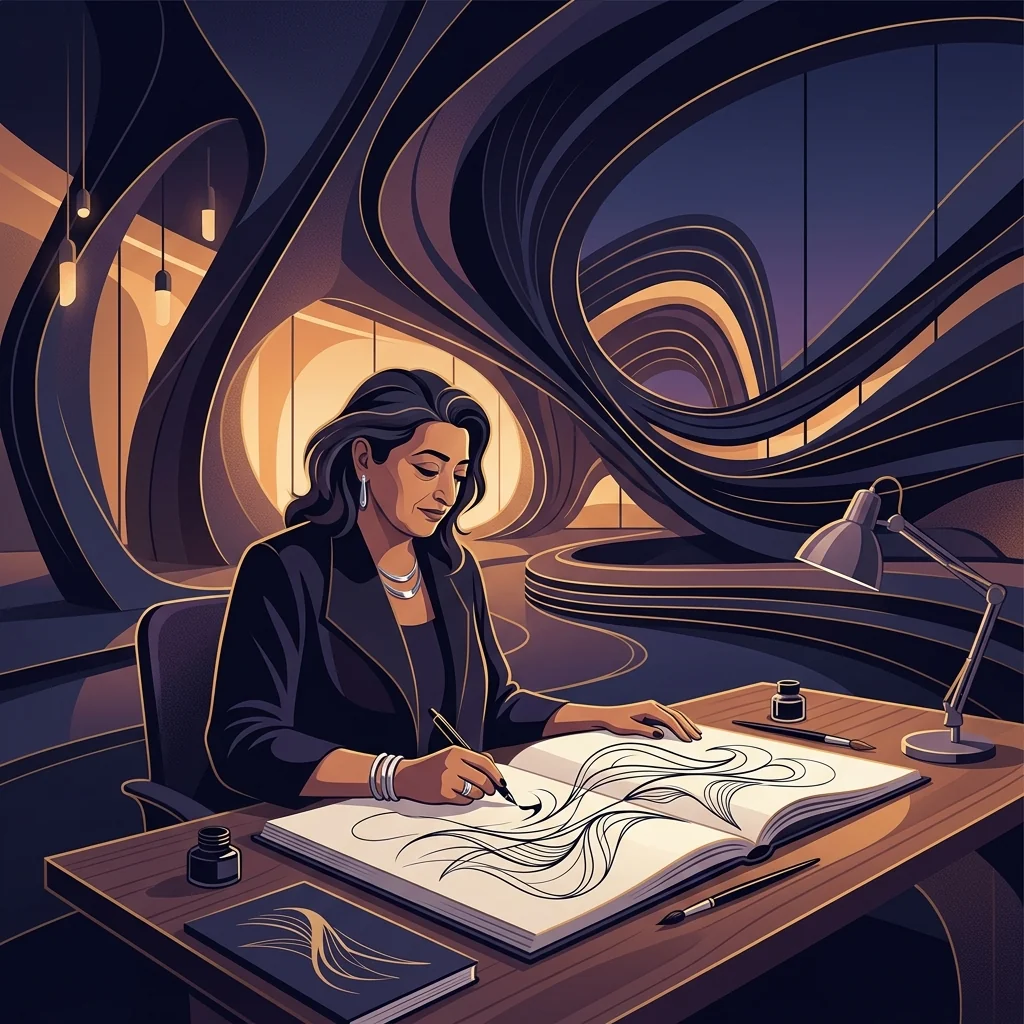
“Architecture should be a space where people can breathe and dream, never trapped inside a rectangular box.” 🏛️
Zaha Hadid (1950–2016) was an Iraqi-British architect who revolutionized contemporary world architecture as the first woman to win the Pritzker Architecture Prize. Her futuristic 3D organic structures—such as Dongdaemun Design Plaza (DDP) in Seoul and the Heydar Aliyev Center in Baku—left profound artistic marks on major global cities.
Hadid completely discarded traditional rigid grids and rectangular thinking. On massive blank sketchbooks, using ink and pens, she continuously drew fluid, organic curves and freeform lines by hand. The visuospatial cues captured during this tactile sketching process powerfully stimulated dopamine circuits responsible for 3D spatial thinking and non-linear ideation.
This post explores Zaha Hadid’s ‘free curve sketching’ routine and outlines a 3-step ideation method for modern professionals.
Historical & Academic Evidence
This content is based on Historical records from Zaha Hadid biographies and autobiographical materials & Cognitive Neuroscience research.
 BuildSelf
Inspired by historical greats? Make it your daily habit!
BuildSelf
Inspired by historical greats? Make it your daily habit!

















1. Stimulation of Right-Brain Visuospatial Processing Circuits
Relying strictly on rigid guidelines and straight lines causes the left brain’s logical areas to dominate, reinforcing stereotypes. Executing unrestricted organic hand sketching like Hadid activates the right brain’s visuospatial processing areas, maximizing novel visual ideas.
2. 3-Step Practical Routine for Modern Professionals
Prepare a Large Blank Sketchbook
Prepare a large blank notebook without grids or lines, and place rulers and computers out of reach. Thoroughly eliminate external distractions to establish a clear execution frame for the prefrontal cortex.
Continuous Organic Hand Drawing
Without setting a predetermined form, continuously draw the fluid flow of waves, wind, and curves for 5 minutes.
Capturing 3D Spatial Structures Between Curves
Discover sense of depth, spatial volume, or structural shadows emerging from overlapping free curves and translate them into ideas.
3. Caution Against Obsessing Over Initial Precision and Perfection
If you use a ruler or correct asymmetry early on trying to ‘draw a pretty picture’, the brain’s free ideation circuit closes. For the first 5 minutes, focus solely on the flow of lines rather than perfection. Rather than relying on pure willpower, design a physical environment and habit cues that naturally trigger action.
📌 Frequently Asked Questions (FAQ)
Can I use this routine even if I have zero drawing skills? ▼
Yes, absolutely! The purpose is not creating an artwork, but cognitive training to stimulate right-brain spatial circuits through hand movement. Even simple scribbles yield full benefits.
Does using a digital tablet stylus produce the exact same effect? ▼
Yes, it works! However, if stroke stabilization or the 'Undo' feature is active, the brain becomes self-conscious about making corrections. Turn off stabilization and undo functions for best results.