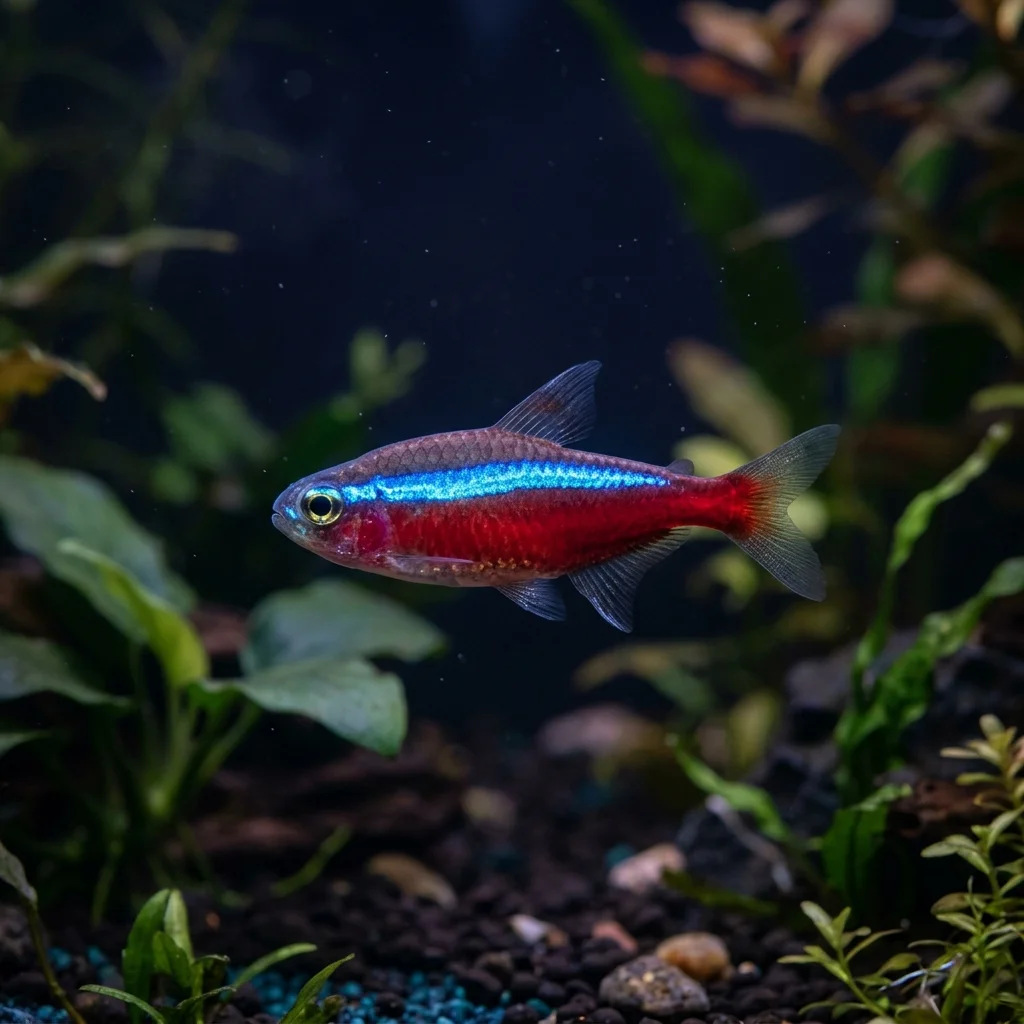
Renowned for its vivid neon blue stripe and full-length brilliant red belly, the Cardinal Tetra (Paracheirodon axelrodi) is a quintessential freshwater schooling fish. Unlike the similar Neon Tetra, whose red stripe covers only the rear half, the Cardinal Tetra’s belly is completely saturated red. However, they are more sensitive to water parameters, requiring soft, slightly acidic water (pH 5.5–6.8) and low nitrates. They also depend on schooling in groups to feel secure and can lose color under severe stress or disease. In this guide, breaks down Cardinal Tetra signals and outlines a 3-step daily homecare routine.
Veterinary & Behavioral Evidence
This content is based on Ornamental Aquatic Trade Association (OATA) Guidelines & Tropical Freshwater Fish Clinical Standards.
 FreshSelf
Keep pet food and supplements perfectly fresh!
FreshSelf
Keep pet food and supplements perfectly fresh!









1. Cardinal Tetra Physical Signals: Daytime Color Fading and Isolation from the School
Cardinal Tetra Physical Signals: Daytime Color Fading and Isolation from the School
While a 'dull white loss of red coloration at night or right after turning on aquarium lights' is a normal physiological state to conserve energy during sleep, 'severe color loss during daytime accompanied by leaving the school' is an emergency indicator of pH shock, nitrate spikes, or contagious Neon Tetra Disease (NTD).
2. Cardinal Tetra (Paracheirodon axelrodi)‘s Body Language & Behavioral Signals
Daytime Color Fading & Isolation
Severe stress caused by pH shock, nitrate explosion, sudden temperature drops, or infectious Neon Tetra Disease (NTD).
Test pH and nitrate levels immediately. Perform a gradual drip water change if water quality has degraded, and isolate visibly sick fish.
Scattering & Corner Hiding
Extreme anxiety triggered by small group sizes (fewer than 6 fish) or intimidation from aggressive tank mates.
Keep Cardinal Tetras in groups of at least 8–10 individuals, avoid housing with aggressive species, and provide dense live plants.
3. Customized 3-Step Home Care Routine for Cardinal Tetra (Paracheirodon axelrodi)
Morning: Post-Lighting Color Recovery & Water Temp Inspection
Verify that the vivid red and neon blue hues return shortly after turning on lights, and check that water temperature remains steady (24–28°C / 75–82°F).
Afternoon: Schooling Behavior Observation & Plant/Filter Check
Observe if fish are swimming together peacefully and inspect individuals for white patches or spinal curvature associated with NTD.
Evening: Micro-Pellet Feeding & pH Parameter Testing
Feed small sinking micro-pellets or crushed flakes that can be consumed within 2–3 minutes, and test pH (5.5–6.8) and nitrates weekly.
📌 Frequently Asked Questions (FAQ)
How can I tell a Cardinal Tetra apart from a Neon Tetra? ▼
Look at the red stripe on the belly. On Neon Tetras, the red coloration extends only from the mid-body to the tail. On Cardinal Tetras, the deep red stripe runs along the entire length of the lower body, from head to tail. Cardinals also tend to grow slightly larger and are more sensitive to water parameters.
What is Neon Tetra Disease (NTD) and can it be cured? ▼
NTD is a parasitic infection caused by Pleistophora hyphessobryconis that bleaches the fish's neon stripe, causes spinal deformity, and leads to mortality. There is no known cure, so infected fish must be isolated immediately to prevent transmission, and water quality must be kept pristine.