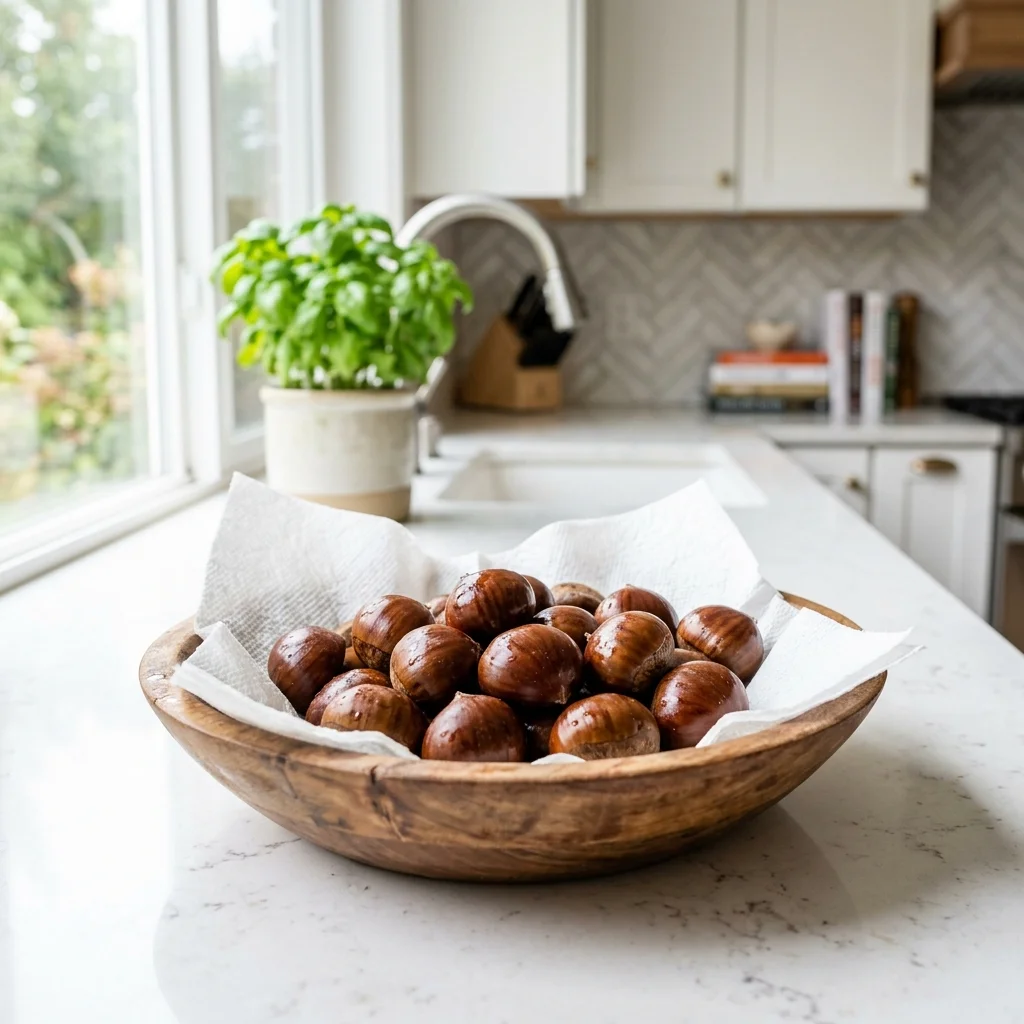
Have you ever stored fresh chestnuts at room temperature only to find them covered in white mold, shriveled, or infested with weevil larvae within a few days? 🌰
Unlike most nuts that are rich in fats, chestnuts have a unique composition containing about 50% water and a high starch content. Storing them at room temperature causes rapid moisture loss, shrinkage, Fusarium and Penicillium mold growth, and activation of chestnut weevil larvae.
In this guide, based on official guidelines from the USDA and the Rural Development Administration (RDA), we share a 3-step scientific storage method to prevent moisture loss, stop mold growth, and maximize sweetness through ‘chilling saccharification.’ 🛡️
Food Safety & Scientific Evidence
This content is based on USDA & MFDS & RDA.
 FreshSelf
Zero waste! Your smart storage assistant
FreshSelf
Zero waste! Your smart storage assistant









1. Scientifically Proven Storage Guide
Store at 0–2°C for cold saccharification ripening — Cold Saccharification Storage (30–60 Days) 🌰
Storing chestnuts at 0–2°C (32–36°F) and 85–90% relative humidity activates amylase enzymes. This triggers 'chilling saccharification,' converting starch into glucose and sugars to maximize sweetness. 💡 Storage Tip: Soak in saltwater for 1–2 hours, discard floating nuts, dry surfaces thoroughly, and store in perforated bags at 0–2°C.
Filter floating infested nuts using saltwater immersion — Saltwater Screening 🧂
Submerging chestnuts in saltwater causes hollow or insect-damaged nuts to float to the surface. 💡 Storage Tip: Skim off and discard floating nuts. Wash remaining good chestnuts, dry surfaces completely in the shade, and proceed to cold storage to block mold growth.
Parboil or steam before peeling and freezing for long-term storage — Parboiled Freezing (180–360 Days) 🧊
For storage exceeding six months, parboiling prior to freezing is the best method. 💡 Storage Tip: Parboil chestnuts in boiling water for 5–10 minutes, cool, peel off shells, and store in airtight freezer bags at -18°C (0°F) or below. Starch structures stabilize, making them ready to cook.
2. Essential Storage Rules and Cautions
Chestnuts contain nearly 50% water. Exposing them to room temperature (above 15°C / 59°F) leads to rapid water evaporation, flesh shrinkage, Penicillium mold infection, and weevil infestation within 3 to 5 days.
Sealing chestnuts with excess surface water promotes fungal decay, whereas keeping them completely exposed causes shriveling. Soak in saltwater to filter damaged nuts, thoroughly dry the surface, and store in perforated plastic bags or with paper towels.
📌 Frequently Asked Questions (FAQ)
Why do chestnuts become sweeter when stored at cold temperatures (0–2°C)? ▼
Cold storage at 0–2°C triggers a physiological reaction that activates the internal amylase enzyme. This enzyme breaks down complex starch into glucose and simple sugars through 'chilling saccharification,' dramatically increasing the sweetness over time.
How can I prevent worms (chestnut weevils) in my chestnuts? ▼
Soak chestnuts in saltwater (1–2 tablespoons of salt per liter of water) for 1–2 hours right after purchase. Discard any floating nuts as they contain air pockets or larvae. Thoroughly dry the remaining sound chestnuts and store at 0–2°C to suppress insect hatching.