Have you ever put leftover sliced bread in the refrigerator hoping to make it last longer, only to find it dried out, hard, and crumbly? 🍞
The starch in wheat flour undergoes rapid ‘starch retrogradation (staling)’ at refrigerator temperatures between 1–6°C (34–43°F), where water molecules are rapidly expelled and starch crystallizes. Therefore, refrigeration is actually the worst way to store bread if you want to keep it soft and moist.
In this guide, shares a scientifically proven 3-step storage guide based on guidelines from the USDA and FSA to preserve the moisture and fresh-baked fluffiness of your bread for up to 90 days. 🛡️
Food Safety & Scientific Evidence
This content is based on USDA & FSA & MFDS.
 FreshSelf
Zero waste! Your smart storage assistant
FreshSelf
Zero waste! Your smart storage assistant









1. Scientifically Proven Storage Guide
Never store in the refrigerator compartment — Prevent Rapid Starch Retrogradation ❌🍞
At refrigerator temperatures (1–6°C), starch molecules in bread expel moisture and realign into a rigid crystalline structure, causing staling to peak. 💡 Storage Tip: Bread dried out in the fridge cannot regain its soft texture even after heating. For a moist texture, choose room temperature or immediate freezing instead of the fridge.
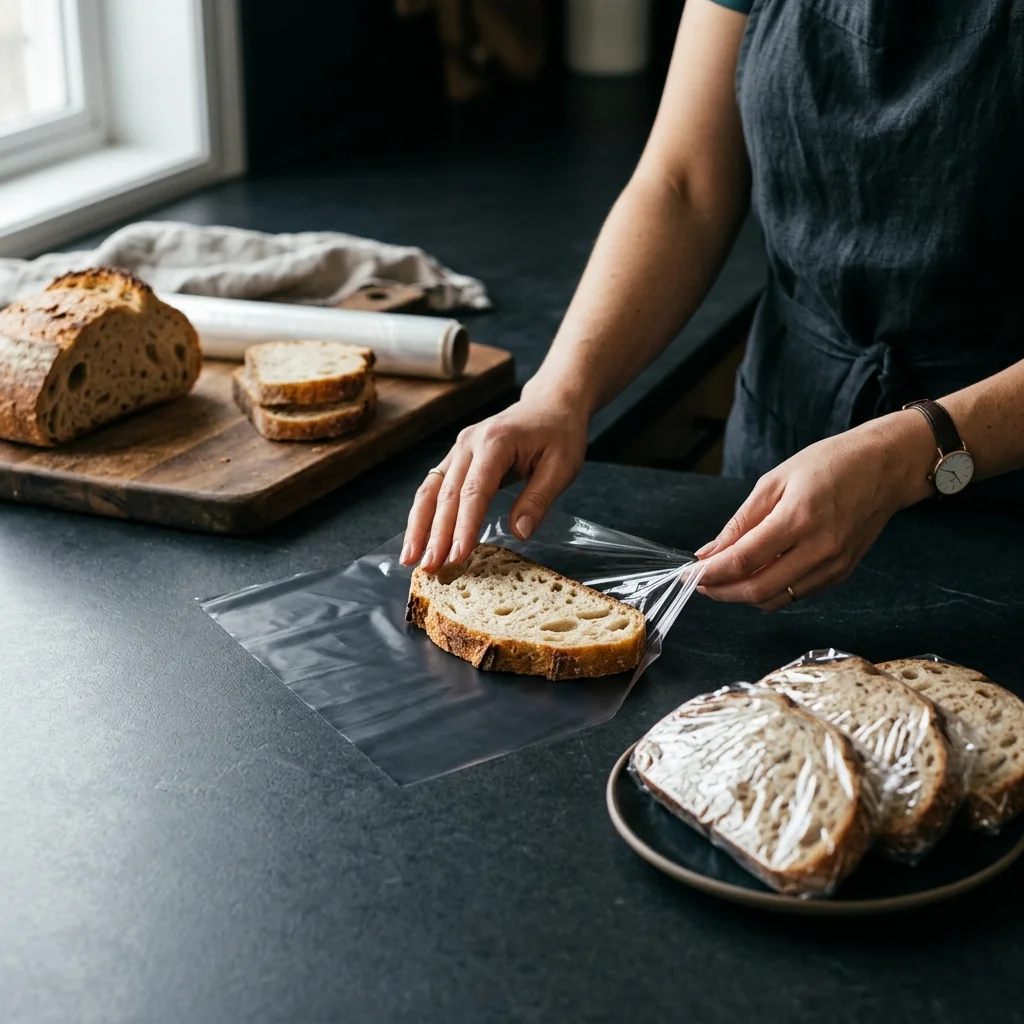
Wrap individual slices tightly with plastic wrap — Retain Moisture & Prevent Frost 📦
Storing sliced bread as a whole loaf increases air exposure, drying out the surfaces and causing slices to freeze together. 💡 Storage Tip: Wrap each slice tightly in food-grade plastic wrap without leaving air pockets. Eliminating air gaps prevents condensation and freezer burn while locking in moisture.
Double seal in a Ziploc bag and freeze immediately — Cold Storage (90 Days) ❄️
At temperatures below -18°C (-0.4°F), starch retrogradation halts completely and water molecules freeze in place, capturing the fresh-baked state. 💡 Storage Tip: Stack individually wrapped slices into a freezer Ziploc bag, squeeze out excess air, and store in the freezer. When needed, thaw at room temperature for 15–20 minutes or toast directly for a crispy outside, fluffy inside texture.
2. Essential Storage Rules and Cautions
The porous sponge structure of bread easily absorbs moisture and odors inside the freezer. If the packaging is loosely sealed, odors from other foods will penetrate the slices and frost (freezer burn) will ruin the texture. Always double-seal with plastic wrap and ziploc freezer bags.
Preservative-free sliced bread stored at room temperature (15–25°C / 59–77°F) is highly vulnerable to green mold under humid conditions within 2 to 3 days. Keep only what you will eat within 1–2 days at room temperature, and freeze the rest immediately.
📌 Frequently Asked Questions (FAQ)
Why does sliced bread turn dry and hard when kept in the refrigerator? ▼
Refrigeration temperatures (1–6°C) fall right in the peak range for starch retrogradation (crystallization). As starch molecules release bound water and recrystallize into a rigid structure, the bread turns stale and hard. Store only what you will eat within 2–3 days at room temperature, and freeze the rest immediately below -18°C.
What is the best way to thaw and reheat frozen bread for optimal taste? ▼
The best method is to thaw slices at room temperature for 15–20 minutes and enjoy them as is, or toast them lightly in a preheated toaster, oven, or skillet. If using a microwave, moisture can evaporate quickly and leave the bread tough later; heating for just 10–15 seconds alongside a small cup of water restores a crisp-outside, soft-inside texture.