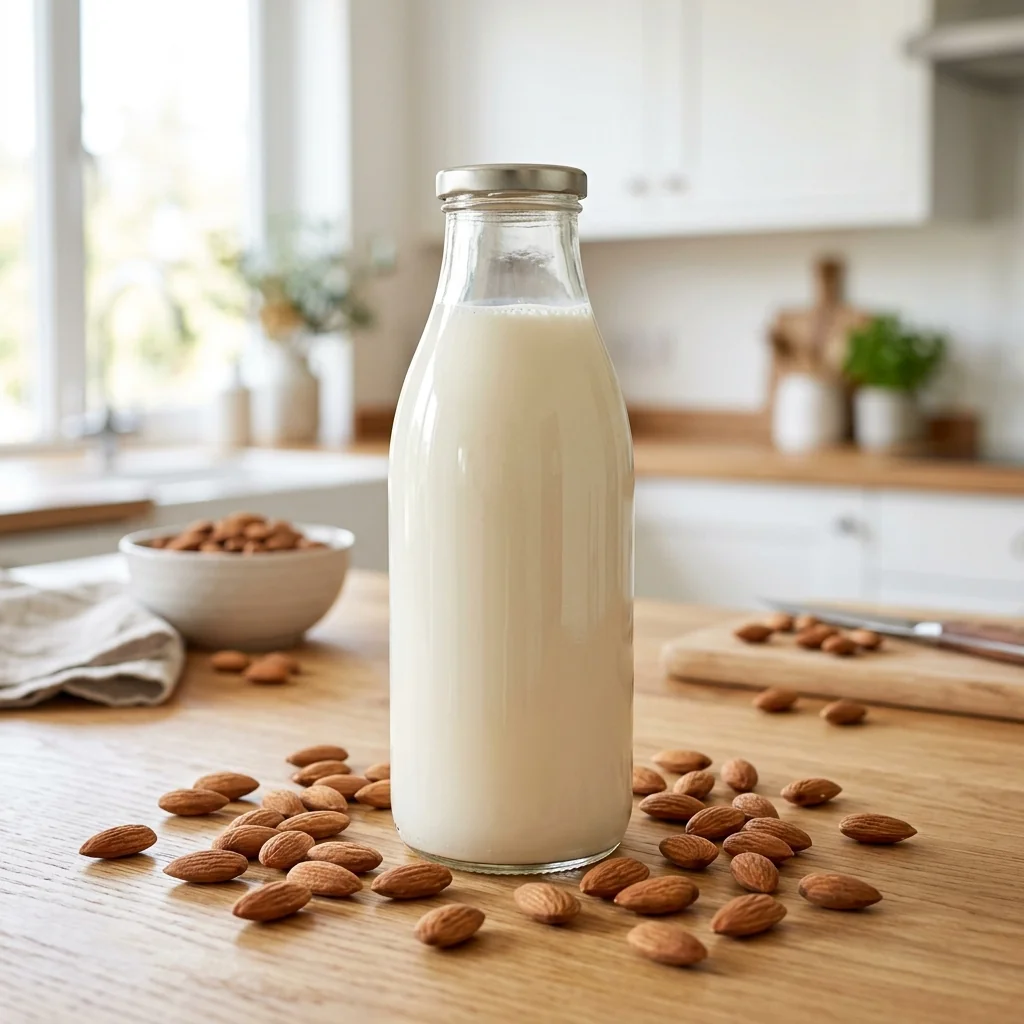
Have you ever enjoyed a glass of nutty, refreshing almond milk only to find it curdling or smelling sour after a few days on the fridge door? 🥛
Almond milk is a plant-based beverage formed by suspending almond particles in water. Unlike fermented dairy products, opened almond milk is highly susceptible to microbial contamination from ambient air. Its high moisture content means leaving it at room temperature or storing it in the temperature-fluctuating fridge door rapidly speeds up bacterial growth and emulsion breakdown.
In this guide, shares a scientifically proven 3-step almond milk storage guide based on guidelines from the FDA and USDA to prevent separation and keep your almond milk safely fresh. 🛡️
Food Safety & Scientific Evidence
This content is based on FDA & USDA & MFDS & RDA.
 FreshSelf
Zero waste! Your smart storage assistant
FreshSelf
Zero waste! Your smart storage assistant









1. Scientifically Proven Storage Guide
Shake gently before drinking — Re-Emulsify Natural Sediment 🥛
Almond milk is a suspension of finely ground almonds and water, so solids naturally settle over time. 💡 Storage Tip: This separation is a normal physical process, not spoilage. Gently shake the carton before serving to restore a smooth, creamy texture.
Refrigerate at 0–4°C on an interior shelf — Cold Storage (7–10 Days) ❄️
Opened almond milk needs constant cold temperatures to inhibit microbial reproduction. 💡 Storage Tip: Ensure the cap is tightly sealed and place the container inside the main fridge compartment at 0–4°C. Consume within 7–10 days of opening for optimal safety.
Store unopened cartons in a cool, dark pantry — Pantry Storage 🏺
Unopened shelf-stable tetra-paks are commercially sterile and remain stable at ambient temperatures. 💡 Storage Tip: Keep unopened cartons in a cool, dry pantry away from direct sunlight (10–20°C). They stay fresh until the printed expiration date.
2. Essential Storage Rules and Cautions
While unopened shelf-stable cartons can sit at room temperature, opening them introduces airborne microbes. Given its high moisture content, bacteria multiply exponentially within hours at room temperature, so refrigerate immediately after opening.
The refrigerator door experiences frequent temperature fluctuations whenever opened, encouraging bacterial blooms and fat separation. Always store opened almond milk on an interior shelf maintained at 0–4°C.
📌 Frequently Asked Questions (FAQ)
Can I freeze almond milk for long-term storage? ▼
Freezing is generally not recommended for drinking purposes. Freezing breaks the emulsion between water and almond solids, causing a grainy, separated texture upon thawing. However, if you plan to use it for cooking or smoothies, freezing in ice cube trays works well.
How can I tell if almond milk has gone bad? ▼
Spoiled almond milk develops a sour smell, curdles into thick clumps resembling tofu, or shows container bloating. If you spot mold spores or notice a sharp, acidic taste, discard it immediately as it has spoiled.