Have you ever opened your cocoa powder for home baking or a warm mug of hot chocolate, only to find it clumped into hard lumps or smelling stale? 🍫
Although cocoa powder is a dry food with a moisture content of only 2–5%, it is exceptionally hygroscopic, meaning it greedily absorbs moisture from the surrounding air. Absorbing humidity causes molecules to bind together in a process known as caking, while the cocoa butter fat inside undergoes hydrolysis (lipolysis), producing rancid off-odors.
In this guide, we introduce a scientifically proven cocoa powder storage guide recommended by international food safety experts to preserve its quality and rich flavor. 🛡️
Food Safety & Scientific Evidence
This content is based on FDA & EFSA & MFDS.
 FreshSelf
Zero waste! Your smart storage assistant
FreshSelf
Zero waste! Your smart storage assistant








1. Scientifically Proven Storage Guide
Store in airtight, opaque containers — Complete Sealing 🫙
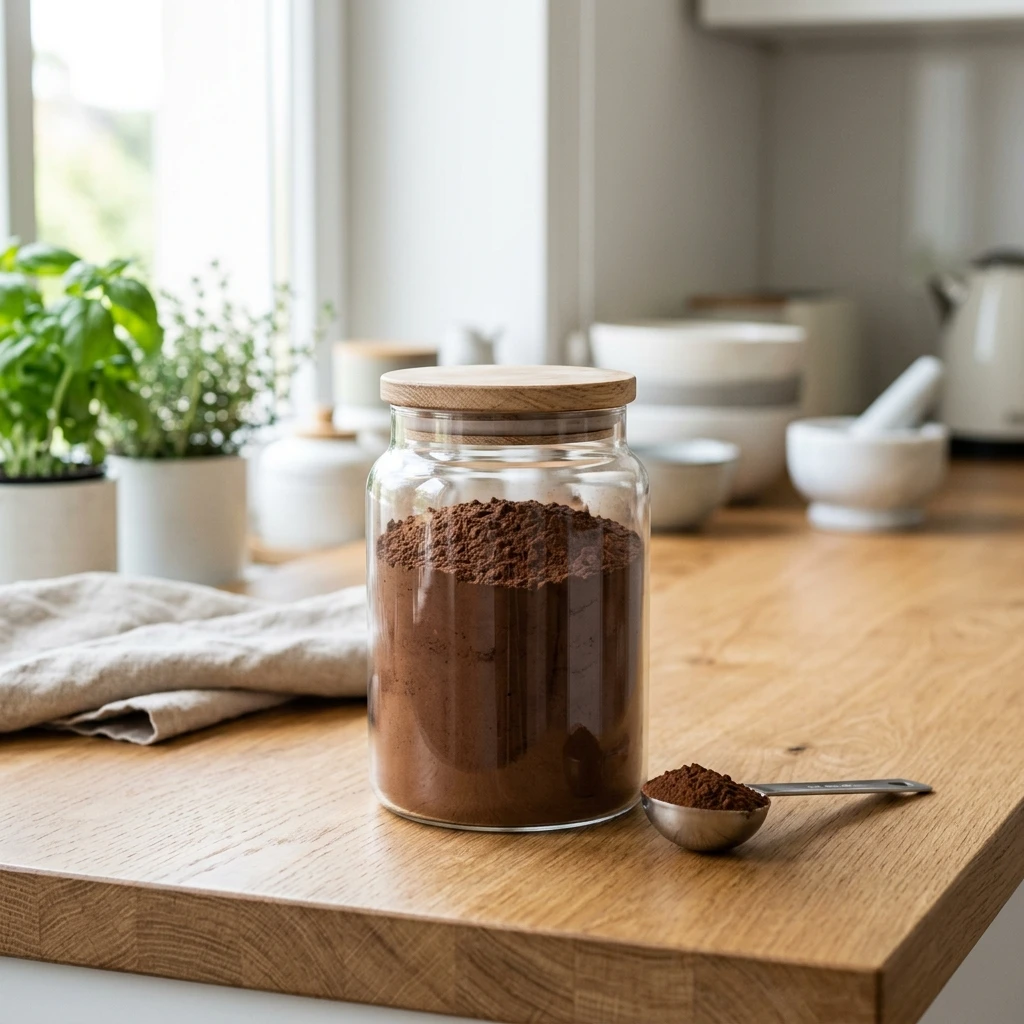
The greatest enemies of cocoa powder are atmospheric moisture and light. 💡 Storage Tip: After opening, transfer the powder from its original pouch into an opaque glass, stainless steel, or light-blocking airtight container, and seal tightly to prevent air entry.
Store at cool, dry room temperature (15–20°C / 59–68°F) — Room Temp Storage (2 Years Unopened / 1 Year Opened) 🌡️
An environment with relative humidity under 50% and temperatures between 15–20°C (59–68°F) is ideal. 💡 Storage Tip: Keep away from heat and steam sources such as stoves, ovens, and dishwashers. Store inside a dark, cool pantry or cabinet. Unopened cocoa powder lasts up to 2 years, and sealed opened powder stays fresh for 1 year.
Use only clean, completely dry spoons — Prevent Contamination 🥄
Even a drop of moisture introduced while scooping can ruin the whole batch. 💡 Storage Tip: Never insert a wet spoon or hold the container directly over a steaming hot pot. Always use a thoroughly dry, clean utensil to measure out the required amount.
2. Essential Storage Rules and Cautions
Taking refrigerated cocoa powder out into room temperature causes rapid thermal changes that create surface condensation. This micro-moisture penetrates the powder, causing severe caking and creating an ideal breeding ground for mold and bacteria.
The cocoa butter in cocoa powder undergoes photo-oxidation when exposed to ultraviolet light and ambient sunlight, degrading its flavor and aroma. Always store it in an opaque container that blocks light entirely.
📌 Frequently Asked Questions (FAQ)
My cocoa powder has formed clumps. Is it still safe to use? ▼
If the clumps crumble easily when pressed with a spoon and there is no off-odor, it is simply mild caking from absorbed humidity and is safe to use. However, if the lumps are hard, impossible to break, or smell sour/rancid, fats have oxidized or mold may be present, so it should be discarded.
Does Dutch-processed cocoa powder require different storage than natural cocoa powder? ▼
No. While they differ in pH levels, both natural and Dutch-processed cocoa powders share the same hygroscopic nature and lipid oxidation properties. Regardless of the type, keep them in an opaque, airtight container at cool room temperature (15–20°C).