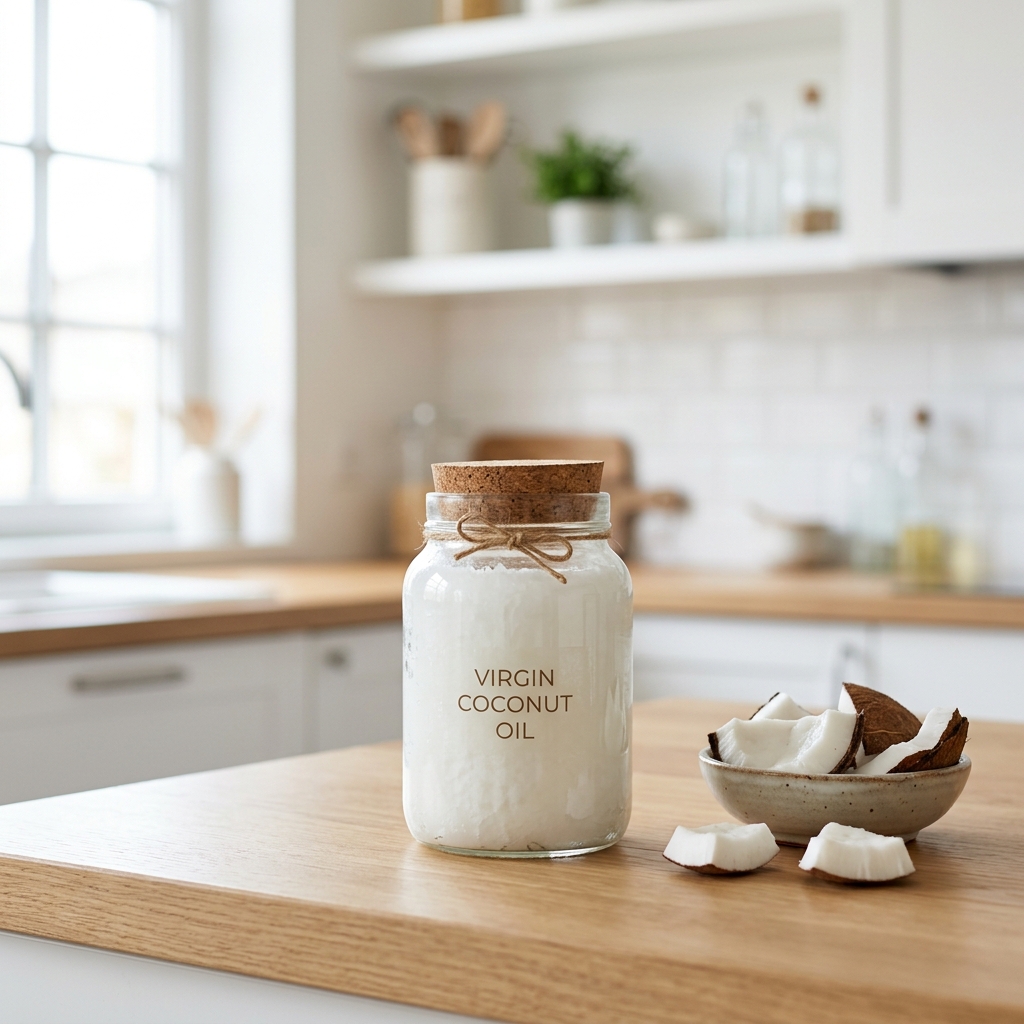
Have you ever stored coconut oil only to find it frozen hard and solid white, or melted into a clear liquid during summer? 🥥
Coconut oil is composed of nearly 90% saturated fatty acids, making it one of the most chemically stable plant oils against oxidation (rancidity). However, it exhibits a unique physical property: its melting point is around 24°C (75°F), meaning it changes naturally between solid and liquid depending on room temperature.
In this guide, introduces a scientifically proven 3-step coconut oil storage guide based on guidelines from the USDA, MFDS, and the Asian and Pacific Coconut Community (APCC) to preserve its sweet flavor and nutritional quality. 🛡️
Food Safety & Scientific Evidence
This content is based on USDA & MFDS & APCC.
 FreshSelf
Zero waste! Your smart storage assistant
FreshSelf
Zero waste! Your smart storage assistant









1. Scientifically Proven Storage Guide
Store in a cool, dark pantry at 20–24°C — Sealed Pantry Storage (360–720 Days) 📦
Coconut oil does not require mandatory refrigeration and is most convenient to use at cool room temperature. 💡 Storage Tip: Store in a dark pantry or cabinet away from sunlight (20–24°C / 68–75°F). In these conditions, opened coconut oil easily maintains its flavor and freshness for 1 to 2 years.
Close lid tightly after use to block oxygen — Airtight Sealing 🧴
Although high saturated fat content protects against rapid oxidation, long exposure to air evaporates volatile aromas and slowly degrades oil quality. 💡 Storage Tip: Wipe the rim clean with a dry cloth after use and seal the lid tightly to block air.
Refrigerate for long-term storage or solid butter consistency — Cold Storage ❄️
Below 24°C, coconut oil solidifies naturally into a scoopable butter-like state. 💡 Storage Tip: If you prefer a solid state for scooping or want to prevent melting during hot summer months, refrigerating coconut oil (0–10°C / 32–50°F) is completely safe and extends shelf life further.
2. Essential Storage Rules and Cautions
While pure coconut oil strongly resists lipid oxidation, moisture droplets or food crumbs induce hydrolysis and fungal/bacterial growth. Always use a clean, dry dedicated spoon when scooping.
Ultraviolet light and high ambient heat near cooking appliances breakdown fatty acids and destroy delicate aromatic compounds. Store it in a dark, cool place away from heat sources.
📌 Frequently Asked Questions (FAQ)
My coconut oil melted into liquid and then froze into a white solid. Has it gone bad? ▼
Not at all! Coconut oil has a melting point of approximately 24°C (75°F). Above 24°C, it becomes a clear liquid; below 24°C, it solidifies into a milky white fat. This physical transition is purely temperature-dependent and does not affect quality, safety, or nutrition.
How can I tell if coconut oil has gone rancid? ▼
Fresh coconut oil smells sweet and coconutty, appearing clear (liquid) or white (solid). If it develops a sour, stale, or chemical odor, turns yellowish-brown, or shows dark/green spots (mold), the oil has degraded and should be discarded.