Have you ever wondered whether to store Ghee—popularized in keto diets and bulletproof coffee—in the pantry or the refrigerator? 🧈
Ghee is clarified butter produced by slowly heating butter to evaporate moisture and filter out over 99% of milk proteins (casein and whey) and lactose. This clarification process reduces its water activity to $a_w \le 0.2$, creating a biologically stable state where bacteria and mold cannot survive.
In this guide, we share a scientifically proven 3-step Ghee storage guide based on guidelines from FSSAI, USDA, and MFDS to preserve its rich nuttiness and nutritional quality without degradation. 🛡️
Food Safety & Scientific Evidence
This content is based on FSSAI & USDA & MFDS.
 FreshSelf
Zero waste! Your smart storage assistant
FreshSelf
Zero waste! Your smart storage assistant









1. Scientifically Proven Storage Guide
Store sealed in a cool, dark pantry — Room Temp Storage (90–180 Days) 📦
Ghee remains exceptionally stable at room temperature as long as external moisture is kept out. 💡 Storage Tip: Store sealed in a cool cabinet or pantry (15–20°C / 59–68°F) away from heat and light. Without moisture intrusion, its distinct aroma and flavor stay perfect for 3 to 6 months.
Refrigerate for long-term preservation to completely prevent rancidity — Cold Storage (360+ Days) ❄️
Refrigeration is the safest method if you plan to store Ghee for longer than 6 months or live in a hot climate. 💡 Storage Tip: Keeping Ghee sealed in the refrigerator (0–5°C / 32–41°F) suppresses lipid oxidation reaction rates, allowing it to remain fresh for over a year. Since it solidifies when chilled, scoop out required portions in advance.
Wipe the container rim dry and close tightly after use — Sealed Storage 🧴
It is vital to prevent butter residue on the rim from absorbing atmospheric humidity. 💡 Storage Tip: Wipe the rim clean with a dry cloth after use and seal the lid tightly to block air and moisture exposure.
2. Essential Storage Rules and Cautions
While pure Ghee resists microbial growth due to its low water activity ($a_w \le 0.2$), introducing moisture or food crumbs enables microbial proliferation and triggers hydrolytic rancidity. Always use a clean, completely dry spoon when scooping.
Although Ghee is high in saturated fats and resistant to rapid oxidation, intense UV rays and heat cause lipid oxidation and destroy its delicate aromatic compounds. Store it in a cool, dark pantry away from heat sources.
📌 Frequently Asked Questions (FAQ)
Does Ghee need to be refrigerated, or is room temperature safe? ▼
Refrigeration is not strictly necessary! Heating and clarifying butter removes over 99% of moisture and milk solids, lowering water activity to $a_w \le 0.2$. Bacteria and mold cannot survive in this environment, making Ghee safe at room temperature (15–20°C) for 3 to 6 months as long as a clean, dry spoon is used.
How can I tell if Ghee has gone bad or rancid? ▼
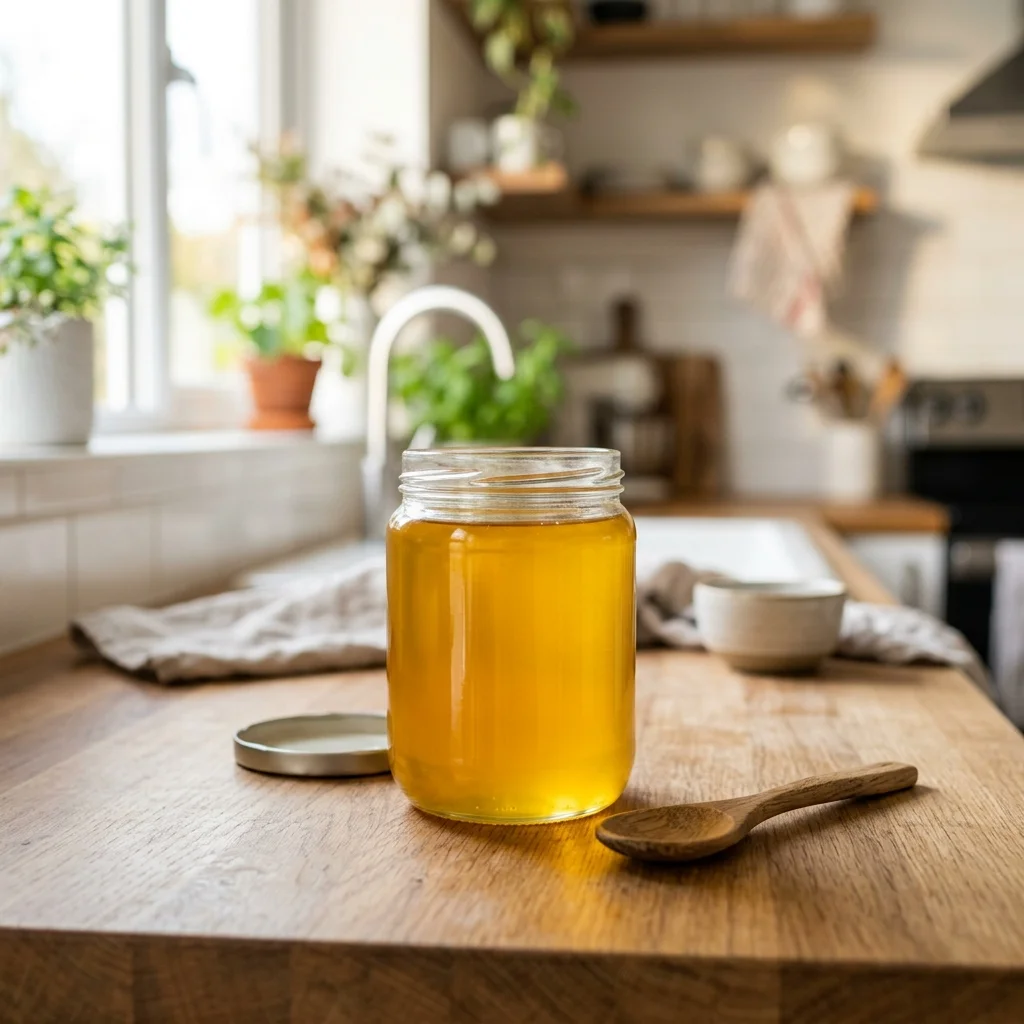
Fresh Ghee exhibits a golden yellow color and a sweet, nutty aroma. If it develops a stale, sour smell (rancid odor), tastes unpleasantly bitter, or displays visible mold/dark spots on the surface, it has degraded and should be discarded immediately.