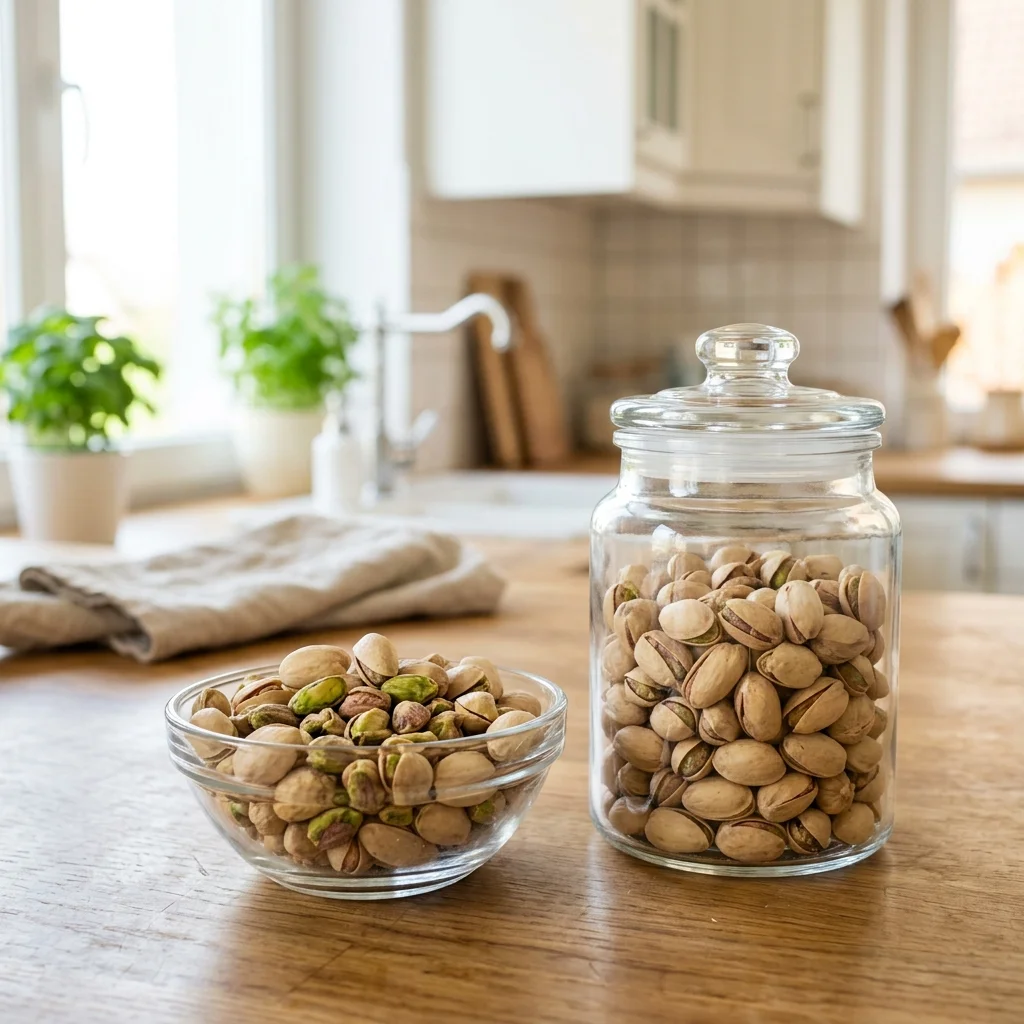
Have you ever stored pistachios in your pantry only to find them stale, soft, or smelling rancid after a short time? 🥜
Pistachios are rich in unsaturated fatty acids, which rapidly undergo lipid peroxidation upon contact with atmospheric oxygen, leading to offensive rancid odors. More critically, when relative humidity rises to $RH \ge 65%$, the mold Aspergillus thrives and produces Aflatoxin—a potent Group 1 human carcinogen. Therefore, controlling moisture and oxygen is vital.
In this guide, we share a scientifically proven 3-step pistachio storage guide based on standards from the FDA, USDA, and MFDS to safely preserve their crunchy texture and rich flavor. 🛡️
Food Safety & Scientific Evidence
This content is based on FDA & USDA & MFDS.
 FreshSelf
Zero waste! Your smart storage assistant
FreshSelf
Zero waste! Your smart storage assistant





1. Scientifically Proven Storage Guide
Seal tightly and store in a cool, dry pantry — Room Temp Storage (90 Days) 📦
If you plan to consume pistachios within a few months, store them at a cool room temperature. 💡 Storage Tip: Place pistachios in an airtight container or ziplock bag and store in a dark, cool cabinet (15–20°C / 59–68°F, $RH \le 60\%$) away from sunlight to maintain crispness for 3 months.
Refrigerate in airtight containers for medium-term storage — Cold Storage (180 Days) ❄️
During hot summer months or for storage beyond 3 months, low temperatures are significantly safer. 💡 Storage Tip: Refrigerate pistachios at 0–5°C (32–41°F) in an airtight container. Cold conditions slow lipid oxidation rates, preserving nutty flavor and crunch for 6 months.
Freeze in double-sealed bags for long-term preservation — Frozen Storage (360+ Days) 🧊
Freezing is the best choice for bulk purchases or storage over 6 months. 💡 Storage Tip: Divide into smaller portions, seal tightly in double freezer bags, and store below -18°C (0°F). This completely suppresses lipid oxidation and mold growth, keeping pistachios fresh for over a year.
2. Essential Storage Rules and Cautions
When relative humidity exceeds $RH \ge 65\%$, *Aspergillus* molds proliferate and produce heat-resistant Aflatoxins (Group 1 carcinogens). Thoroughly block external moisture and high humidity.
High levels of unsaturated fatty acids in pistachios bind with oxygen to form peroxides that generate stale rancid smells. Always store in airtight containers or vacuum bags to minimize air exposure.
📌 Frequently Asked Questions (FAQ)
My pistachios smell stale or have visible mold. Can I wipe them off and eat them? ▼
No, absolutely not! *Aspergillus* mold that grows on pistachios under high humidity produces Aflatoxin, a potent Group 1 carcinogen that cannot be destroyed by heating or roasting. If you spot any mold or smell a paint-like rancid odor, discard the entire batch immediately.
What is the single most critical factor when storing pistachios? ▼
The most critical factor is completely blocking moisture and oxygen. High humidity triggers toxic Aflatoxin mold growth, while oxygen exposure oxidizes unsaturated fats into rancid compounds. Storing pistachios in airtight containers under low temperatures (refrigerated or frozen) provides the highest level of safety.