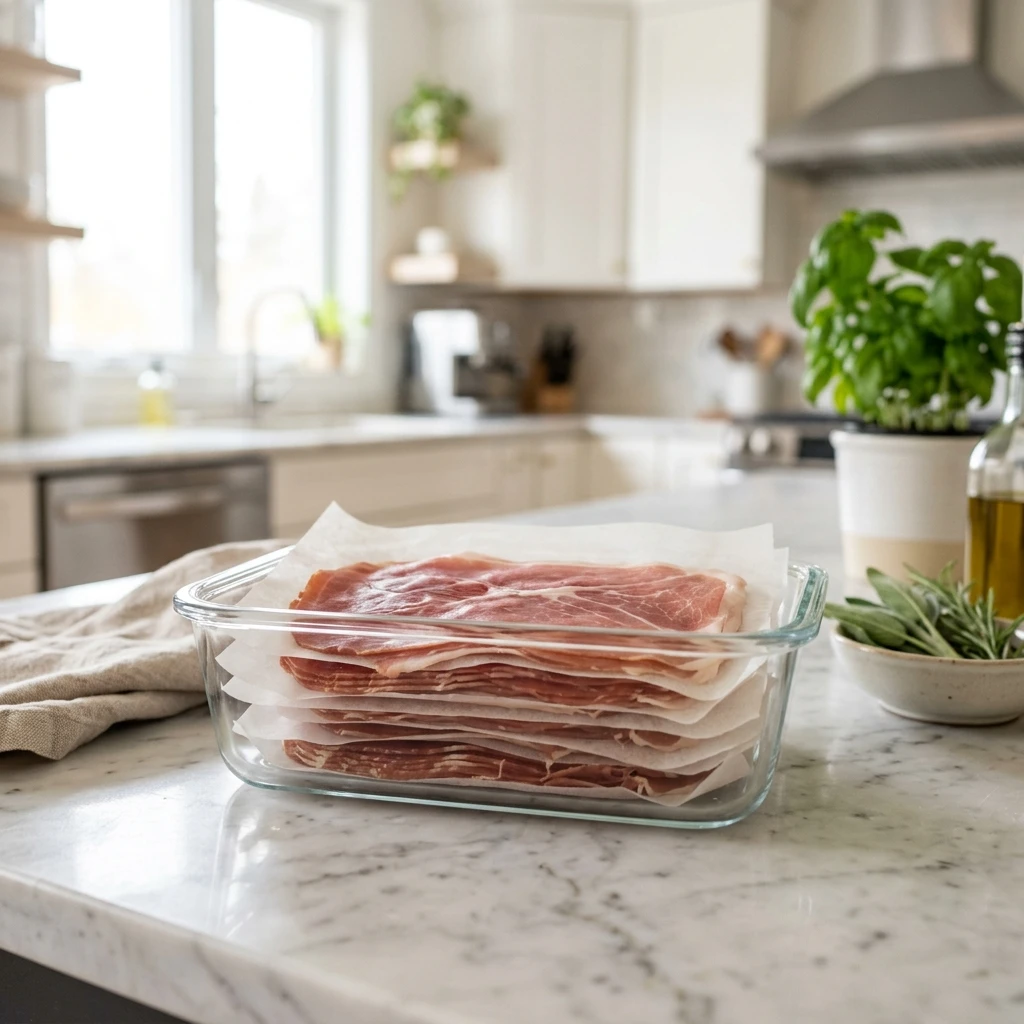
Have you ever served premium prosciutto or jamón for wine pairings, stored the leftover slices in the fridge, only to find them dry, stiff, and yellowed a few days later? 🥓
Prosciutto and dry-cured ham undergo extended salting and curing, reducing water activity (Aw< 0.85) to inhibit pathogenic bacterial growth. However, because they are rich in unsaturated fatty acids, exposure to atmospheric oxygen triggers lipid peroxidation (auto-oxidation). This oxidizes myoglobin, leading to browning, rancid off-odors, and a tough dried-out texture.
In this guide, we introduce a scientifically proven 3-step storage guide recommended by food safety experts to preserve the texture and delicate flavor of dry-cured hams. 🛡️
Food Safety & Scientific Evidence
This content is based on USDA & EFSA & MFDS.
 FreshSelf
Zero waste! Your smart storage assistant
FreshSelf
Zero waste! Your smart storage assistant








1. Scientifically Proven Storage Guide
Lightly brush surfaces with Extra Virgin Olive Oil — Create an Oxygen-Barrier Shield 🫒
Coating slices with edible oil is a highly effective way to block atmospheric oxygen. 💡 Storage Tip: Lightly brushing Extra Virgin Olive Oil over the slice surfaces or cut edges forms a natural barrier that seals in moisture and prevents oxidation.
Wrap tightly with plastic film and refrigerate at 2–5°C — Cold Storage (3–6 Months Unopened / 3–5 Days Opened) 🥩
Removing air pockets is critical to halting oxidation. 💡 Storage Tip: Wrap oil-brushed slices tightly in cling film, leaving no air pockets, and place inside an airtight container or Ziploc bag in the fridge (2–5°C / 35–41°F). Unopened vacuum-sealed packs last 3–6 months; opened slices should be enjoyed within 3–5 days.
Rest at room temperature 15–30 minutes before serving — Restore Flavor and Texture 🍷
Gentle warming melts solidified fats to unlock natural umami. 💡 Storage Tip: Serving dry-cured ham cold keeps fats firm and masks delicate aromas. Resting slices at room temperature (18–22°C / 64–72°F) for 15–30 minutes melts the oleic-acid-rich fats, unlocking their soft texture and complex bouquet.
2. Essential Storage Rules and Cautions
Exposure to oxygen causes lipid peroxidation and myoglobin denaturation, leading to discoloration, rancidity, and a rubbery, dried-out texture.
Freezing disrupts the delicate unsaturated fat structures. Thawing separates protein and lipid layers, completely ruining the signature tender texture and rich umami flavor.
📌 Frequently Asked Questions (FAQ)
There are small white dots on my jamón/prosciutto. Is it mold? ▼
No, small white specks on cured ham are typically tyrosine amino acid crystals, formed naturally as proteins break down during long aging. They are a sign of quality long-cured ham and completely safe to eat. However, if you see fuzzy mold or smell sourness, discard it.
Why shouldn't dry-cured ham be frozen? ▼
Freezing forms ice crystals that break down fragile cell structures and disrupt unsaturated fatty acid distributions. Upon thawing, moisture escapes, fats rancidify rapidly, and the texture becomes tough and leathery.