Have you ever stored quail eggs in the refrigerator only to find them dried out or with broken yolks faster than expected? 🥚
Quail eggs have significantly thinner eggshells and cuticle layers compared to chicken eggs. This causes carbon dioxide and moisture to evaporate more than twice as fast, making them relatively more vulnerable to external pathogens like Salmonella.
In this guide, based on official guidelines from the USDA and MFDS, we share a 3-step scientific storage method to preserve the freshness and nutrition of quail eggs without moisture loss. 🛡️
Food Safety & Scientific Evidence
This content is based on USDA & MFDS & KAPE.
 FreshSelf
Zero waste! Your smart storage assistant
FreshSelf
Zero waste! Your smart storage assistant





1. Scientifically Proven Storage Guide
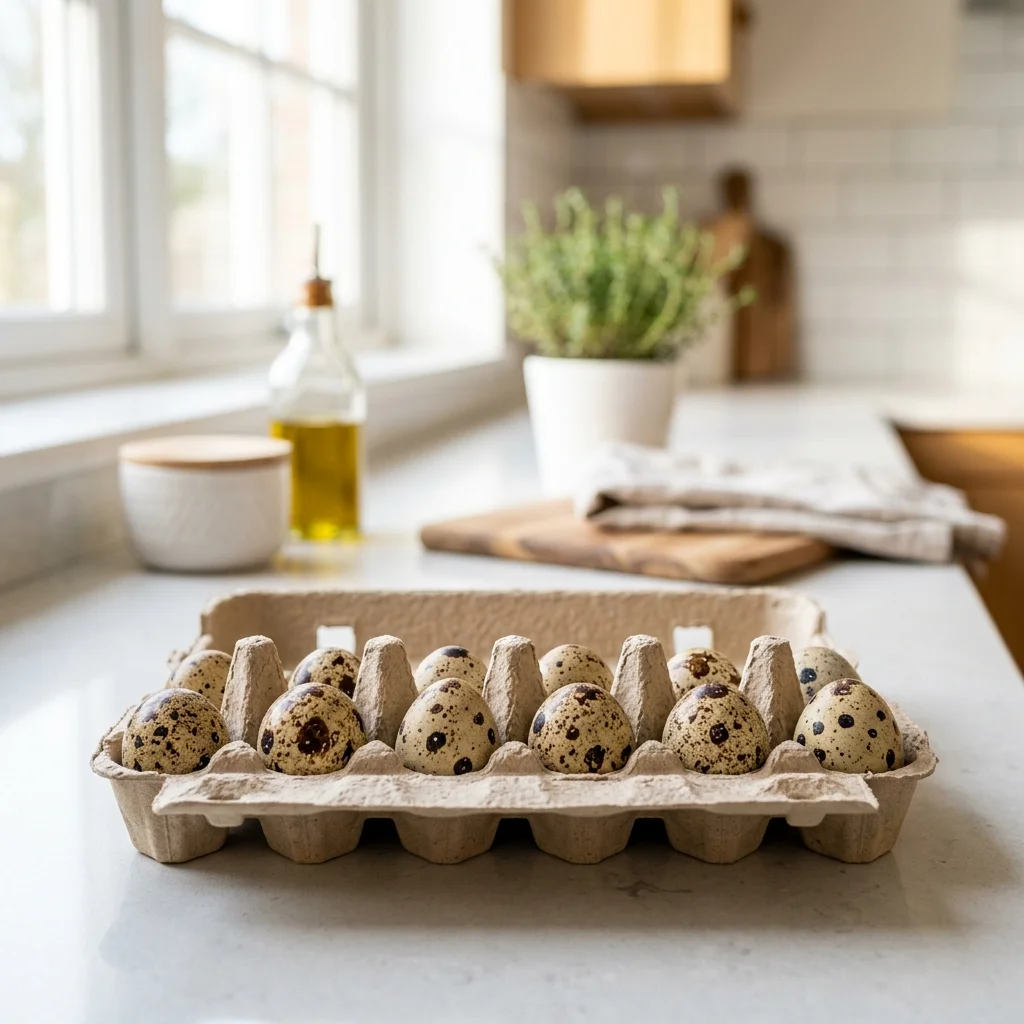
Store refrigerated with the blunt end (air cell) facing up — Cold Storage at 1–4°C (21 Days) 🥚
Quail eggs lose moisture faster than chicken eggs, making 1–4°C (34–39°F) cold storage essential. 💡 Storage Tip: Keep eggs in their original carton with the blunt end pointing up on an interior refrigerator shelf to keep the yolk centered for 3 weeks.
Store deep inside the refrigerator rather than on the door — Temperature Control ❄️
Frequent temperature fluctuations from opening the refrigerator door accelerate CO2 loss through thin shells. 💡 Storage Tip: Keep quail eggs on an inner shelf where temperatures remain consistently cold.
Keep hard-boiled quail eggs sealed in airtight containers — Boiled Egg Storage (3–7 Days) 🍲
Peeled hard-boiled quail eggs are susceptible to bacterial contamination. 💡 Storage Tip: Unpeeled boiled eggs last up to 7 days in the fridge; peeled eggs stored in cold water or marinade should be consumed within 3 to 5 days.
2. Essential Storage Rules and Cautions
The air cell is located at the blunt end of the quail egg. Storing the pointed end up causes the yolk to float against the air cell, damaging the yolk membrane and increasing the risk of bacterial contamination.
Washing quail eggs dissolves the cuticle layer—a natural protective barrier that blocks bacterial entry. Microscopic pores are exposed, allowing external pathogens to penetrate rapidly.
📌 Frequently Asked Questions (FAQ)
Why do quail eggs have a shorter shelf life than chicken eggs? ▼
Quail eggs have a much higher surface-area-to-volume ratio with thinner shells and cuticle layers than chicken eggs. Moisture and carbon dioxide escape more than twice as fast, making them more vulnerable to bacteria and limiting their refrigerated shelf life to about 3 weeks.
What is the scientific reason for storing quail eggs blunt-end-up? ▼
The air cell is located at the blunt end. Storing the egg blunt-end-up prevents the buoyant yolk from pressing directly against the inner shell membrane and air cell, keeping the yolk membrane intact and centered to maximize freshness.